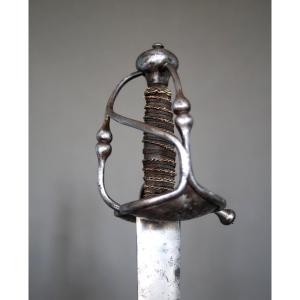
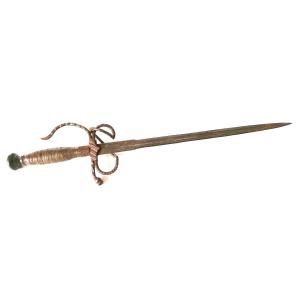
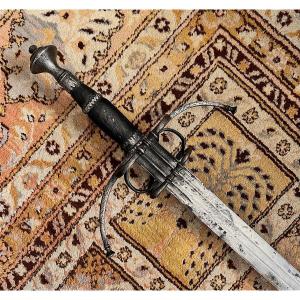
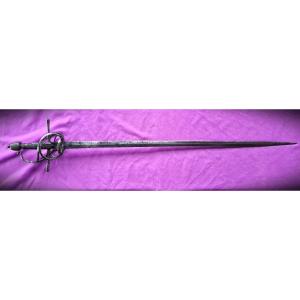
This rapier with amulti branches hilt is from Germanic origin, dating from the first quarter of the 17th century. The blade bears a crescent moon hallmark on the ricasso, which Lenkiewicz lists (in "1[...]
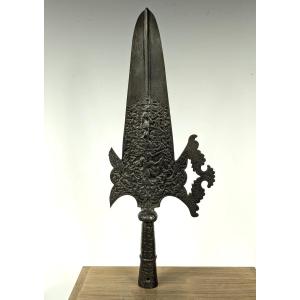
Halberd with abundant decoration, warriors, mascarons, and scrolling foliage. Cast iron. A decorative object popular during the second half of the 19th century. There is probably a missing piece: see [...]
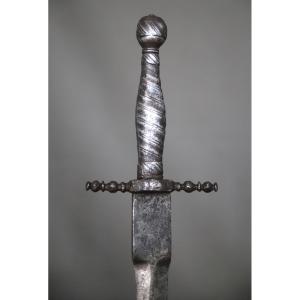
This rondel dagger is from Germanic origin and can be dated to the 16th century. In fact, the engravings on the blade leave no doubt: the style of the decoration is clearly later than the 15th century[...]
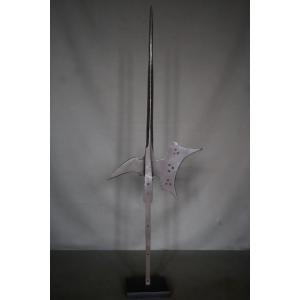
Halberd Head - Europe, 16th Century. Forged steel with a four-sided spike on the first half, then rounded to the point. One of the braces is cut/missing. Weight 1013g. Length 81cm. Width 29.5cm. Spike[...]
A Walloon-type cavalry saber - Probably Germanic, 17th century. Curved blade with a single edge and a false edge on the last third. The wolf of Passau is engraved on one side. Walloon-style hilt. Miss[...]
Renaissance dagger - Western Europe, late 16th/early 17th century. Blade with a strong, flat ricasso, later becoming four-sided and double-edged. Maker's marks (very faded but discernible) are present[...]
A rare powder flask, known as a "boiled leather" flask, originating from Italy around 1580. This military-style powder flask was used in combat during the 16th century. Its base is made of boiled leat[...]
A rare Italian boiled leather powder flask, dating from around 1580. This military model was carried in combat during the 16th century. Its body is made of boiled leather, obtained by boiling the leat[...]
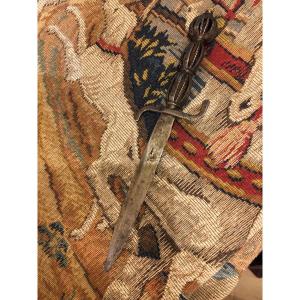
Dagger with a twisted bronze hilt, in two sections separated by a central ring. Short, straight guard, also twisted, with symmetrical quillons in rosettes. Lobed discoid pommel. Narrow, double-edged b[...]
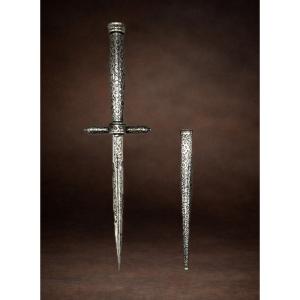
Civil ceremonial stylus (stiletto da cintura) in fully engraved and chiseled steel, Northern Italy (Lombardy - Veneto), around 1620–1650.Remarkable example of the Italian art of steel decoration in th[...]
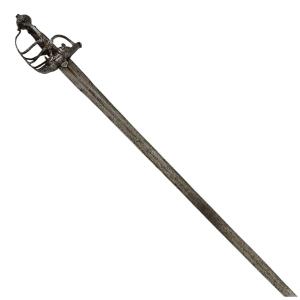
A superb English Civil War period “Mortuary” sword. Broad double-edged blade that shows the maker’s mark ‘Andrea Ferrara’ running along the central fuller, as well as armory stamp to either side of th[...]
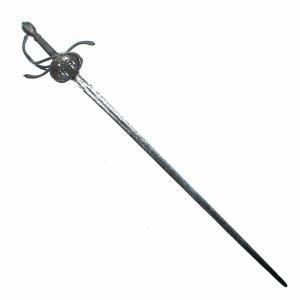
German made Rapier sword with double edged tapered blade showing fuller running approximately one third of the blade. The blade is marked with “Me Fecit Solignen” and shows traces of other engraved de[...]
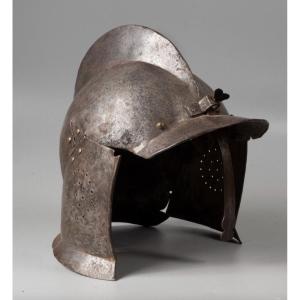
Burgundian Helmet. Crested helmet forged in one piece. Visor fixed by rivets, cheek pieces pierced and articulated. Removable nasal guard and plume holder at the rear. 17th century. Height: 26 cm
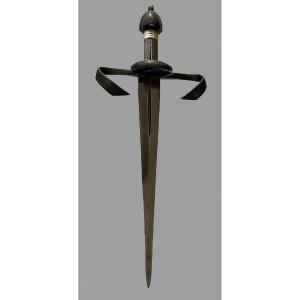
This left-handed dagger with a ring guard has a morphology distributed across a fairly wide geographical area; typically, it can be attributed to Northern Italy or Southern Germany, but examples of th[...]
This war axe is made entirely of metal, in the style of the 16th century, but manufactured in the 19th century. The head and handle of the axe are richly decorated: AXE HEAD: On one side, within a med[...]
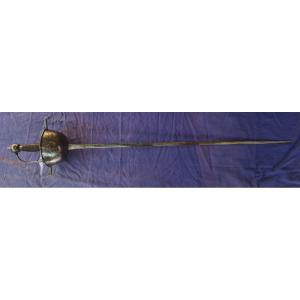
Spanish rapier (sword) with a tang - Spain, late 17th-first half of the 18th century. The hilt has a tang, two large quillons, and a guard branch. The grip is made of beautiful fluted horn. This type [...]
Sword signed Enrique CoelSpain17th centurySteel, leatherTotal length: 98 cm; Blade length: 84.3 cmStraight double-edged blade with a flat edge, with a fuller in the first third, engraved with ‘por la [...]
A black and white morion, two-piece, riveted iron skull with stylised embossed decorations; smooth medium comb; distinctive boat-shaped brim with rounded border; original iron comb and a row of simple[...]
Germany produced large quantities of antler powder pouches during the Renaissance. The finest pieces were made in the south of the country, in Nuremberg and Augsburg. The quality of these pouches vari[...]
A rapier with a very refined cut, dating from the first half of the 17th century, around 1630-1640. The openwork hilt is richly decorated with floral and vegetal motifs, punctuated by cartouches depic[...]
This model cannon depicts a wheeled bombard from the mid-15th century. It comes from Spain and dates from the 20th century. The cannon itself is made of metal, probably a type of spelter (?) with an o[...]
Arm and shoulder defence, Northern Italy (Milan or Brescia), mid-16th century (circa 1550–1580)
A substantial steel armour element comprising a pauldron, upper arm (rerebrace), articulated elbow (cou[...]
This stiletto is a fairly large model designed for fighting. The style of the handle might initially suggest Italian craftsmanship, but the blade, with its cross-shaped globus, its shape, and its deco[...]
This stiletto likely originated in Northern Italy, although a Southern German origin is also possible. Its large size makes it a model designed for combat. It dates from the 17th century. Stilettos fi[...]
EXTREMELY RARE DAGGER KNOWN AS "CINQUEDEA" Italy, late 15th/early 16th century. Triangular, double-edged iron blade, grooved in the middle, the central section double-fullered, an oval hallmark on a g[...]
A 17th-century wheellock arquebus converted to flintlock, chambered for 14 balls per pound, fitted with a smoothbore octagonal barrel, then a round one. The weapon is mounted in brass, including the l[...]
Late Medieval Iron Spaulder (Shoulder Defence) with Brass Edge & Rotating Button, c. 1480–1520
Authentic-looking late medieval iron spaulder / shoulder defence from a harness, with brass rolled edg[...]
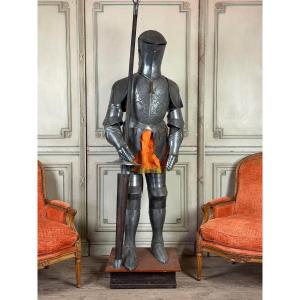
It consists of a breastplate with arms and a helmet with movable protection; it is articulated like a real one. A piece from the first half of the 20th century, it features a Maltese cross in its cent[...]
THE GALLERY OFFERS
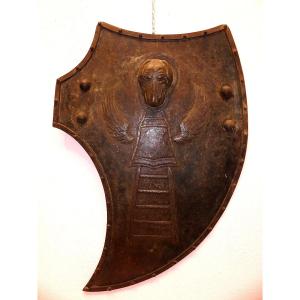
INTERESTING FORGED IRON SHIELD FROM THE ARMS ROOM
FROM THE "DELLA SCALA" OR "SCALIGERI" DYNASTY
RULING FAMILY OF VERONA AND THE VERONESE REGION IN THE 14TH CENTURY
VENET[...]
Collector's item and curiosity: Small 19th-century virtue dagger: a dagger that women carried in their handbags or under their petticoats for defense against overly amorous men. It is also known collo[...]
Mercy dagger bearing the arms of Savoy and monogrammed for Emmanuel Philibert, 16th century. This dagger is said to have been given by Duke Emmanuel Philibert of Savoy to Marshal Blaise de Montluc of [...]
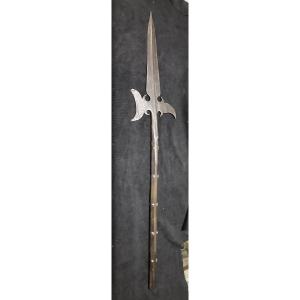
17th-century halberd. Asymmetrical iron head with an axe and hook, 44 cm long, including an 8 cm long socket; 9.5 cm long brace with two nails. Rebuilt wooden shaft. Overall length 98.5 cm. Good condi[...]
This dagger is somewhat difficult to classify; it could be defined either as a variant of a "mercy dagger" or as a rather atypical stiletto. The blade, with its robust ricasso, would suggest a mercy d[...]
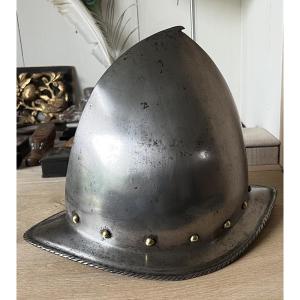
A heavy german or flemish cabasset.Heavy, one-piece, heavily ridged skullcap with a small, backward-sloping point. The lower edge is encircled by brass lining rivets with decorative rosettes (some inc[...]
Rare cloak button of a noble Norman Knight, depicting a lion's head plated in pure gold, a symbol of strength, pride, dignity, and nobility, originally the emblem of the Dukes of Normandy. Sicily, 12t[...]
A swordsman's rapier with a thick blade, Hispano-Portuguese, 17th century. The thick blade has a lenticular cross-section and a small faceted iron pommel with a rivet button, securing the guard branch[...]
This rapier is Spanish. Its origin from the Iberian Peninsula is beyond doubt, as this type of hilt is found almost exclusively on Spanish or Portuguese rapiers. The hilt can be dated to the mid-17th [...]
A straight, rigid thrusting dagger with a chain-piercing point and longitudinal fullers pierced with trefoil and cruciform motifs on the first half. The cylindrical guard terminates in small spherical[...]
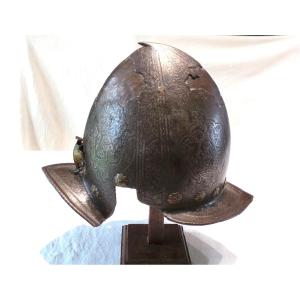
A fine example of an interesting type of pointed Burgonet helmet with a flattened ergo pointing backwards, from Brescia, northern Italy, 16th century (circa 1560). The pointed ogival helmet is formed [...]
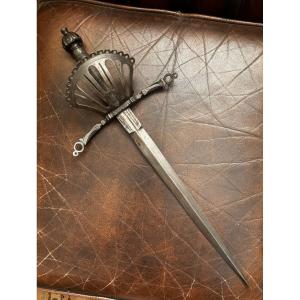
Left hand dagger with S guard, openwork ring and silver handle"Northern Italy or Germany, around 1560-1600.Superb and rare Renaissance dagger, used as an auxiliary weapon in the rapier duel, perfectly[...]
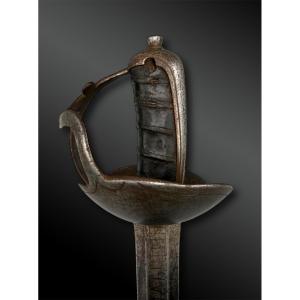
This is a beautiful and long rapier called "a la taza" in Italian style that can be dated to the mid-17th century. The very deep bowl of the Taza corresponds to Italian taste. The very large arms "fin[...]
This rapier called "taza rapier" (rapier with bowl guard) dates from the first half of the 17th century. It comes from the region of South Germany with an Italian influence. If the very deep bowl corr[...]
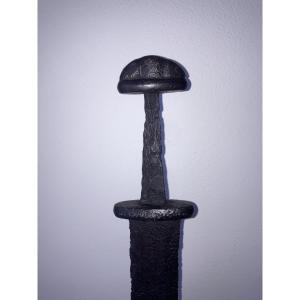
A rare and fine Viking sword in good condition , typical pommel with rest of gold metal decoration , straight guard of the typical form . 98 cm length . The sword is guarantee authentic lifetime and c[...]
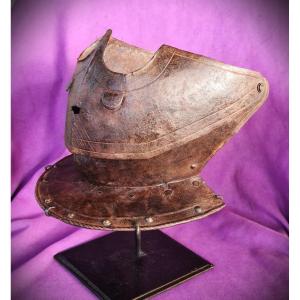
This is the entire front part of a 16th-century Savoyard armet, consisting of the gorget and the movable mesail. This is by far the most delicate part to manufacture, and it requires a certain mastery[...]
Plaster cannon model taken from the San Paolo cannon today kept at the Bargello Museum of Florence and commissioned in the seventeenth century by Ferdinand II de 'Medici to the founder Cosimo Cenni.Ma[...]
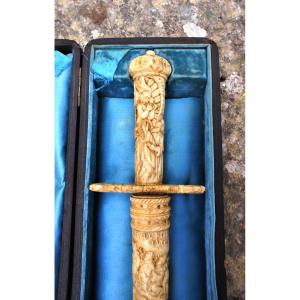
Rare Ceremonial German Bone Dagger 16th CenturyThe hilt is comprised of a set of straight quillons and are completely made of deer bone.The bone fittings are richly and masterfully engraved, the guar[...]
Skeleton dagger from the 16th century, marking called left hand, engraved with the name "BD-MONTLUC" Marshal of France in 1574 Lieutenant of Guyenne, LASSERAN de MASSENCOMME de MONTLUC family. Born in[...]
Large left-hand daggerVery beautiful compound dagger, probably from the time of Viollet-Le-Duc in the 19th century. The blade appears older, probably dating from the 18th or 19th century. The dagger i[...]
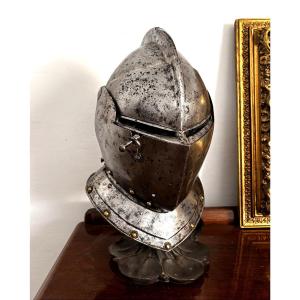
Italian Knight's Helmet circa 1620.Forged around 1620, this closed knight's helmet offered advanced protection to its wearer. Crafted by the finest master armorers in Italy, these armorers produced th[...]
16th Century Italian Hand and a Half (Bologna / Venice)This magnificent Italian hand and a half, originally from Venice or Bologna, is recognizable by the smith's marks on the blade. These swords are [...]
Very beautiful cabasset helmet - Morion of superb forge forged in one piece large and high model powerful helmet made for combat and not for parade end of 16th century German probably
Halberd head Viollet Le Duc period XIXth. XVIth style engraved on both sides. Beautiful spearhead in iron and not cast iron. Good condition. Length 38 cm, width 21 cm.- This item is for immediate purc[...]
Proantic uses a cookie to analyze traffic and improve its service by using Google Analytics. Data sent to Google Analytics (frequency of visits to the site and pages visited) are anonymous. No other cookie tracks your activity, your personal data is not collected. Thank you for helping us to have better understanding how Proantic is used.
























 Le Magazine de PROANTIC
 TRÉSORS Magazine
 Rivista Artiquariato