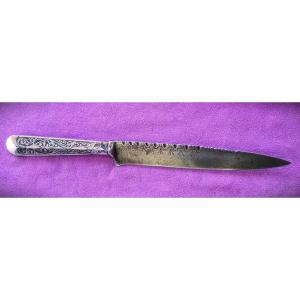
Large Stiletto, Northern Italy, 17th Century
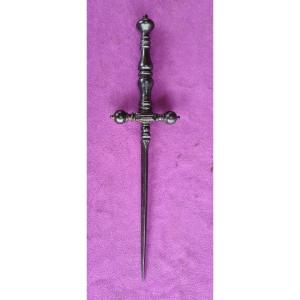
This stiletto likely originated in Northern Italy, although a Southern German origin is also possible. Its large size makes it a model designed for combat. It dates from the 17th century.
Stilettos first appeared in Spain in the early 16th century. They quickly became popular, first in Italy, and then spread throughout Europe. Antonio Manciolino, in his "Opera Nova," a fencing treatise from the Bolognese school published in 1531, already mentions stiletto fencing. These weapons were designed to inflict deep, difficult-to-treat wounds and to penetrate the rings of chainmail. The particularly long blade of this weapon suggests that it was carried concealed on the back, in the so-called "Italian style."
BLADE: The blade has a somewhat atypical shape, beginning with a narrow, square section, then a baluster shape, and again a small square section that quickly widens slightly into a narrow triangular shape. At the base of the flat face, there is a small vegetal design in outline, in the Italian style.
Blade length = 25.2 cm. Width near the guard = 7.6 mm, widening to 10.5 mm. Thickness near the guard = 7.6 mm.
GUARD: The crossguard has two small baluster-shaped quillons around a rounded rectangular center.
HANDLE: It is in three pieces: a kind of ferrule near the guard, then the grip, and finally the pommel. The join between these three parts is barely visible. The grip is twisted, with a small decoration of chiseled rings. The blade's tang is riveted to the pommel; it is therefore not a screw-on assembly as found on later stilettos.
Ref X4Y-25/18
Shipping costs France €20, Europe €30
Stilettos first appeared in Spain in the early 16th century. They quickly became popular, first in Italy, and then spread throughout Europe. Antonio Manciolino, in his "Opera Nova," a fencing treatise from the Bolognese school published in 1531, already mentions stiletto fencing. These weapons were designed to inflict deep, difficult-to-treat wounds and to penetrate the rings of chainmail. The particularly long blade of this weapon suggests that it was carried concealed on the back, in the so-called "Italian style."
BLADE: The blade has a somewhat atypical shape, beginning with a narrow, square section, then a baluster shape, and again a small square section that quickly widens slightly into a narrow triangular shape. At the base of the flat face, there is a small vegetal design in outline, in the Italian style.
Blade length = 25.2 cm. Width near the guard = 7.6 mm, widening to 10.5 mm. Thickness near the guard = 7.6 mm.
GUARD: The crossguard has two small baluster-shaped quillons around a rounded rectangular center.
HANDLE: It is in three pieces: a kind of ferrule near the guard, then the grip, and finally the pommel. The join between these three parts is barely visible. The grip is twisted, with a small decoration of chiseled rings. The blade's tang is riveted to the pommel; it is therefore not a screw-on assembly as found on later stilettos.
Ref X4Y-25/18
Shipping costs France €20, Europe €30
780 €
Period: 17th century
Style: Renaissance, Louis 13th
Condition: Good condition
Material: Other
Length: 36 cm
Width: aux quillons 5.7 cm
Reference (ID): 1675774
Availability: In stock
Print