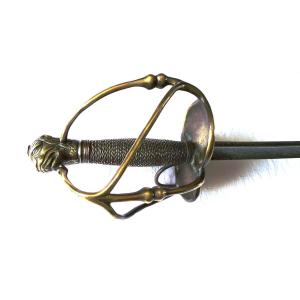
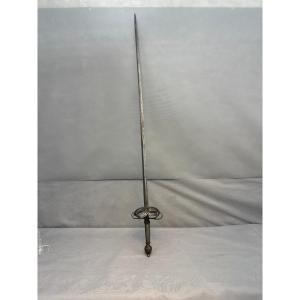
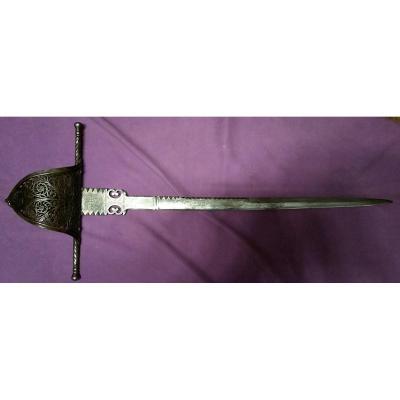
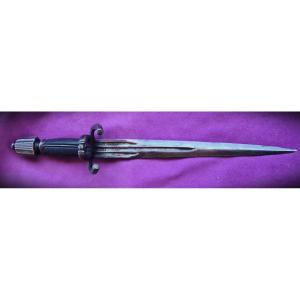
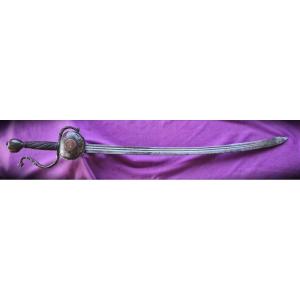
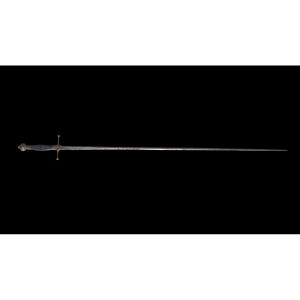
Thrusting Dagger With Guard Ring, Northern Italy Or Southern Germany, Circa 1580–1620
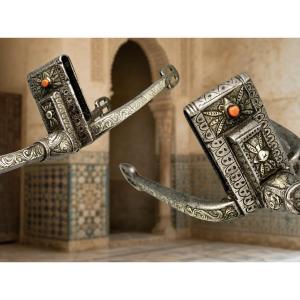
A straight, rigid thrusting dagger with a chain-piercing point and longitudinal fullers pierced with trefoil and cruciform motifs on the first half. The cylindrical guard terminates in small spherical knobs, and a lateral guard ring protects the left hand's finger. The handle is finely filigreed with twisted steel wire stretched over a metal core, ending in a flattened spherical pommel with a mirror-polished terminal knob. Construction and assembly: The guard consists of applied quillons, fixed by hot welding (an old brazing technique) to the central block. This method, consistent with late 16th-century practices in the workshops of Milan and Augsburg, confirms its period manufacture. The slightly differentiated metallic texture and the visible join at the quillon attachment point attest to a traditional assembly, in which the forged elements (blade, guard, ring, pommel) were fitted, brazed, and then polished. This detail is an indication of structural authenticity and confirms the absence of modern casting. Overall length: 39 cm Blade width at the ricasso: 2.5 cm Overall width (including guard): 12.5 cm Materials: polished steel, braided steel wire Finish: bright polish with old pitting from use Typology and attribution This model belongs to the family of left-hand daggers (or parrying daggers), used with rapiers in civilian duels during the Renaissance. Their function was to parry, seize, or deflect the opponent's blade, while retaining an offensive capability thanks to their chain-piercing point. The formal characteristics of this example—narrow blade, side ring, filigree handle, and spherical pommel—allow for an attribution to workshops in northern Italy (Milan, Brescia) or southern Germanic centers (Augsburg, Nuremberg), circa 1580–1620. Museum comparisons: • Wallace Collection (London) – inv. A.581: Left-hand dagger, Northern Italy, circa 1600. • Museo Stibbert (Florence) – inv. 2931: Ring dagger, openwork blade, and chain-piercing point, circa 1600. • Kunsthistorisches Museum (Vienna) – inv. A 312: Italian thrusting dagger with openwork fullers, circa 1590. • Metropolitan Museum of Art (New York) – acc. 14.25.716: Parrying dagger, Milan, 1600–1610, similar filigree hilt. Condition: Very good overall condition. Well-preserved blade, superficial pitting from use, solid hilt, intact filigree grip. Homogeneous antique patina, original polish preserved. Stylistic Analysis: The elegance of the filigree, the precision of the openwork, and the symmetry of the hilt indicate a high-quality piece, probably intended for an officer or gentleman. The balance between the geometric rigor of the quillon and the softness of the pommel evokes late Mannerism, reflecting Italian refinement around 1600. Estimate (2025 value): • At auction: €2,500–€4,000, depending on provenance and condition. • In a specialist gallery or private collection: up to €5,000–€6,000 for this complete, well-documented, and illustrated example.
4 000 €
Period: 17th century
Style: Renaissance, Louis 13th
Condition: Excellent condition
Reference (ID): 1646167
Availability: In stock
Print