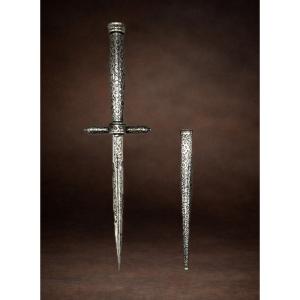
Germanic Stiletto With Marian Monogram, 17th Century
Artist: Solingen
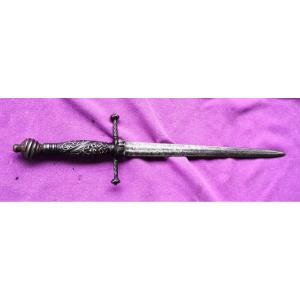
This stiletto is a fairly large model designed for fighting. The style of the handle might initially suggest Italian craftsmanship, but the blade, with its cross-shaped globus, its shape, and its decoration, indicates a Germanic origin. The weapon dates from the first half of the 17th century.
Stilettos first appeared in Spain at the beginning of the 16th century. They quickly became popular, first in Italy, then throughout Europe. Antonio Manciolino, in his "Opera Nova," a treatise on fencing from the Bolognese school, published in 1531, already mentions stiletto fencing.
These weapons were designed to inflict deep, difficult-to-treat wounds and to pierce the rings of chainmail or even break them, in the case of sharpened blades like that of this weapon. When I speak of "breaking the rings," I am obviously not referring to the sturdy hauberks or chainmail worn in war, but to the lighter models worn with civilian clothing.
BLADE: It has a somewhat unusual shape and is relatively thin. After an initial section shaped like a baluster for 1 cm, the blade takes on a flattened triangular section. At the beginning of the two triangular faces, there is a hallmark known as the "globe crucigen," an imperial mark characteristic of Solingen manufacture. The central ridge separating the two smaller faces is decorated with regular notches, outlined in lines.
On the wide, flat face, there is a representation of a flower, probably the "Mystic Rose," a symbol of the Virgin Mary. The decoration continues with plant branches of a design frequently found on Germanic blades from the late 16th and 17th centuries, particularly on the blades of Justice swords. Between these plant branches, one can decipher "Sa MARIA OPM" for Sancta Maria Ora Pro Me (Holy Mary, Pray for me).
Blade length = 21.7 cm. Width near the guard = 12.8 mm. Thickness near the guard = 5.2 mm.
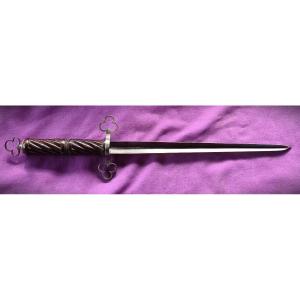
GUARD: It is across guard with two bulbous quillons ending in a small knob, around a rectangular center. These small knobs are not only decorative but also allow for a sharp and painful blow to the bones (hands, wrists, or skull). At the center of the guard cross:
On the two smaller sides, we find "IHS" for Iesu Hominem Salvator (Jesus, Savior of Mankind).
On the opposite side, which is the same side as the Mystic Rose of the blade, we find the Marian monogram with the intertwined letters A and M, for Ave Maria. This monogram is common in Catholic religious decorations. The engravings IHS and AM are positioned to be read when holding the dagger with the blade downwards, the entire weapon then symbolizing the Latin cross. These inscriptions allow us to date the weapon to the period of the Catholic Counter-Reformation in Germany, therefore the 1620s.
HANDLE: It is a single piece, grip and pommel. Shaped like a double baluster, around a twisted central ring. The pommel is twisted in the shape of a flattened turban. The portion of the blade's tang that is riveted to this pommel has been chiseled to blend with the shape of the rest of the pommel.
An interesting object, which would be a good addition to a collection on the theme of Renaissance and 17th-century daggers.
Shipping costs France €20, Europe €30
Ref AX2Y-25/2-18
Stilettos first appeared in Spain at the beginning of the 16th century. They quickly became popular, first in Italy, then throughout Europe. Antonio Manciolino, in his "Opera Nova," a treatise on fencing from the Bolognese school, published in 1531, already mentions stiletto fencing.
These weapons were designed to inflict deep, difficult-to-treat wounds and to pierce the rings of chainmail or even break them, in the case of sharpened blades like that of this weapon. When I speak of "breaking the rings," I am obviously not referring to the sturdy hauberks or chainmail worn in war, but to the lighter models worn with civilian clothing.
BLADE: It has a somewhat unusual shape and is relatively thin. After an initial section shaped like a baluster for 1 cm, the blade takes on a flattened triangular section. At the beginning of the two triangular faces, there is a hallmark known as the "globe crucigen," an imperial mark characteristic of Solingen manufacture. The central ridge separating the two smaller faces is decorated with regular notches, outlined in lines.
On the wide, flat face, there is a representation of a flower, probably the "Mystic Rose," a symbol of the Virgin Mary. The decoration continues with plant branches of a design frequently found on Germanic blades from the late 16th and 17th centuries, particularly on the blades of Justice swords. Between these plant branches, one can decipher "Sa MARIA OPM" for Sancta Maria Ora Pro Me (Holy Mary, Pray for me).
Blade length = 21.7 cm. Width near the guard = 12.8 mm. Thickness near the guard = 5.2 mm.
GUARD: It is across guard with two bulbous quillons ending in a small knob, around a rectangular center. These small knobs are not only decorative but also allow for a sharp and painful blow to the bones (hands, wrists, or skull). At the center of the guard cross:
On the two smaller sides, we find "IHS" for Iesu Hominem Salvator (Jesus, Savior of Mankind).
On the opposite side, which is the same side as the Mystic Rose of the blade, we find the Marian monogram with the intertwined letters A and M, for Ave Maria. This monogram is common in Catholic religious decorations. The engravings IHS and AM are positioned to be read when holding the dagger with the blade downwards, the entire weapon then symbolizing the Latin cross. These inscriptions allow us to date the weapon to the period of the Catholic Counter-Reformation in Germany, therefore the 1620s.
HANDLE: It is a single piece, grip and pommel. Shaped like a double baluster, around a twisted central ring. The pommel is twisted in the shape of a flattened turban. The portion of the blade's tang that is riveted to this pommel has been chiseled to blend with the shape of the rest of the pommel.
An interesting object, which would be a good addition to a collection on the theme of Renaissance and 17th-century daggers.
Shipping costs France €20, Europe €30
Ref AX2Y-25/2-18
900 €
Period: 17th century
Style: Renaissance, Louis 13th
Condition: Good condition
Material: Other
Length: 32 cm
Width: aux quillons 6.7 cm
Reference (ID): 1675898
Availability: In stock
Print