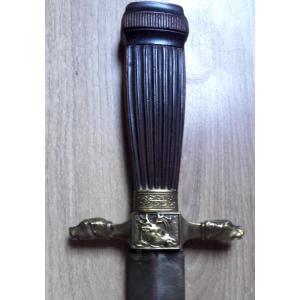
A Second Empire court sword with the head of Athena and lion heads. Bronze hilt with a symmetrical pommel featuring lion heads and the head of the helmeted goddess Athena. Vertically grooved ebony gri[...]
We present this antique 19th-century knife, marked on the blade with the inscription TOLEDO, indicating Spain. The blade is decorated on both sides: one side depicts a bullfighting scene, and the othe[...]
Trishula, a trident originating in southern India, commonly used as a religious symbol in Hinduism, Balinese, and Buddhism. It is the Hindu weapon of the god Shiva, and its name means "three spears."
JAPAN - Edo Period (early 19th century). Samurai wakizashi in shirasaya style. Zoomorphic kashira in chased copper, patinated black and gold, depicting a shishi (a type of fish). Fushi in finely chase[...]
This war axe is made entirely of metal, in the style of the 16th century, but manufactured in the 19th century. The head and handle of the axe are richly decorated: AXE HEAD: On one side, within a med[...]
JAPAN - Edo Period (1603-1868). Samurai Tanto. FUSHI and KASHIRA in a set of chased, patinated, and gilded copper decorated with horses and flowers on a nanako background (very slight oxidation). TSUK[...]
JAPAN - Edo Period (1603-1868). Samurai Katana. FUSHI and KASHIRA in a set in silvered copper depicting stylized geese flying in clouds. TSUKA in wood covered with ray skin and black silk braid. MENUK[...]
JAPAN - Edo Period (1603-1868). Samurai Katana. Black patinated copper kashira. Chiseled, patinated, and gilded copper fushi depicting a bamboo forest. Wooden tsuka covered with red-dyed stingray skin[...]
Silver sword hilt, hallmarked (1st standard 950/1000), 1809/1819. Parisian manufacture by the goldsmith Jean Juste (received in 1807). Finely chased hilt, openwork keyboard, in the center an imperial [...]
CHATELLERAULT FOLDING KNIFE 19th century FranceSteel, nickel silver, boneClosed length: 10cm; Open length: 18.3cm; Blade length: 8.6cm Slightly curved steel blade with one cutting edge and one counter[...]
Carved bone kris (dagger) handle depicting a demon - Indonesia, 19th century. A very fine and expressive sculpture. The demon is depicted with a protruding belly and genitals. The face has a grotesque[...]
Firefighters' Sabre of the National Guard, Firefighters of the Cantonal and Municipal Guards, July Monarchy. Brass hilt with a Gallic rooster motif, pommel molded in the shape of a rooster's head. Str[...]
This dagger belongs to the stiletto family, due to its long, narrow blade. It is likely of Italian origin, based on its shape and the type of handle made of horn discs. It can be dated to the mid-19th[...]
INFANTRY OFFICER'S SABRE, "melon-sided" model. France, Revolutionary period, circa 1800. Gilt bronze hilt. Melon-sided pommel, knuckle guard decorated with lines. Almond-shaped crossguard and curved, [...]
Sabre of the 2nd Company of Musketeers "Black" of the King's Household, Model 1814. Silvered brass hilt. Shagreen-covered grip with wire wrapping. Short, straight pommel. Four-branch battle-type guard[...]
A large antique folding knife of the navaja type, made in Thiers for Valero Jun, a prominent hardware merchant based in Zaragoza. This production reflects the trade between cutlery makers in the Massi[...]
Senior officer's sword - France, First Empire. Asymmetrical gilt bronze hilt adorned with a trophy of arms. Checkered ebony grip. Pommel slightly inclined forward, decorated at the base with a winged [...]
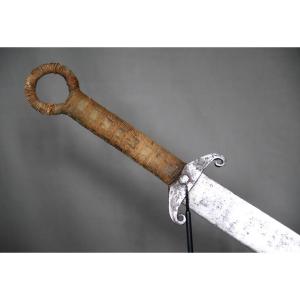
Chinese Saber - China, late 19th/early 20th century. This rustic saber is notable for retaining its original, traditional lacing around the handle. It has a slightly curved, single-edged blade and a r[...]
Beautiful small French naval dagger; Napoleon III period, curved model with a triangular blade, engraved ebony handle with engraved mounts, steel scabbartrare model with orient influence
Infantry Briquet Sabre dated 1837, Louis Philippe period. One-piece brass hilt, fluted grip with 28 strands, simplified quillon rolled into a button. Single-branch guard. Flat steel blade with a gray [...]
Civic reward sword – Franco-Prussian War of 1870. Presented to Chevalier Pagel, mayor of L'Isle-Saint-Denis, at the end of the siege of Saint-Denis during the Franco-Prussian War. Alexis Jean-Baptiste[...]
Sword of the students of the École Polytechnique, model 1872 modified 1884FranceThird RepublicSteel, wood, brass, leatherTotal length: 90 cm; blade length: 75 cmPommel with ‘diabolo’ button.Joint mark[...]
Sword of a naval officer and naval control officialsFranceThird RepublicSteel, leather, hornTotal length: 93 cm; blade length: 78 cm(Sleeve missing)Pommel chiselled with a scallop shell.Upper ring eng[...]
INFANTRY SWORD, MODEL 1831, LOUIS PHILIPPE 19th CENTURY. Good hilt, entirely in bronze. Grip with 26 bands, straight quillon guard with trunnion ends. The 48.5 cm straight blade has a central ridge on[...]
General's staff sword from the First Empire with a blade signed by Antonio Ruiz in Toledo, 18th century. The 18th-century blade is signed by Antonio Ruiz in Toledo within the fuller. The blade has a c[...]
The "bichaq" is a side knife typical of Ottoman, Balkan, and Southern European regions. Carried by military personnel and high-ranking officials, it was often adorned with silver, coral, and other pre[...]
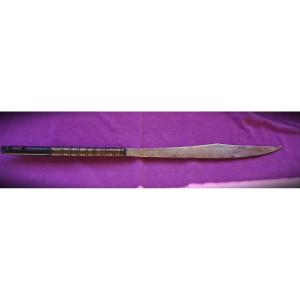
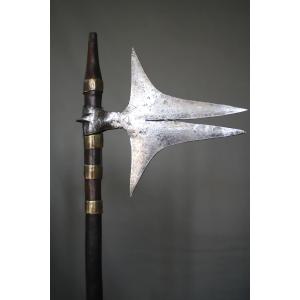
This large war halberd originates from Indochina. It was collected in the 19th century by a French Officer. The shaft has been shortened for an exhibition, but since the cut is at an angle, it would b[...]
An exceptional collector's item: unlike standard models with simple floral decoration, this example is a rare commissioned piece featuring a guitar in relief highlighted with vermeil, a powerful symbo[...]
Naval officer's dagger from the First Empire, non-regulation, Oriental style, 19th century. No visible hallmark, the cutlers wishing to remain anonymous due to the Emperor's prohibition of this type o[...]
SABRE-BAYONET model 1866 Chassepot from the Imperial ManufactoryFrance19th centurySteel, brassTotal length: 69.7 cm; Blade length: 57.5 cmYatagan-type blade with one cutting edge and one counter-cutti[...]
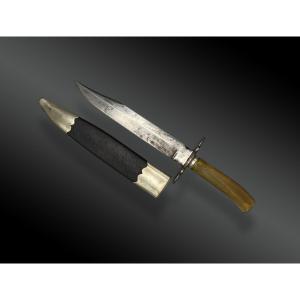
BOWIE KNIFE, WITH SHEATH United Kingdom, 19th centurySteel, nickel silver, antler, leather.Total length: 23.7 cm; blade length: 13.7 cm Straight blade with one cutting edge, ricasso at the heel 2.3 cm[...]
BOWIE KNIFE BY WILKINSON AND SON SHEFFIELDUnited Kingdom, 19th centurySteel, brass, boneTotal length: 38.5 cm; Blade length: 24 cm Straight blade with one cutting edge, ricasso at the heel 3.3 cm wid[...]
BOWIE KNIFE WITH BRASS-RINGED HANDLEUnited States, 19th centurySteel, horn, brass.Total length: 27 cm; blade length: 17.3 cm Straight blade with one cutting edge.Straight nickel silver guard with two [...]
BOWIE KNIFE BY WILKINSON AND SON SHEFFIELDUnited Kingdom, 19th centurySteel, nickel silver, antler.Total length: 25.5 cm; blade length: 15.3 cm Straight blade with one cutting edge, ricasso at the hee[...]
BOWIE KNIFE, WITH SHEATHEurope, 19th centurySteel, nickel silver, horn, leather.Total length: 35 cm; Blade length: 22.7 cm Straight blade with one cutting edge and one counter-cutting edge, ricasso wi[...]
Indian bulova axe - Northeast India, 19th century. The bulova axe is a rustic weapon of the indigenous peoples of Northeast India. The axe head is usually crescent-shaped. This one has a much rarer fo[...]
Short sword, known as a yataghan - Ottoman Empire, 19th century. Single-edged, convex blade. Maker's mark on one side. Grip made of two blond horn scales. A silver band is missing from the back of the[...]
Saxon Fascine Knife, Model 1855, Infantry Regiment "Kronprinz" (5th Royal Saxon) No. 104. Manufacturer: Sedlmayr – monogram HZ. This item is a Saxon Fascine Knife, Model 1855, a regulation edged weapo[...]
A beautiful officer's sword of the Imperial Guard, Model 1860. This sword is a true symbol of the military nobility of the Second Empire. This example is in remarkable condition, notably retaining all[...]
Short Afghan saber, also known as a Khyber saber - Afghanistan, 19th century. The hilt has two bone scales and a chased brass mount. The blade is single-edged with a T-shaped back. The wooden scabbard[...]
The hilt is made of silver-colored metal, featuring an elegant crossguard with short quillons, a chain guard, and a finely chiseled lion's head pommel, a traditional symbol of authority and command. T[...]
Short Afghan saber, also known as a Khyber saber - Afghanistan, 19th century. Horn scale grip and brass hilt. Single-edged blade with a T-shaped back. Wooden scabbard covered in black leather. The sca[...]
Era: Mid-19th century, Rattanakosin period (around 1860), reign of King Mongkut (Rama IV), era represented in the film "Anna and the King". Origin: Siam (now Thailand) Materials: Silver damask steel b[...]
Deluxe model dueling sword - France/Spain, 1879. Special order made in Toledo for Mr. Charles Cuel. Three-sided, fuller-edged blade. Acid-etched interlacing and arabesque designs on the first third of[...]
This cutlass is certainly of Balkan origin, probably Serbian. It can be dated to the 19th century. Its size and robust appearance are likely related to its use in hunting. The shape of the blade is re[...]
Daisho (dagger) with two wakizashi (swords), the blade of the larger one certainly not being the original. This may have been done for ceremonial purposes or for a merchant who was not allowed to carr[...]
Katana from the late Edo to Meiji period. Blade: Otoshi-zukuri (V-shaped cross-section with two faces) blade, Iori-mune (two-sided) blade spine. O-kissaki (long) points. Shinoji (11 mm) (face 1). Jiga[...]
Oriental-style fantasy saber - France, 19th century. Cast and molded brass hilt. French cavalry saber blade, model 1822, with steel oxidation. No play. Overall length 99 cm. Blade length 85 cm. Weight[...]
Proantic uses a cookie to analyze traffic and improve its service by using Google Analytics. Data sent to Google Analytics (frequency of visits to the site and pages visited) are anonymous. No other cookie tracks your activity, your personal data is not collected. Thank you for helping us to have better understanding how Proantic is used.






















 Le Magazine de PROANTIC
 TRÉSORS Magazine
 Rivista Artiquariato