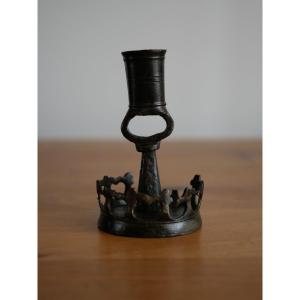
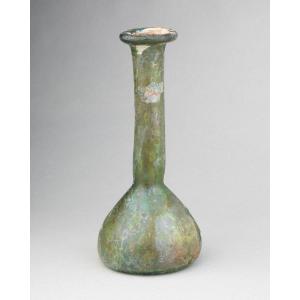
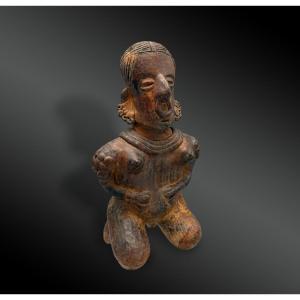
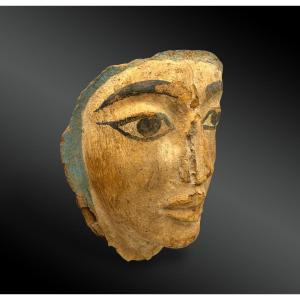
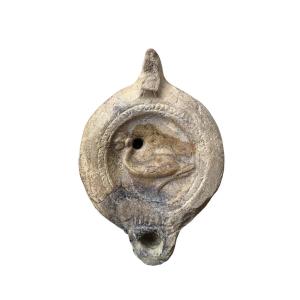
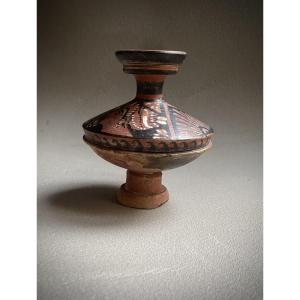
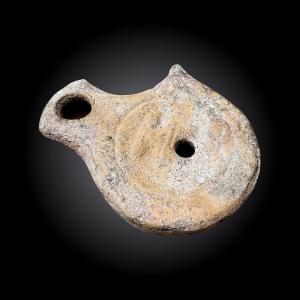
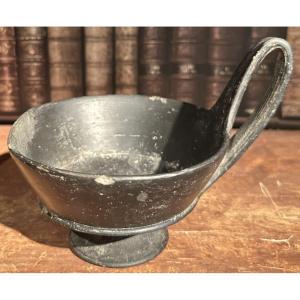
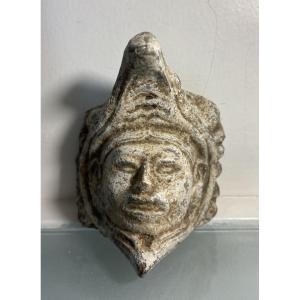
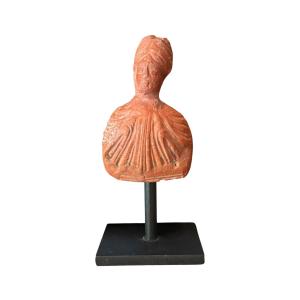
A small set of three oil lamps, typical of Carthaginian production from the late Roman period (4th century). The set comprises three small lamps, averaging 4 cm in height and 7.5 cm in diameter. The u[...]
Medieval and Crusader Era Bronze Bezel Ring with Unusual Decoration.Material: BronzeDimensions: 15 mm inner diameterWeight: 1.40 gPeriod: 11th-13th Centuries ADCondition: Good, usable. See photos.
Medieval and Crusader Era Bronze Ring Medieval bronze ring richly decorated with solar symbols.Material: BronzeDimensions: 15 mm inner diameterWeight: 1.40 gPeriod: 11th-13th Centuries ADCondition: Go[...]
Byzantine Bronze Ring.The Bezel set with a Blue Stone Cabochon.Origin: Private EU collectionProvenance: Collectors' MarketMaterial: BronzeDimensions: 16 mm inner diameterWeight: 2.16 gPeriod: 8th-10th[...]
Byzantine silver ring engraved with "EENDA," 6th-8th century.In the context of the Byzantine Empire, "Eenda" likely refers to a city such as Andeda (an ancient city and bishopric in Anatolia) or Edess[...]
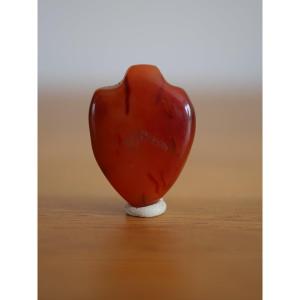
The Eye of Horus Amulet Fragment.One of the oldest symbols in Egypt. It represents strength, health, safety, life, and vigor. The piece would have been part of an amulet.Provenance: Spanish Private co[...]
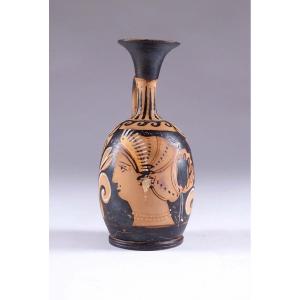
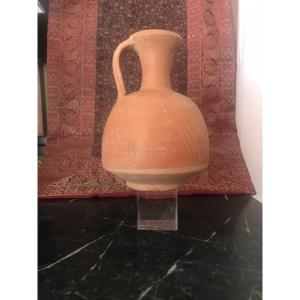
A Lagynus wine jug, made of terracotta. Roman period (1st/2nd century AD), a jug with a lenticular body and a beautiful central carination; a typical piece of Punic ceramics.
A terracotta feeding bottle, Roman period, 3rd century, with an ovoid body, a flared neck with a strainer at its junction with a short spout. A handle on the back. The spout is nipple-shaped, clearly [...]
Small Punic terracotta amphora, Roman period, 3rd and 4th centuries. Dimensions: 27 x 17 cm, opening diameter: 4.5 cm. Weight: approximately 500 grams. A small crack on the neck, as well as two chips [...]
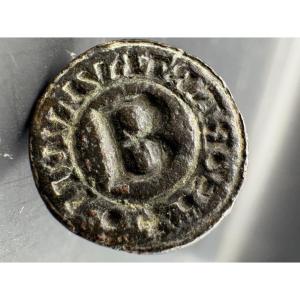
Superb lead bulla of Robert of Anjou (Count of Provence and Forcalquier, Duke of Calabria, King of Naples and Sicily...). On the reverse, the shield with the arms of Aragon, for Yolande of Aragon, wif[...]
Roman Head of a Bearded Dionysus , Marble, 2nd Century AD. A beautiful antique marble head depicting a bearded god, probably Dionysus, sculpted during the Roman Imperial period. The slightly inclined [...]
A rare and authentic Renaissance games box from the Embriachi workshop or Lombard “certosina” tradition, produced in Northern Italy around 1470–1520.
Compact in form (15.5 × 15.5 × 7 cm), this box wa[...]
13th-14th Century Bronze Islamic Ring w Silver Inlaid Eight Pointed StarA beautiful large medieval ring with beautiful silver inlay through the ring. the main focus is the inlaid eight pointed star.Th[...]
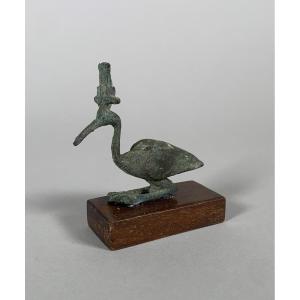
Archaeology: Bronze Osiris with a dark patina. Ancient Egypt, Late Period (664-332 BC). He holds a flail and scepter, wears the atef crown, and sports a false beard. Dimensions: Length: 6.4 cm. Width:[...]
Very old two-handled flask, known as a pilgrim's flask, made of Roman Empire terracotta, decorated with scenes of figures surrounded by arabesques. Condition: no cracks, a small chip on the neck, wear[...]
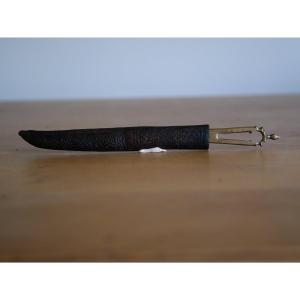
Bronze dagger from Luristan (western Iran), dating from the 2nd–1st millennium BC. The elongated triangular blade displays a beautiful antique green patina typical of buried bronzes. The cylindrical h[...]
I am offering this charming antique piece from a small collection in the Berry region. Please note that two small cabochons need to be reattached. The label is marked "Byrsa" for Carthage in Tunisia.
Silver and gold ring with carnelian intaglio - Roman period - 3rd century AD. A well-preserved Roman silver and gold ring from the 3rd century AD. The solid silver band measures 21 millimeters in inne[...]
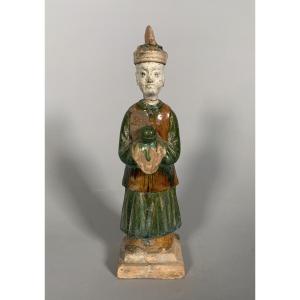
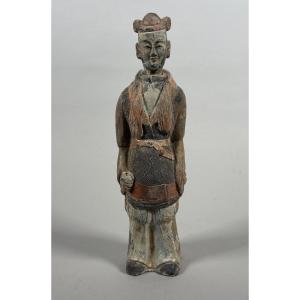
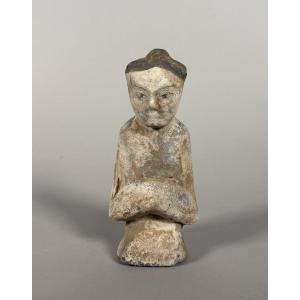
This rare set comprises twelve Chinese zodiac figurines, each modeled in terracotta and covered with ancient polychromy using mineral pigments. The figures, depicted standing, hold in their hands the [...]
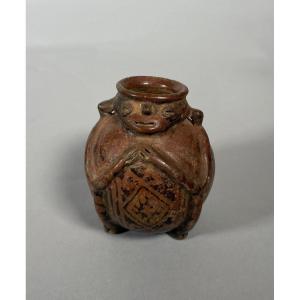
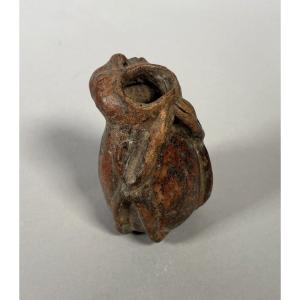
Peru, Inca culture, 1400-1500 AD, orange-brown terracotta with traces of black ornamental paint. Bottle-shaped vase with a stirrup handle and a long tubular neck carved with a small monkey in relief, [...]
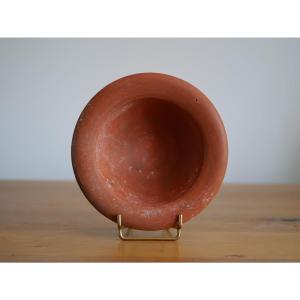
Montans Sigillata Dish – Chresimus Stamp – Early 2nd Century AD. This superb sigillata dish comes from the workshops of Montans in the Tarn region and dates from the early 2nd century AD. It bears the[...]
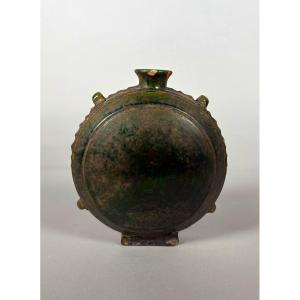
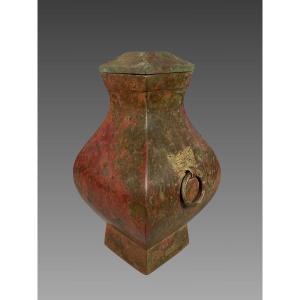
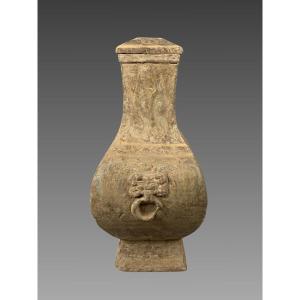
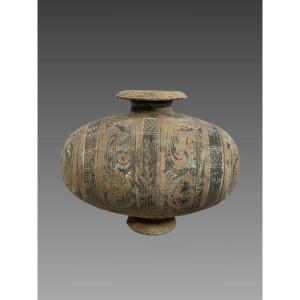
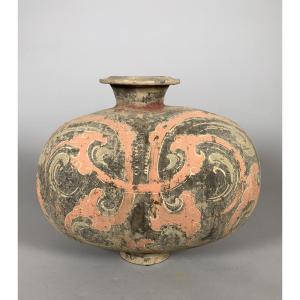
Extremely rare bronze HU vase, China, Han Dynasty (206 BC - 220 AD). Bulging body, two handles in the form of masks (rings missing). Excavated find, beautiful nuanced patina, very hardened clay on the[...]
Denarius of Lucius Procila, minted in Rome in 80 BC. Weight: 3.92 grams. Diameter: 19 mm. Obverse: Laureate head of Jupiter right, behind, SC. Reverse: Juno Sospita fighting right, wearing a goatskin [...]
Denarius of Lucius Rustius, dating: 76 BC, weight: 3.87 g, diameter: 19 mm. Obverse: head of Mars, reverse: ram. /L.Rusti. Coin classified R2. In superior condition.
Agent of Maximinus Hercules, minted in Rome in 294. Weight: 3.31 grams. Diameter: 18 mm. Coin in superior condition, very well centered on the portrait. Classified R2.
Very rare bull for the bishopric of Mende; obverse: Odilon de Mercoeur (1247/1274) S.Odilonis ...Episcopis Mimaten. Odilon facing forward, holding a crozier in his left hand and blessing with his righ[...]
A very rare bulla for the Hospitallers of the city of Orange. This bulla dates from 1277. Obverse: S Hospitalis Sancti Ioannis, Cross pattee. Reverse: Bound horn of the Princes of Orange. Sigillum Vil[...]
A very fine silver denarius of Charlemagne, minted in Pavia, Italy. Dated 774 AD. It measures 20 mm in diameter and weighs 1.72 grams. This coin is graded R2 and is in Very Fine+ condition, with a sli[...]
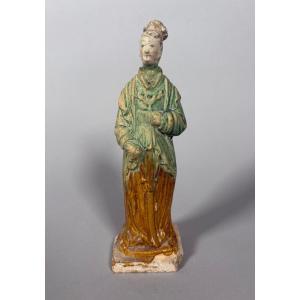
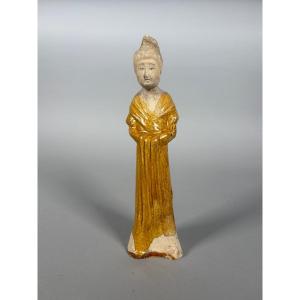
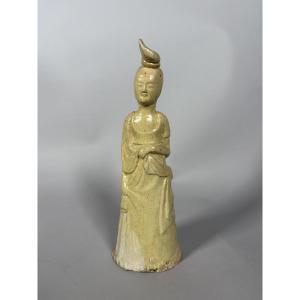
This monumental funerary statuette (75.5 cm) is an emblematic work of mingqi ("spirit objects") statuary from the Han Dynasty. Depicting a court lady in an attitude of protocolar reverence, it is dist[...]
Persia, Seljuk period, 13th century. Zoomorphic bird-head jug – siliceous ceramic with turquoise glaze and manganese highlights. H. 26 cm. Superb persian zoomorphic jug from the 13th century, depictin[...]
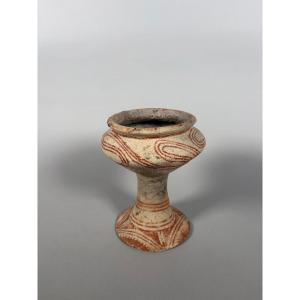
This artifact is a Canaanite pyxis dating from the Late Bronze Age, a direct witness to the material culture of the Southern Levant between 1400 and 1200 BC. The object is characterized by its squat g[...]
Gold Ring Set with an Ancient Carnelian Scarab Depicting a Deer Hunt.5th century BC scarab; modern gold ring, 1970s.MeasurementsRing size: M 1/2 UK / 6.5 US / 53 EU.Weight: 13.83 grams.DescriptionAn 1[...]
Period: 1st century BC – 1st century AD. Origin: Gallo-Roman world. Provenance: Former private collection in southern France, by inheritance, acquired before 1970. Fragmentary terracotta votive head r[...]
Fine, compact Greek lekythos in ceramic, decorated with large radiating palmettes painted in black on an orange slip, stylistically dated to the 4th century BC. The vessel displays a harmonious profil[...]
ROMAN BONE KNIFE HANDLE WITH LION'S HEAD Roman Empire - 1st-2nd century AD Knife handle (manubrium cultri) in carved bone, decorated with a stylized lion or panther's head in the round. 4 cm long. Ani[...]
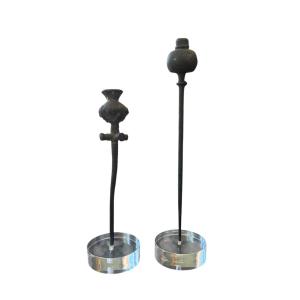
Roman bronze pin with the likeness of Heracles - 2nd century AD. Roman bronze pin (acus crinalis) with a verdigris patina, surmounted by a statuette of Heracles at rest. Total length: 15 cm. Height of[...]
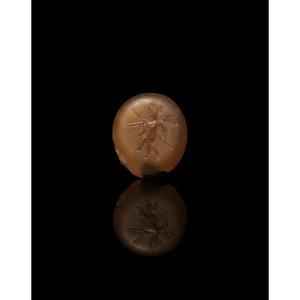
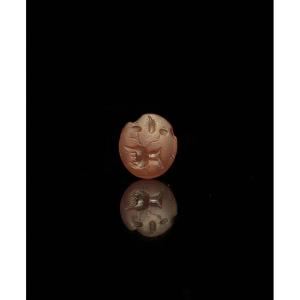
Engraved Stone Scarab. Small scarab carved from hard stone, in a simple and refined form, typical of early utilitarian models. The back is convex, the elytra barely suggested. The underside is engrave[...]
Rare large red-figure bell krater (H: 29.3 cm). Magna Graecia. This krater comes from an Apulian workshop dating to the late 4th century BC (authenticated by D. Lebeurrier, archaeological expert). The[...]
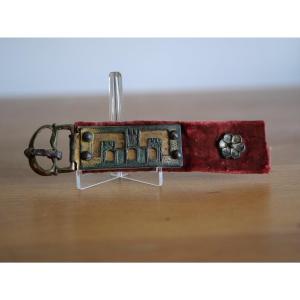
Very elaborate decoration in gilded and silvered bronze.Floral and geometrical design. Probably part of an armor strap fitting and of continental European manufacture.Dimensions: 4x4 cm.
Gallo-Roman copper alloy cauldron – Bessonneau Collection, Eggers Type 9-10 – 1st-2nd century AD. The cauldron was discovered in Vic-sur-Seille (Moselle) – Vicus Bodatius. Exceptional Gallo-Roman copp[...]
Goddess with Child – Archaic Cyprus – Circa 550 to 500 BCE. A rare votive statuette representing a goddess with a child (kourotrophe), an exceptional example of Cypriot religious art from the Archaic [...]
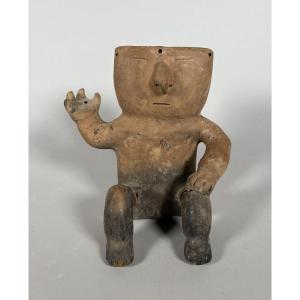
Anthropomorphic MaskNariño–Carchi Culture, Andean region of southern Colombia and northern Ecuador, ca. 600–1500 ADModelled and painted terracottaSold with its baseH: 16.8 cmExcellent condition; trace[...]
Rare, well-preserved fossil of a large, Quaternary-era holy water scallop shell, once used for holy water in a chapel. This natural wonder, a work of art in itself, is rich in symbolism, reflecting it[...]
A very pretty rock crystal intaglio depicting a beautiful antique profile. Bronze mount. Superb bronze-green patina. Height: 2.2 cm Width: 2 cm Thickness: 1 cm Weight: 5.30 g
Babylonian Terracotta Tablet with Erotic Scene, 2100 BCE - 1600 BCETerracotta, 9.7 x 9.4 cm, height including stand 13 cmProvenance: auction Christie’s, New York, 8 June 2001, lot 337, reproduced (sol[...]
Period: Middle or Late Bronze Age.Date: 2nd millennium BCE.Origin: Iberian Peninsula.Material: Bronze.Provenance: Old Portuguese Private Collection.Item condition: Repaired in two places. Some chips a[...]
A grotesque bust depicting an emaciated figure with clasped hands raised against the upper torso. The ribcage is rendered in high relief, with prominent ribs that accentuate the extreme thinness of th[...]
A solid-cast Near Eastern bronze nude goddess, dating to the 1st millennium BC. This finely modelled votive figure represents a frontal female divinity in the long-standing Astarte / Ishtar tradition,[...]
Reliquary or funerary urn in Byzantine marble, Eastern Mediterranean, 5th–6th century AD. Rectangular reliquary in fine white marble, carved from a single block with a double-sloped lid pierced by a c[...]
Proantic uses a cookie to analyze traffic and improve its service by using Google Analytics. Data sent to Google Analytics (frequency of visits to the site and pages visited) are anonymous. No other cookie tracks your activity, your personal data is not collected. Thank you for helping us to have better understanding how Proantic is used.