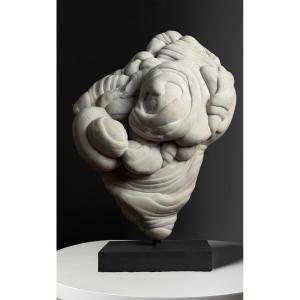
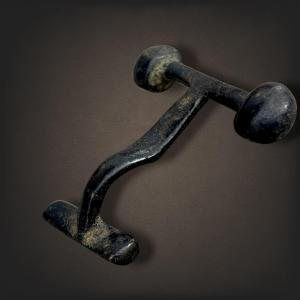
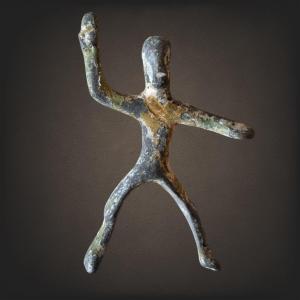
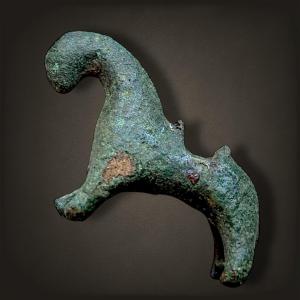
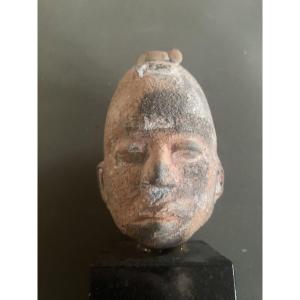
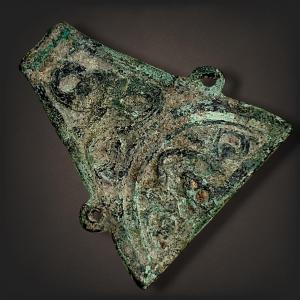
Socketed axe with edges hemmed with a line extending to the cutting edge. Bronze with dark patina. Very well preserved. REGION: Iran, Elam MATERIAL: Bronze PERIOD: 2nd millennium BC DIMENSIONS: 15.5 c[...]
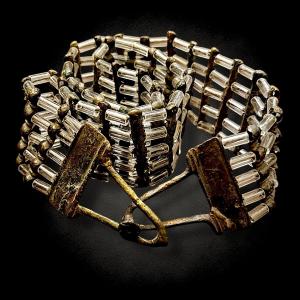
Ancient beads from the Roman period and the Greco-Bactrian empire (or Bactrian period), Hellenist regions of Central Asia founded from the 3rd-2nd century BC since the conquest of Alexander the Great.[...]
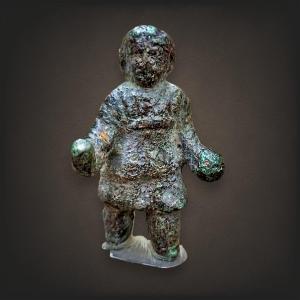
Gallo-Roman Art, Statuette of a Gallic divinity, He holds in his right hand a cup or a disc, His left hand open towards the sky, Dressed in a toga, A rod under his left foot, In good used condition, b[...]
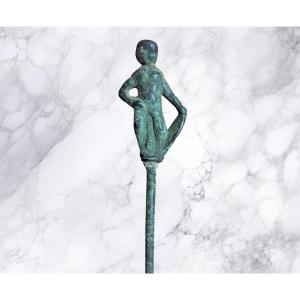
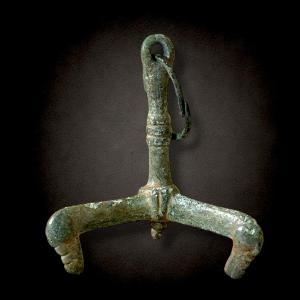
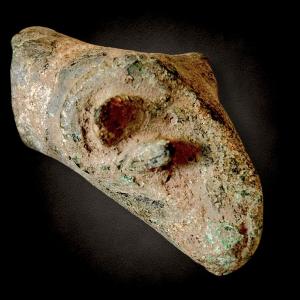
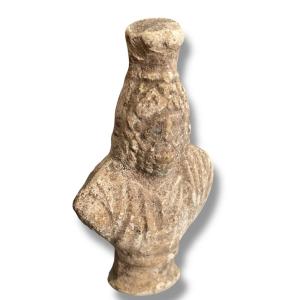
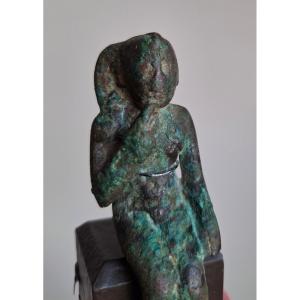
Funeral bale marker. It consists of a handle topped with a head. The mouth is half-open, the eyes are diamond-shaped, and it has a long nose extending from the forehead. A cylindrical headdress adorne[...]
Greece or Rome, 3rd century BC: a black glazed earthenware canthmare. Dimensions: - height 11 centimeters. - diameter: 14 centimeters. - from handle to handle: 20.5 centimeters.
This type of colored enamel is also called 'millefiori' and the high quality technique (champlevé) that was required to make this type of colored enamel demonstrates a high degree of skill by Roman gl[...]
The pair of standing figures represent the government officials. They look vivid with lovely details particularly in their special male dresses. Such type of figures is rarely found, as the dynasty (3[...]
Tang Dynasty Chinese ceramic (618-907 AD), set of three foreign grooms or caravaneers in brown, yellow, and green glazed terracotta, their right arms raised.The flesh is reserved in bisque, Tang Dynas[...]
Beautiful funerary statue of a standing banner bearer or guardian in lead-glazed earthenware armor. China Sui Dynasty (581-618) AD in good condition. Height: 38 cm
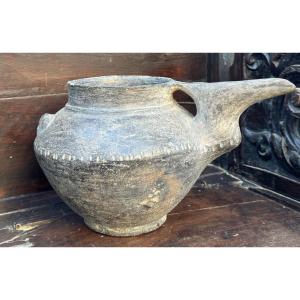
Circa: 9th-10th Century.Origin: Iberian Peninsula.Material: Earthenware.Item condition: Minor chips along the pieces. One small firing crack to the rim of one bottle. Strong and stable. Age weathered [...]
Large Ushabti from the Ramesside Period An ushabti is a funerary figurine from ancient Egypt, usually made of clay, wood, or stone. These figurines were placed in the tombs of the deceased and were in[...]
Europe, Late Middle Ages to Renaissance, ca. 1400 to 1600 CE. A beautifully-preserved chain mail Gauntlets of Mail, in mitten form, made of thousands of interlinked rings of iron. Although the rings w[...]
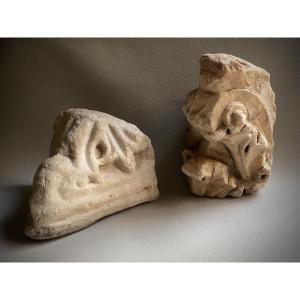
Circa: 2nd-3rd Century A.D..Origin: Iberian Peninsula.Material: Stone.Note: Could be displayed has a decor piece.Item condition: Some chips and flaws along the piece. Some small cracks. Strong and sta[...]
Beautiful cast iron socketed axe dating from around 600-900 BC. The axe has an outer ring for attaching it to the tool. It is decorated with segmented edges and has a beautiful glossy patina. Axes of [...]
Wedjat Eye Amulet – Ancient Egypt, Late Period. Rare amulet in the shape of a Wedjat Eye, a major protective emblem of ancient Egypt. Seen horizontally, it presents the complete shape of the Eye of Ho[...]
Terracotta elephant - India, late 1st millennium BC - early 1st millennium AD. Visible flaws. 11.5cm X 15cm. Two similar examples in the British Museum: https://www.britishmuseum.org/collection/object[...]
Male terracotta figure - India, Mathura region, 1st-3rd century AD. Pot-bellied figure, visible genitals, hands clasped at chest level. A similar example is on display at the British Museum: https://w[...]
Bust of a Female Goddess in Terracotta - India, Maurya Empire, 3rd-2nd Century BC (3)This type of sculpture was produced in large quantities under the Maurya Empire as an object of devotion. Height 10[...]
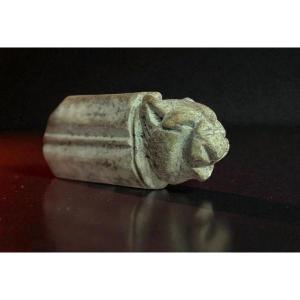
Socketed halberd with three digits and a lion protome spitting out a short blade. Bronze with dark patina. Very well preserved. Iran, Elam, 2nd millennium BC. Length: 14.5 cm.
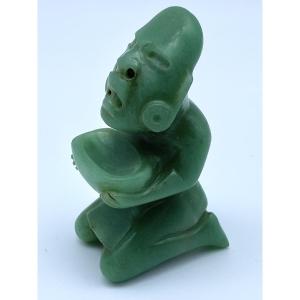
Here is a rare anthropomorphic talismanic amulet in polished green jadeite, probably representing a dignitary. Peak of the Mayan Civilization, Costa Rica 5th-8th century AD Great ancient craftsmanship[...]
This black-glazed pottery jug comes from southern Italy and can be dated to around the 4th century BC. The spherical body of this unique oinochoe rests on a ring-shaped foot and has a handle. This jug[...]
Sculpture of a horseman in terracotta HAN dynasty 206 BC-220 AC Mingqi in polychrome painted terracotta Represents a lady in court dress perched on a horse Dimensions 45 x 40 x 18 cm Comes from a Fren[...]
Sancai glazed jug China Tang Dynasty (618 - 907 AD) terracotta with green and brown ochre glaze Dimensions: 18 x 13 x 11 cm Crack on the heel and small chip on the outside of the neck of the jug
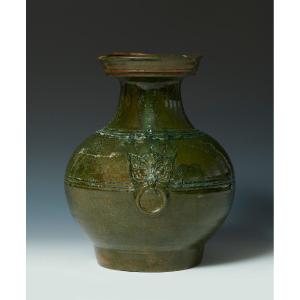
A typical Han period terracotta "Hu"-shaped vase features an elegant and functional shape. It is large in size, with a slender, flared silhouette. The surface of the vase is decorated with two taotie [...]
This type of mini-sized unglazed jar appeared during the Eastern Zhou and early Han dynasties. The jar was gray after firing, and its base has dark gray, purple, and reddish hues, probably due to its [...]
This type of unglazed jar appeared during the Eastern Zhou dynasty and early Han dynasty. The jar was grey after firing, and the jar’s base has dark grey, purple and reddish hues, which could result [...]
Three goddess bust fragments - India, Mauryan Empire, 3rd-2nd century BC Terracotta depictions of female goddesses. This type of sculpture was produced in large quantities during the Mauryan Empire as[...]
Terracotta male head - India, Gupta period, 4th-6th century Male head with protruding eyes, large ears, moustache and beard collar. Height of base 12.5cm Height without base 9cm
Female Head in Terracotta - India, Gupta Period, 4th-6th CenturyThe head with fine features, large earrings and elaborate hairstyle.Height of base 17.5cmHeight without base 14cm Price: €430
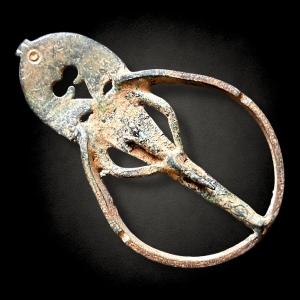
A large, two-part, tongue-shaped buckle crudely engraved with a fantastical beast motif. The composition of this beast echoes prehistoric cave paintings or chalk hill compositions in the UK. It was fo[...]
Terracotta head - India, Gupta period, 4th-6th centuryAnthropomorphic head with grotesque features and a sophisticated headdress.Height of base 16.5cmHeight without base 12.5cm
Female Head in Terracotta - India, Gupta Period, 4th-6th Century The head sports large earrings and an elaborate hairstyle. Height with base 17.5cm Height without base 13cm
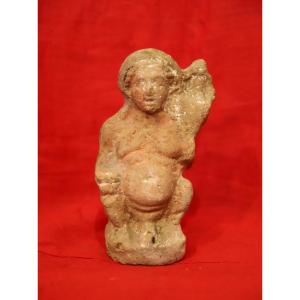
Anthropomorphic representation in terracotta - North India 1st-3rd century Representation of a seated dwarf man, with a prominent belly and a crowned head. A very similar example, discovered in Mathur[...]
Terracotta head of a female goddess - India, Maurya Empire, 3rd-2nd century BC This type of sculpture was produced in large quantities during the Maurya Empire as an object of devotion. For a similar [...]
Terracotta head of a female goddess - India, Mauryan Empire, 3rd-2nd century BC This type of sculpture was produced in large quantities during the Mauryan Empire as an object of devotion. For a simila[...]
Sculpture of an idol representing a woman carrying a child terracotta Chupicuaro civilization 1000-100 BC Mexico Broken at the neck, the head has been glued back on, a crack is still visible Dimension[...]
Socketed axe formed by a curved blade spat out by a lion protome. Bronze with a crusty green and brown patina. Very well preserved. REGION: Iran, Luristan MATERIAL: Bronze PERIOD: 1st millennium BC (9[...]
Very pretty row of old beads from the Roman and ancient Egyptian periods. Mainly made of translucent or colored glass or superbly iridescent, some beads are made of hard stone. Beautiful excavation pa[...]
This cup was made during the Majiayao culture, Machang period, around 3000 BC. It represents the high aesthetics of ceramics and the quality of life in the Chinese Neolithic period. It has the exact s[...]
This pair of cups was made during the Majiayao culture, Machang period, around 3000 BC. They represent the high aesthetics of ceramics and the quality of life in the Chinese Neolithic period. They are[...]
This cup was made during the Majiayao culture, Machang period, around 3000 BC. It represents the high aesthetics of ceramics and the quality of life in the Chinese Neolithic period. It has the exact s[...]
Indonesian terracotta statue, 14th - 15th century, representing a sacred spiritual figure from classical Javanese art, at a time marked by the coexistence of Mahāyāna Buddhism and Shivaite Hinduism on[...]
Large terracotta Ding tripod vase characterized by its imposing and elegant form, supported by three sturdy feet. The body of the vase is cylindrical in shape with two small, slightly curved vertical [...]
Very finely detailed headrest. This amulet is an object of funerary offering. Former collection: Gérard Van Der Burgh before 1983. Galerie Cybele 2018.
Two Fragments of Coptic "clavii". The shorter one has geometric patterns and quadrupeds in medallions. Work from the 5th century AD Linen and wool 30x6cm The longer one is composed of geometric patter[...]
Originally from Italy, from the Florence region. Once the slabs have been cut and polished, the sediments accumulated in the limestone reveal ruiniform designs: landscapes, seas, towers, keeps... I'l[...]
Head of a dignitary or deityMaya culture, Classic period (250 – 900 AD)TerracottaH. with base 12.7 cmH. without base 9.5 cmThis terracotta head represents a figure with prominent cheekbones, half-clos[...]
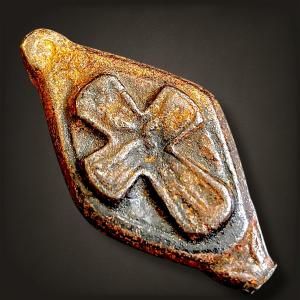
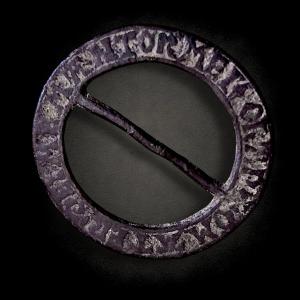
Exceptional medieval bronze coin weight bearing the inscription IHS inlaid in silver.The letter I is inscribed inside a Templar cross.All around the Christogram there is a circular decoration of a whe[...]
Fragment of Coptic fabric called clavi with geometric patterns and a dancer in the lower part. Work from the 7th century AD Linen and wool 14x8cm alone 20x15 with the frame The fragment was affixed to[...]
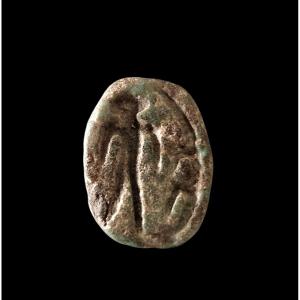
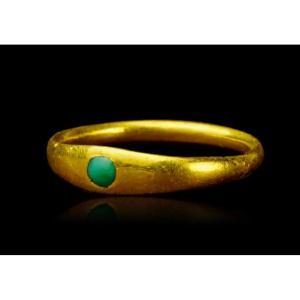
Upper part of a talisman ring, featuring a carefully and meticulously drawn fish, with marked fin and dorsal ridges, the whole presents beautiful naturalistic shapes. Turquoise blue earthenware with b[...]
Proantic uses a cookie to analyze traffic and improve its service by using Google Analytics. Data sent to Google Analytics (frequency of visits to the site and pages visited) are anonymous. No other cookie tracks your activity, your personal data is not collected. Thank you for helping us to have better understanding how Proantic is used.