Artifact – Antiquity – Funerary Olpé In Ceramics On Tour With Documentation - Archaeology
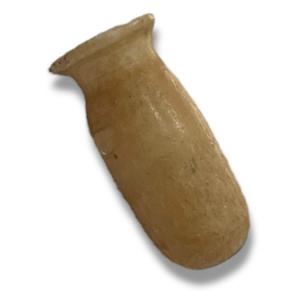
Period: 1st century BC Origin: Necropolis of La Catalane, Les Baux-de-Provence (Southern Gaul) Provenance: Brunet Collection (no. 66), previously acquired before 1973 Olpé in wheel-thrown ceramic, complete, from the funerary furniture of the protohistoric necropolis of La Catalane. This one-handled container, characteristic of Gallo-Greek productions, testifies to the role of tableware in the funerary deposits of the end of the Iron Age, marked by Mediterranean influences. Description: • Material: soft light brown-yellow paste, without coating. • Shape: small vase with rounded body and narrow neck, a flat handle connecting the shoulder to the rim. • Decoration: sober, undecorated. • Technique: careful throwing; traces of turning visible on the inside, well-regulated exterior; flat handle decorated with two longitudinal grooves. Use: This type of olpe was used to contain liquids, probably wine or water, placed next to the deceased in the tomb. It is part of a ritual tradition where dishes played an essential role in symbolic gestures linked to the afterlife. Condition: complete, with stable patina and wear consistent with time. Reference: published in the Revue archéologique de Narbonnaise, volume 6 (1973), inventory of the necropolis of La Catalane, Baux-de-Provence, cat. 59. Note: the magazine mistakenly indicates an opening diameter of 8.8 cm, when it is actually 6 cm, the same for the other dimensions. Dimensions: • Height: 12 cm • Diameter at the opening: 6 cm (corrected error in dimensions on the magazine) ALL DELIVERIES ARE MADE BY DHL EXPRESS ONLY.
190 €
Period: Before 16th century
Style: Rome and Antic Greece
Condition: En l'etat
Material: Terracotta
Reference (ID): 1603432
Availability: In stock
Print