THIS OBJECT WAS SOLD
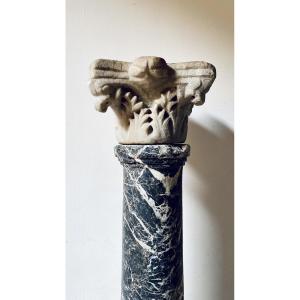
Corinthian Capital Roman Late Antiquity Marbre Visigoth Transition Paleochristian


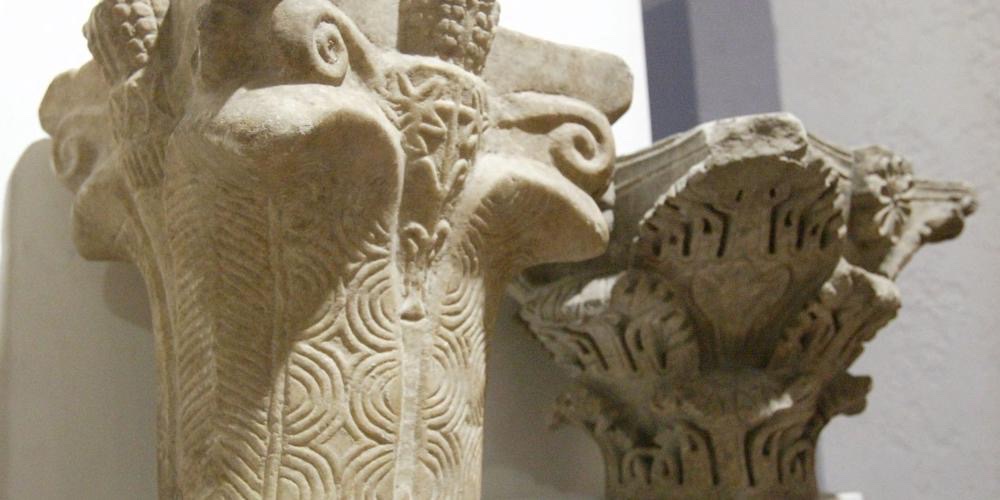

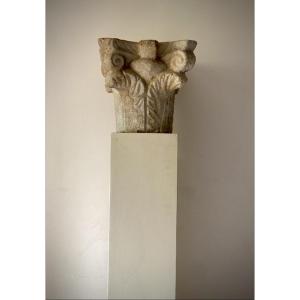


Corinthianizing capital, late Roman (Late Antiquity) - Early Christian Aquitanian tradition
VIth - VIIIth century (probable late IVth-VIth century heritage)
Height: 29 cm
Diagonal: 40 cm
Sculpted chapiteau belonging to the body of Late Antique production in southwest Aquitaine, where the Roman architectural tradition was maintained and gradually transformed.
The object features a decorative organization inherited from the ancient Corinthian vocabulary, but entirely recomposed in a late-period language: the leaves are schematized, the volumes flattened, and the ornamental rhythm becomes concise. This simplification is not a loss, but a stylistic recomposition specific to the workshops of the late Roman Empire and its regional extensions.
The capital belongs to a homogeneous group known as: "Aquitanian late Roman with stylized Corinthian survival"
Historical significance:This capital is a direct witness to the transition between the Roman world and the early Middle Ages, it is not the result of an abrupt stylistic break, but of technical continuity in late Gallo-Roman workshops, it illustrates the persistence of Roman architectural language in Christianized Aquitanian territories, it
belongs to the phase of gradual transformation towards early regional Romanesque art.
This type of production is fundamental to understanding the survival of the Roman model after the political disintegration of the Empire in the West.
ComparisonsDirect approaches with:
Chapiteaux from Saint-Vincent-de-Xaintes (Dax)
Paleochristian group from Dax and Chalosse
Late-Antique ensembles from inner Aquitaine (Landes/Pyrenean foothills)
Corinthian-surviving productions from late Gallo-Roman workshops
-probably : Southwest Gaul, Aquitaine area,Landes / Dax / bassin de l'Adoux, Primitive ecclesiastical context or architectural replacement
- Galerie Chenel Paris ( circa 2018)
- Art market sell in 2024
Good condition
This capital is a significant testimony to the long duration of Roman architectural language in Late Antique Aquitaine. It illustrates the gradual transformation of ancient models into a simplified, yet structurally faithful, repertoire that prefigures the decorative forms of early regional Romanesque art.
Its value lies less in its monumentality than in its historical significance: that of a hinge-object between the late Roman world and the birth of medieval Europe.
Explore similar pieces and discover your ideal find:
archeology