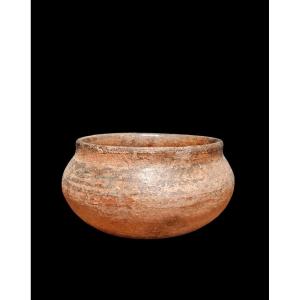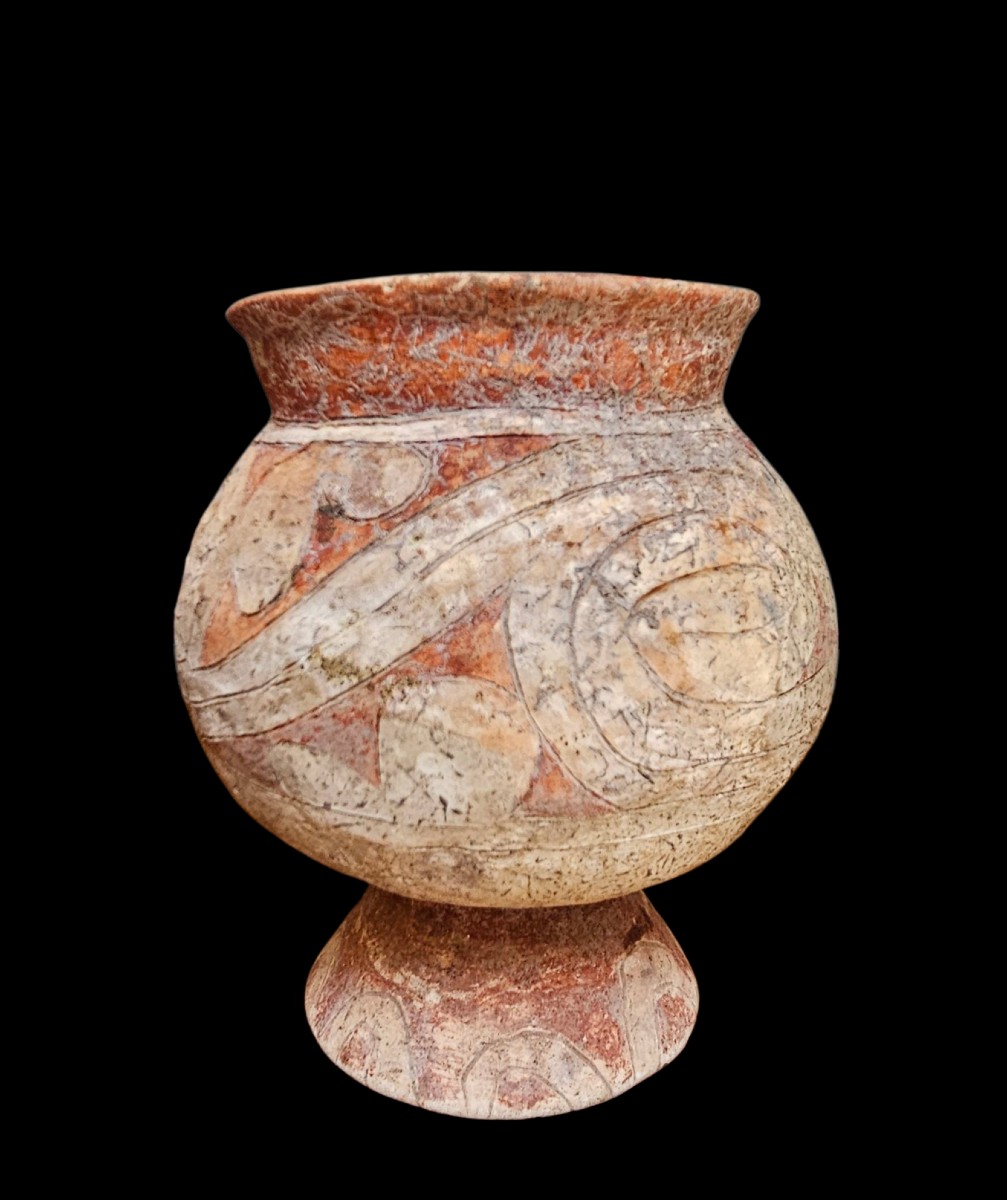


Ban Chiang Vase, Thailand (udon Thani Province) Dating: 1000 – 300 Bc.
Vase resting on a conical, hemispherical foot, surmounted by wide, flat lips, slightly hemmed at their ends. The body is decorated with incised motifs in volutes, discoidal arcs of circles and sinuous lines, in dynamic registers. Beige terracotta, localized coffee-red slip, traces of manganese oxide, and calcareous concretion. Ban Chiang, Thailand (Udon Thani province) Date: 1000 – 300 BC Dimensions: 15.8 × 13 cm Publication: Metropolitan Museum of Art, New York, inv. 1979.254.3 (near example with incised decoration) Provenance: Former collection of a geographer from the south of France, constituted in the 1960s–1970s Context: The Ban Chiang culture, developed in the Udon Thani region between 3600 and 250 BC. BC, is considered one of the oldest Neolithic centers in Southeast Asia. The ceramics of the early phase (1000–300 BC) are distinguished by the use of incision before the widespread use of painted decorations. This vase illustrates this rare decorative tradition, with engraved motifs enhanced with a partial red slip, on a classic pedestal form of funerary production. This type with incised decoration, less common than the spiral-painted vases, occupies a unique place in the Ban Chiang corpus due to its archaism and graphic refinement. Sold with a certificate from the expert Serge Reynes and an invoice from Galerie Ocarina.* Shipping costs on estimate.
850 €
Period: Before 16th century
Style: Asian art
Condition: Good condition
Material: Terracotta
Diameter: 13 cm
Height: 15,8 cm
Reference (ID): 1609481
Availability: In stock
Print