



Tang Dynasty Court Lady Statuette – Certificate Of Authenticity And Qed Test
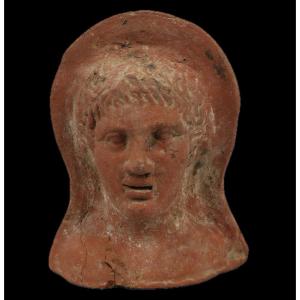
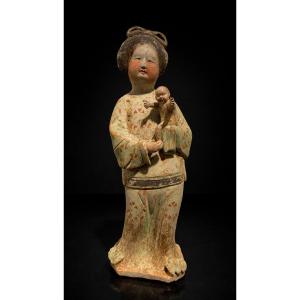
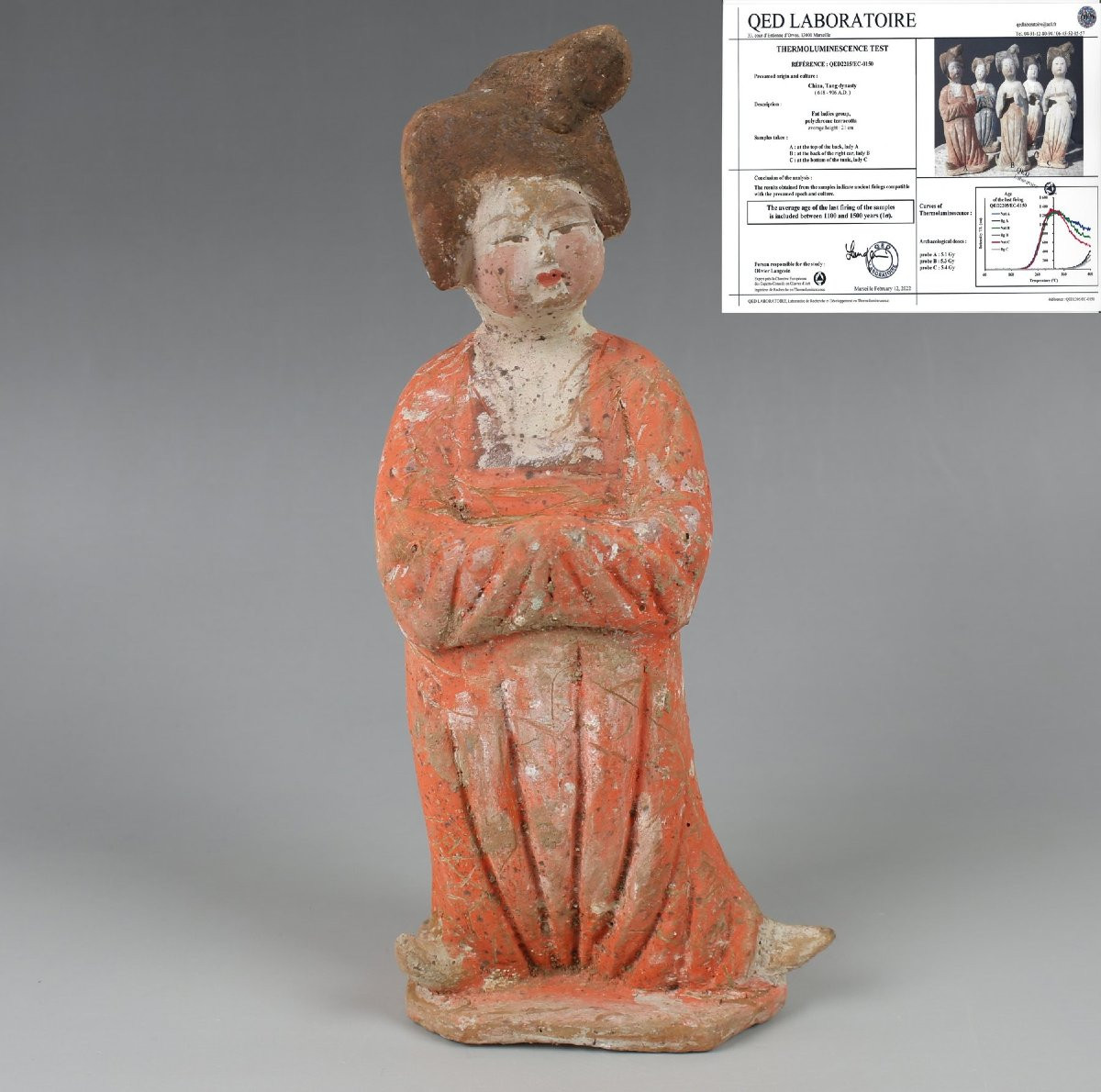
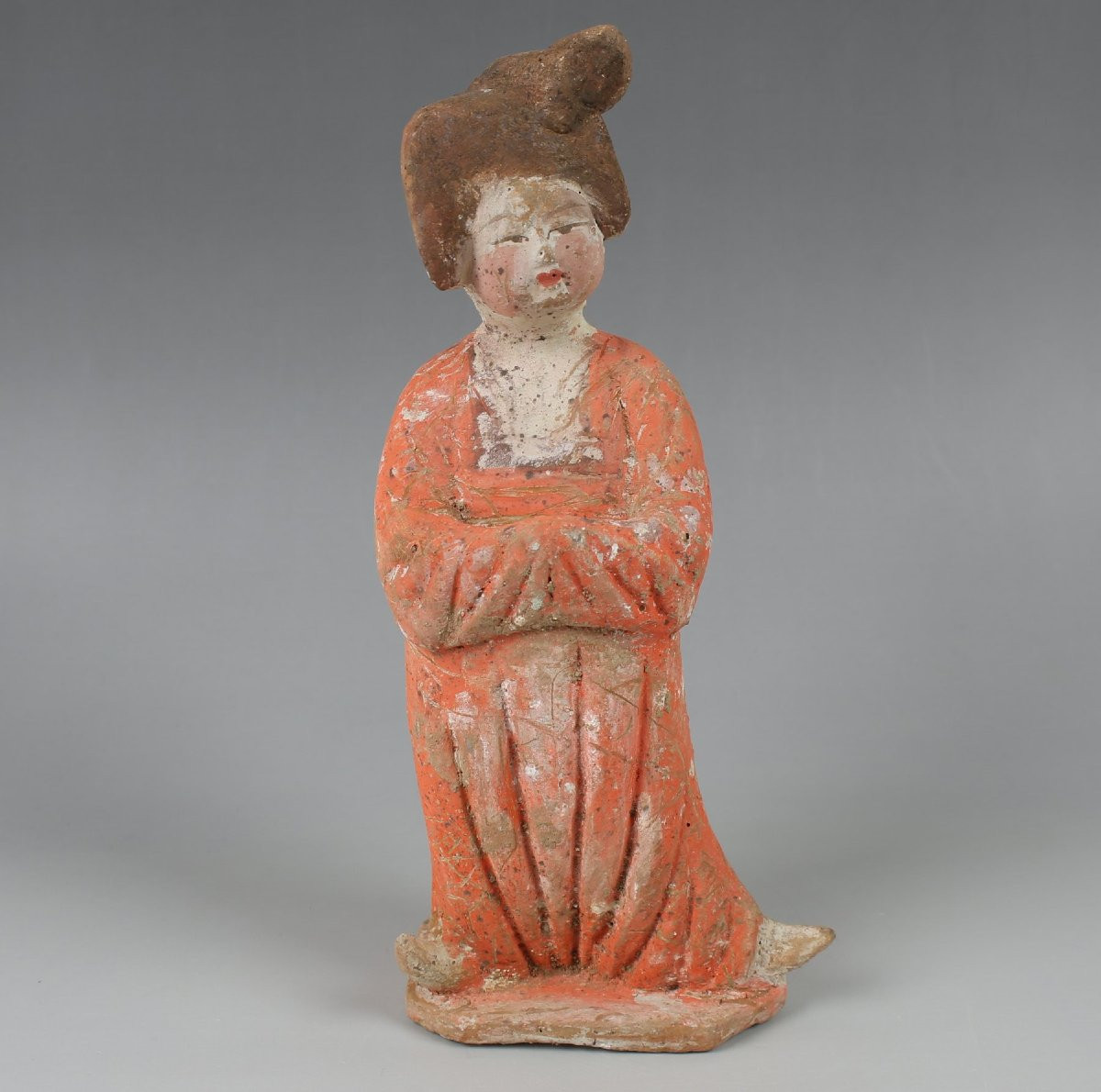
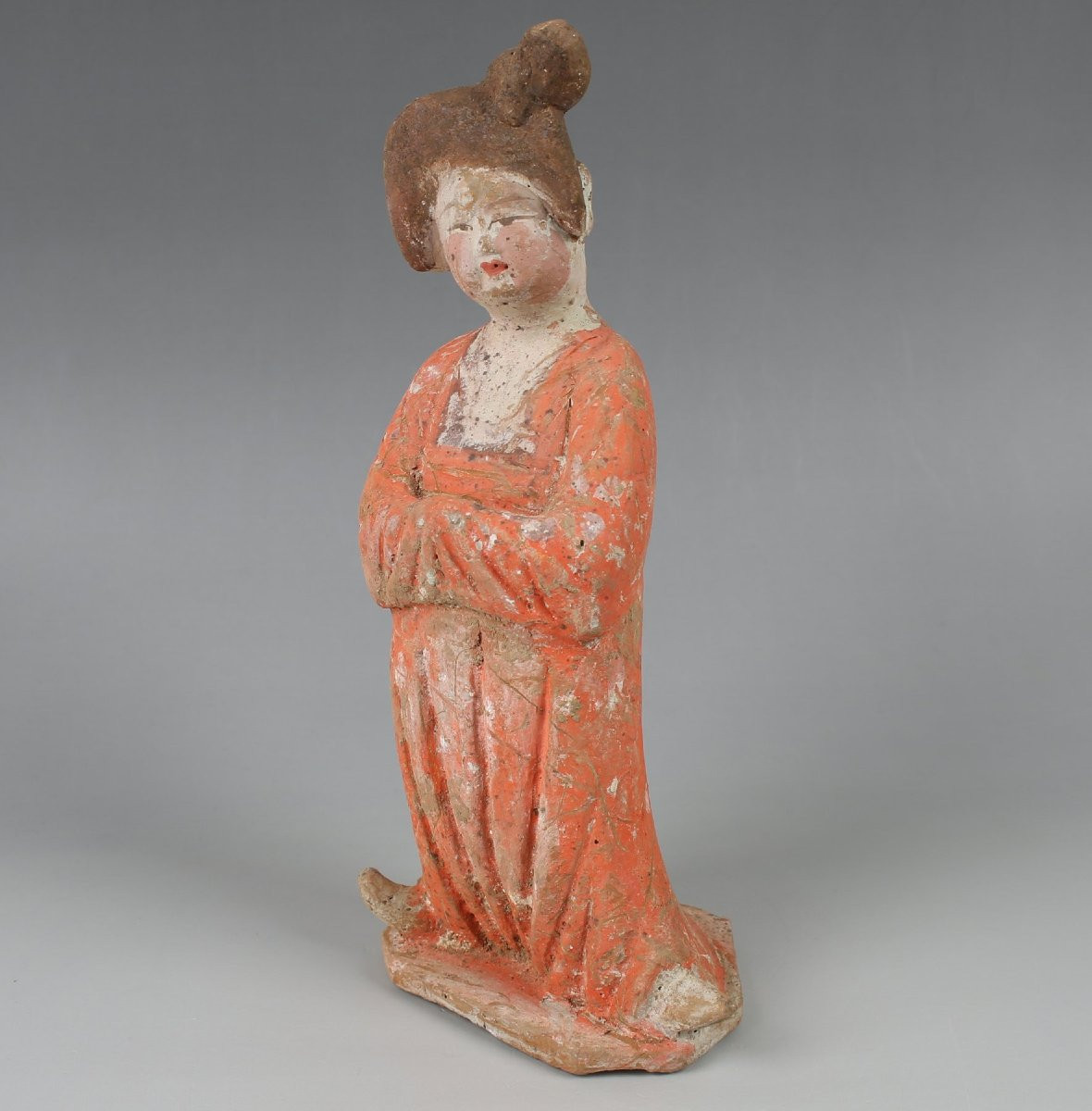
This terracotta statuette of a Tang dynasty court lady is an excellent example of the renowned funerary “Fat Ladies.” Her full and rounded silhouette, serene posture, broad calm face and ample robe reflect the refined aesthetic of the Tang elite. The harmonious proportions, smooth modelling and gentle expression align closely with the finest types of the period.
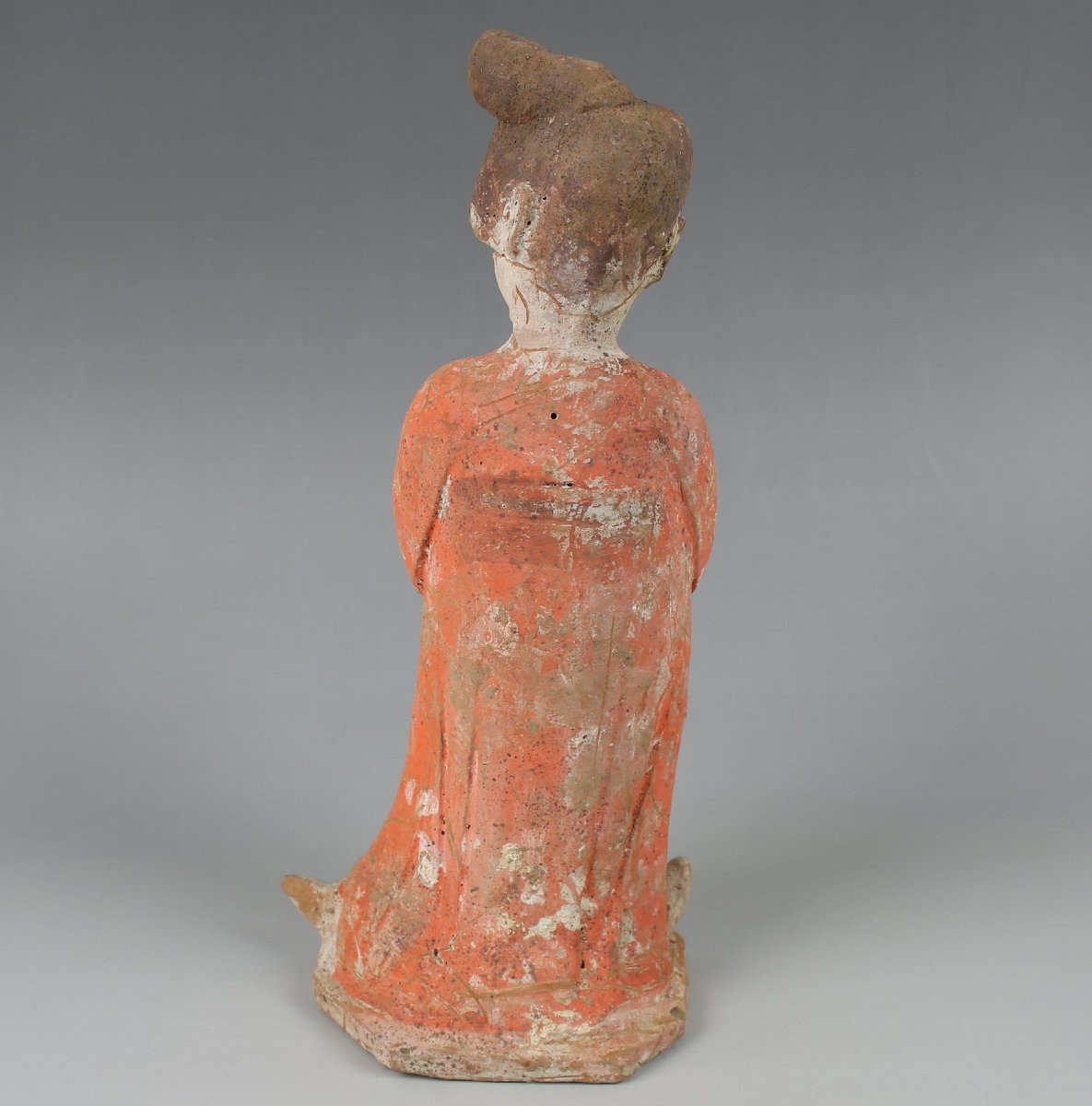
The matte, homogeneous patina shows natural age-related wear: softened ridges, small abrasions on exposed points (coiffure top, nose, base edges), and a lighter clay visible beneath the surface layer. Remnants of ancient polychromy—slight reddish or ochre tones preserved in folds and recesses—correspond to what is expected from a sculpture long buried in a funerary context.
Restorations noted by the previous owner appear discrete and minimal. Slightly smoother transitions or faintly different tones in small areas indicate respectful touch-ups, with no heavy repaint or over-modelling. The statuette retains its full authenticity and visual coherence.
Combined with a thermoluminescence test from QED Laboratory (ref. QED2205/EC-0150), long-standing Spanish provenance and parallels in major collections such as the National Palace Museum in Taipei, the statuette presents itself as a genuine and above-average example for this category.
CharacteristicsObject: Funerary statuette of a Tang court lady (“Fat Lady”)
Material: Terracotta
Culture: Chinese
Period: Tang Dynasty (AD 618–907)
Dimensions: approx. 210 × 95 mm
Condition: Good overall; minor restorations, stable surface, natural wear consistent with age
Provenance: Former Spanish private collection (1980–2020)
Documents included:
– Certificate of authenticity
– Thermoluminescence test (QED, ref. QED2205/EC-0150)
– Export licence for destinations outside the EU (when required)
Tang court lady figurines belong to the broader category of mingqi, funerary substitutes placed in tombs to accompany the deceased in the afterlife. During the Tang dynasty—an era of prosperity, cosmopolitanism and artistic excellence—the ideal of beauty celebrated full, rounded silhouettes, calm expressions and high coiffures. These elegant figures evoke the luxurious life of the aristocracy, projecting grace, music, refinement and social standing into eternity.
“Fat Lady” figurines, sometimes linked in tradition to the celebrated imperial consort Yang Guifei, embody the Tang fascination for opulence, fullness and sensuality. Comparable examples preserved at the National Palace Museum of Taipei illustrate this iconic funerary aesthetic, to which the present piece fully belongs.
Formal & Material Analysis 1. Silhouette & postureThe figure stands upright on a small rectangular base softened by time. The compact, centered volumes convey serenity and restraint, characteristic of Tang court imagery. The hands brought forward or against the torso express a composed and respectful attitude.
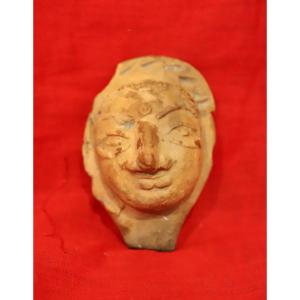
2. Head, expression & coiffureRounded face, soft features, almond-shaped eyes, small mouth and full cheeks define the Tang ideal.
The high coiffure is voluminous and structured, showing natural abrasions on its ridges and preserved darker tones in deeper recesses.
The long robe, treated in wide vertical planes, shows smooth volumes and lightly marked folds. Traces of ancient ochre pigments remain in creases, while exposed reliefs show gentle patination.
4. Surface, patina & restorationsMatte patina, slight granulation, subtle micro-cracks characteristic of ancient terracotta.
Restorations are minimal: small filled chips or carefully blended areas, without repainting large sections or disrupting the original modelling.
Historical value: Reflects the feminine ideals, social codes and court culture of the Tang empire.
Aesthetic value: Balanced silhouette, serene expression, elegant presence in display.
Documentary value: Exemplifies the role of mingqi in Tang funerary practices.
Collecting value: Strong provenance, TL test, and relevant museum parallels make it a secure and desirable acquisition.
– Former Spanish private collection (1980–2020)
– QED thermoluminescence test included
– Certificate of authenticity
– Export licence available for non-EU destinations (when applicable)
The following payment methods are available:
• Cheque
Shipment takes place only after the cheque has fully cleared.
• Bank transfer
Bank details will be provided upon confirmation of your choice.
• Credit card
A secure payment link will be sent to complete the transaction safely.
Please contact us with your preferred payment method so we may provide the necessary information and organise the next steps smoothly.
Period: Before 16th century
Style: Asian art
Condition: Good condition
Reference (ID): 1695540
Availability: In stock