Vandal Nummus Of Thrasamund — Certificate Of Authenticity
Small bronze (Æ) of the Vandal Kingdom, attributed to the reign of Thrasamund (AD 496–523) and to the mint of Carthage: a rare module of everyday circulation, sought after for its historical interest (Vandal Africa) and for the intrinsic difficulty of assembling these very small bronzes with a typology that remains readable.
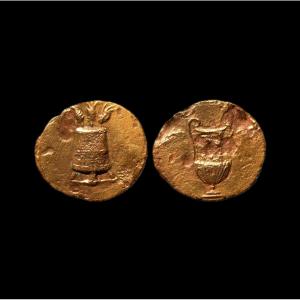
Analysis & expertiseCareful observation under ×10 magnification and raking light: close examination of both sides highlights a very small bronze on an irregular flan, with a compact gray-black dominant patina, featuring broad areas of light encrustations (concretions/mineral deposits) that partially mask the reading of the reliefs. The fields show a heterogeneous texture, alternating smoother sectors and more granular areas, typical of an ancient small module that experienced prolonged circulation and subsequent burial. The edge is naturally irregular, without a perfectly uniform beaded rim, consistent with ancient hammer striking; within the strict limits of what the image allows to establish, the iconographic organization remains coherent with a Vandal nummus of Carthage.
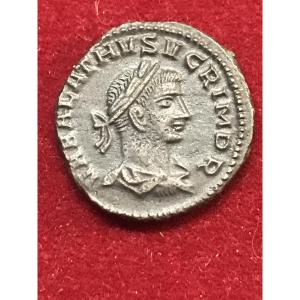
ObverseThe obverse matches the stated type: bust right. Despite the surface condition, the general silhouette (head/nape/shoulder) remains perceptible; under raking light, a suggested profile (forehead–nose–chin) can be made out, along with a very stylized mass of hair/ornamentation, consistent with the aesthetic of Vandal small bronzes. The peripheral legend is not continuously legible on this specimen, which is common on this module (≈10 mm), where centering, wear, and encrustations quickly efface the epigraphy.
ReverseThe reverse shows a standing figure left, attributable to Victory by the general posture and orientation. Fine attributes (wreath, palm, wing details) are partly obscured by the deposits, but the structure “isolated figure + left orientation” remains identifiable. Within the strict limits of observation, this composition remains consistent with the “standing Victory” type recorded for Thrasamund at Carthage.
CharacteristicsAuthority: Vandal Kingdom — Thrasamund (496–523).
Mint: Carthage.
Denomination: Nummus (Æ).
Obverse: bust right.
Reverse: Victory standing left.
Weight: 0.92 g.
Diameter: 10 mm.
Axis: 9h.
References (cross bibliography): MEC 19–20 ; BMC Vandals pl. 3, 14 ; Ladich p. 36, 6.
Rarity: Rare.
Historical contextUnder Thrasamund, the Vandal kingdom of North Africa maintained a production of small bronzes intended for everyday transactions. Victory iconography belongs to a visual continuity inherited from Roman tradition: it retains a language immediately legible to the economic circuits of Carthage, while adapting it to very reduced modules typical of Late Antiquity. These nummi thus constitute direct testimony to monetary life in Vandal Africa, at the hinge between imperial inheritances and post-Roman powers.
Cultural valueFor a collector, this nummus concentrates several enduring attractions:
a genuinely “circulating” module (≈10 mm), often underrepresented in sets yet historically fundamental;
a strong geographic anchoring (Carthage) and a precise dynastic attribution (Thrasamund, 496–523);
a Victory typology, a Roman legacy that can be immediately contextualized in a “Late Antiquity / barbarian kingdoms” display, with a rarity generally recognized for this module.
In accordance with our practices, each specimen is examined, described, and accompanied by a certificate of authenticity consistent with the standards of the art and heritage market; the study is conducted with careful observation under ×10 magnification and raking light, and is based on typological, stylistic, and metrological coherence, as well as confrontation with corpus references (MEC, BMC, Ladich).
The coin is offered with a professional European provenance; the acquisition falls within a specialized international transaction, carried out within a recognized numismatic network and validated by expertise, according to practices applicable to heritage objects.
Careful, secure, and traceable shipping, with protective packaging adapted to small modules, insurance, and delivery against signature depending on destination (France / international). The exact terms are confirmed at the time of order according to the delivery address.
Period: Before 16th century
Style: Rome and Antic Greece
Condition: Good condition
Reference (ID): 1715901
Availability: In stock