


Hadrian Ric Ii.3 114 — Certificate Of Authenticity
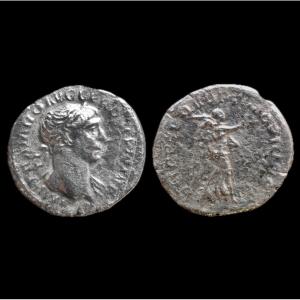
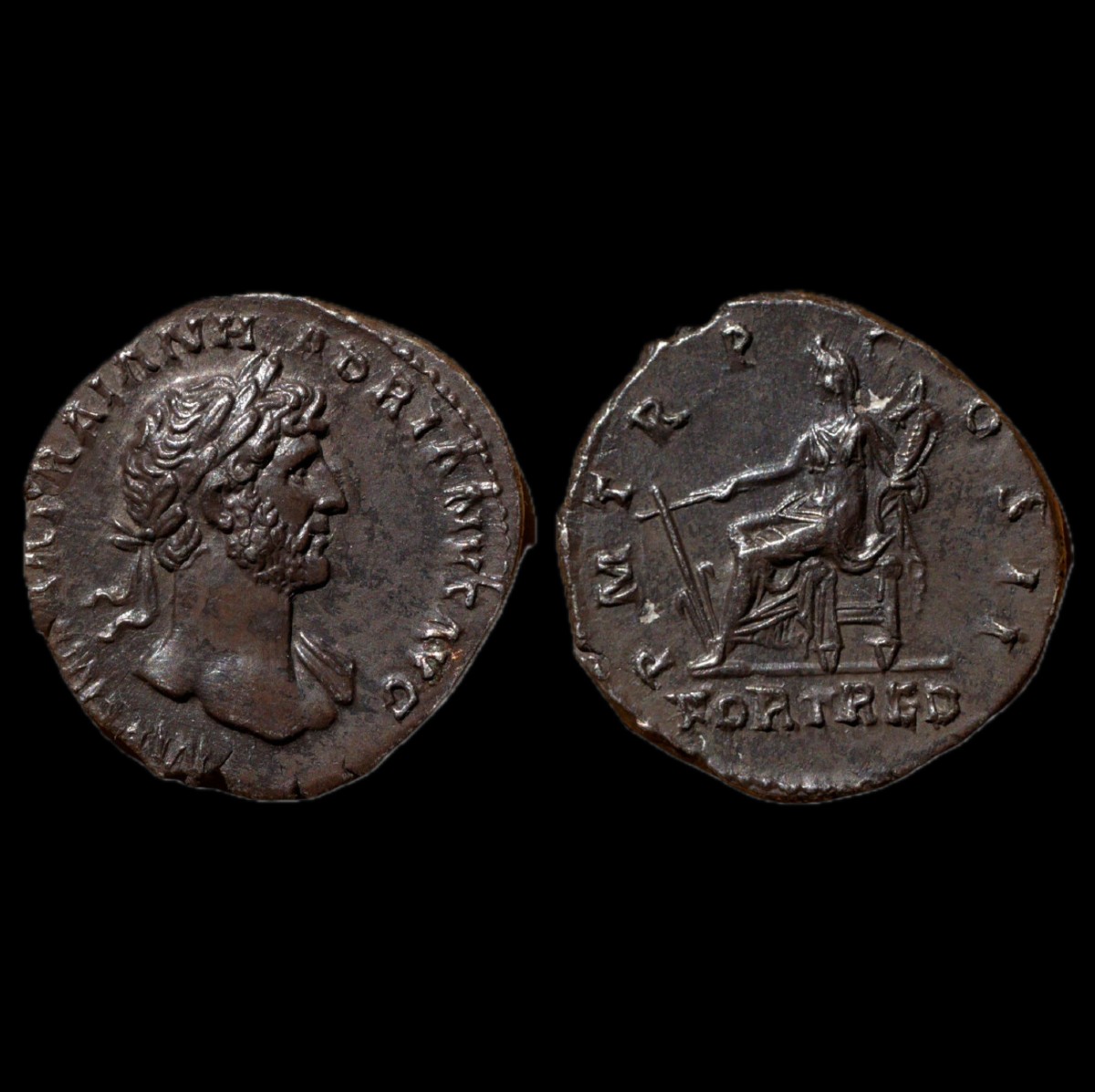
This silver denarius of Hadrian, struck at Rome and attributed to the FORT RED type classified as RIC II.3, 114, belongs to an issue from the first period of the reign, commonly placed in AD 118, with on the obverse IMP CAESAR TRAIAN HADRIANVS AVG around a laureate bust turned right, and on the reverse a Fortuna seated left, holding a rudder and a cornucopia; the examined specimen, at 3.07 g for 18 mm, fits with very fine coherence within the documented parameters for this number, public references publishing for the type a diameter around 18–18.5 mm and a weight around 3.0–3.2 g. Each specimen is examined, described, and accompanied by a certificate of authenticity in accordance with the standards of the art and heritage market.
Analysis & Expertise
Close observation under ×10 magnification and raking light. The obverse presents a laureate portrait of Hadrian right of particularly satisfactory stylistic quality, with hair rendered in tight, supple locks, a laurel wreath clearly readable in its spread, a broad forehead, a distinctly open eye, a firm nasal line, a well-drawn mouth, and a solidly constructed chin, while one can still discern, in accordance with the type definition, traces of drapery on the far shoulder; the peripheral legend remains largely preserved, and the beaded border, still well followed around most of the circumference, gives the obverse a very balanced cabinet presence. The canonical description of this number retains precisely a laureate bust, bare chest, with the usual traces of drapery on the far shoulder, turned right.
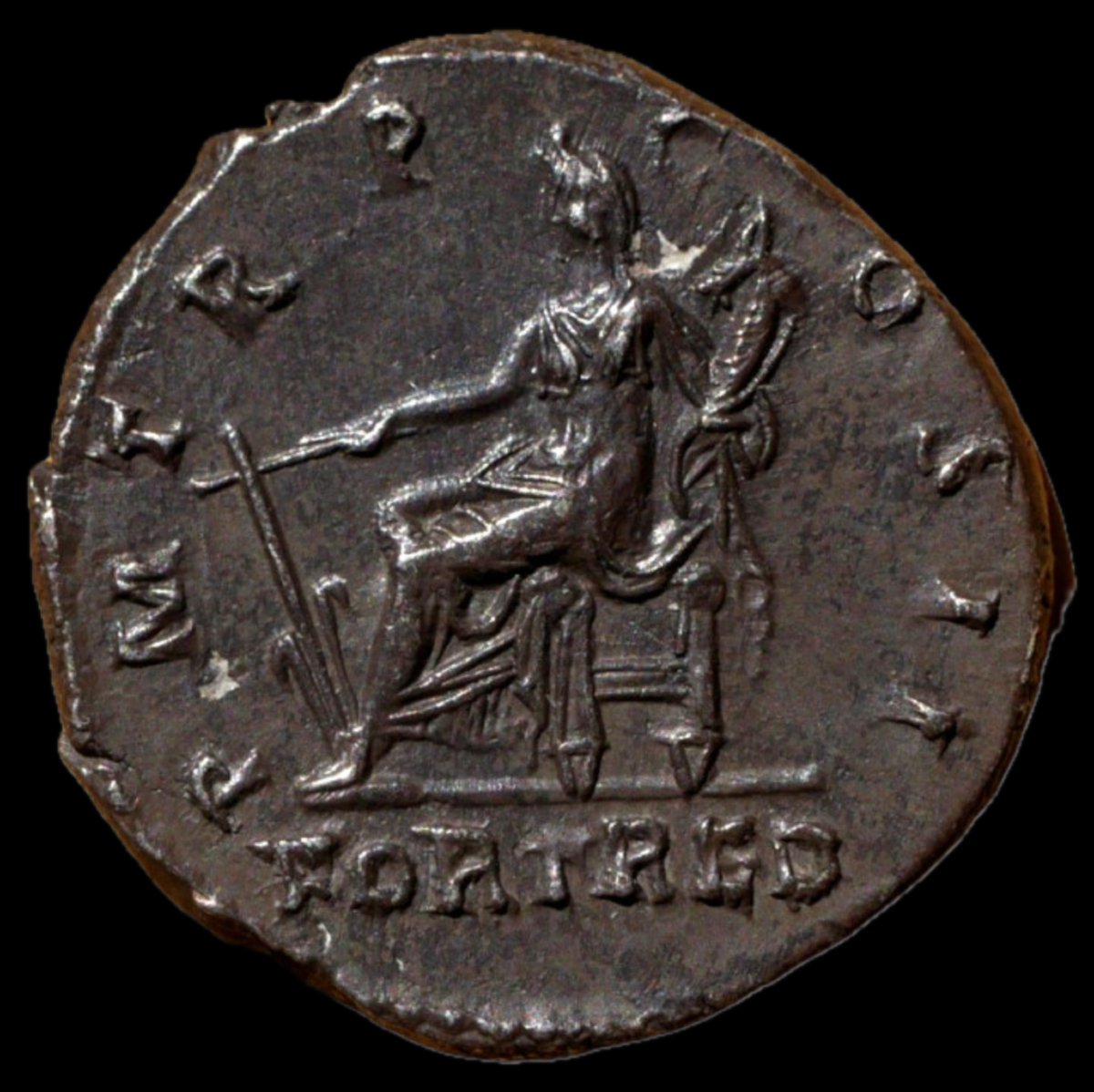
The reverse retains very secure typological readability, with a Fortuna seated left, holding in the right hand a rudder and in the left a cornucopia, according to a composition highly characteristic of the FORT RED type; the goddess’ silhouette remains clearly intelligible, the seat remains perceptible in its structure, and the general economy of the field accords without difficulty with the definition published for RIC II.3, 114. Even when the exergue does not present itself in full sharpness, the observed iconography, together with the titulature and general style, remains fully concordant with the Fortuna Redux family described by the corpora.
Material examination reveals an irregular round flan, consistent with hammer striking, with an ancient silver surface, relief still crisp on the high points of both portrait and reverse, and slight marginal irregularities perfectly compatible with ancient manufacturing technique; the coin as a whole retains very fine visual homogeneity, with no break in reading of the types, and a convincing balance between portrait quality, reverse-scene legibility, and peripheral steadiness. Numista further records this number as an irregular round coin struck by hammer, with a rarity index of 94, allowing it to be presented with justification as a type sought after by collectors of early Hadrianic coinage.
Characteristics
This is a silver denarius of Hadrian, struck at Rome, within the group dated to AD 118, with a recorded weight of 3.07 g and a diameter of 18 mm; the obverse bears the titulature IMP CAESAR TRAIAN HADRIANVS AVG, with laureate bust right and slight drapery on the far shoulder, while the reverse corresponds to the type P M TR P COS II / FORT RED, with Fortuna seated left holding a rudder and a cornucopia. The principal bibliographic attribution is to RIC II.3, 114, with the OCRE reference ric.2_3(2).hdn.114; museum and specialized references give comparable measurements for the same type, notably 18 mm / 3.0 g at the London Museum and 18.5 mm / 3.2 g in the Numista catalogue.
Historical context
This issue belongs to the first years of Hadrian’s principate, when the titulature P M TR P COS II still places the coin within the initial phase of his imperial assertion; the reverse FORT RED refers to Fortuna Redux, i.e., the Fortune who brings one safely home, a distinctly Roman formulation of protection and the prince’s fortunate return. Reference documentation explicitly translates FORT RED as Fortuna Redux and places this Rome type within the horizon of AD 118, giving it a very precise position in the iconographic construction of the early reign.
The choice of Fortuna seated with rudder and cornucopia here carries strong political density, for it unites the idea of provident guidance and that of public abundance in a form of great sobriety; the type thus differs from later issues of the reign by a still highly concentrated formulation, where the allegorical figure alone suffices to carry the message of stability and good government. This articulation between early titulature, the Rome mint, and an allegory of happy return is among the most legible traits of Hadrian’s first coinage.
Cultural value
The cultural interest of this piece lies in the quality with which it concentrates, within a small silver module, an early Hadrianic portrait, a very secure typological reference, and a Fortuna Redux reverse of excellent doctrinal legibility; it is a denarius whose value lies not only in its bibliographic classification but in the clarity with which it expresses, from the very first years of the reign, the imperial rhetoric of return, guidance, and prosperity.
For the knowledgeable collector, this number has particular appeal because it combines a recognized type, a very attractive portrait, sound metrology, and a reverse emblematic of the reign’s beginning; the relative rarity recorded in current surveys further strengthens the type’s interest without removing it from a perfectly stable interpretive framework—often the most sought-after balance in a collection of second-century imperial denarii.
Traceability & Guarantees
From a European provenance, from an established numismatic dealer, this specimen was acquired through a specialized international transaction conducted within a recognized numismatic network and validated by reference experts, according to the highest standards of the art and heritage market; examination of the present object retains exclusively the stylistic, technical, epigraphic, and metrological characteristics effectively observable, set within the framework of the type Hadrian / Fortuna Redux / RIC II.3, 114 and compared against the dossier’s public references.
The concordance between the obverse IMP CAESAR TRAIAN HADRIANVS AVG, the laureate bust with slight drapery on the far shoulder, the reverse with Fortuna seated holding rudder and cornucopia, the Rome mint, the AD 118 dating, the observed metrology, and the attribution to RIC II.3, 114 establishes here a particularly solid numismatic identification, formulated within a framework of strict descriptive exactitude and fully suited to a knowledgeable collecting audience.
Period: Before 16th century
Style: Rome and Antic Greece
Condition: Good condition
Reference (ID): 1730294
Availability: In stock