

Geta As Caesar — Denarius Princ Ivventvtis — Certificate Of Authenticity
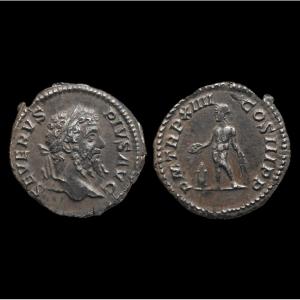
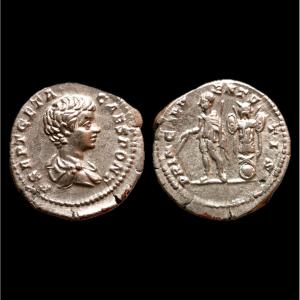
This denarius of Geta as Caesar, struck at Rome within the horizon AD 200–202, belongs to a Severan type of high doctrinal legibility, immediately identified by the obverse P SEPT GETA CAES PONT and by the reverse PRINC IVVENTVTIS, where the young prince appears in military dress before a trophy; the attribution to RIC IV.1, 18 accords with the available typological documentation, notably Numista/OCRE and the British Museum, which record this type as a Rome silver denarius from Geta’s early Caesarian phase. Each specimen is examined, described, and accompanied by a certificate of authenticity in accordance with the standards of the art and heritage market, and the present specimen offers, at 3.20 g for 19 mm, metrology fully consistent with the observed range for this issue.
Analysis & Expertise
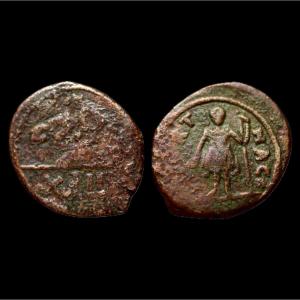
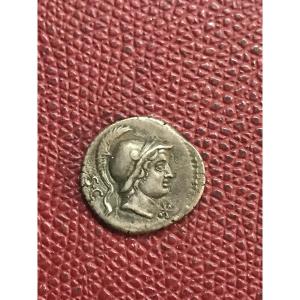
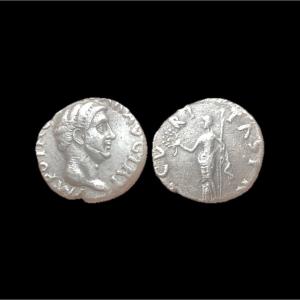
Close observation under ×10 magnification and raking light. The obverse presents a bare-headed and draped bust of Geta right whose stylistic construction remains particularly sharp for this issue, with short, dense hair arranged in firm locks, a regular forehead, a well-opened eye, a frank nasal line, a finely marked mouth, and a youthful chin still well held, while the drapery at the base of the neck remains clearly readable; the beaded border is followed very largely, the titulature unfolds with sustained legibility, and the strike appears well seated on the flan, giving the obverse a very satisfactory cabinet presence.
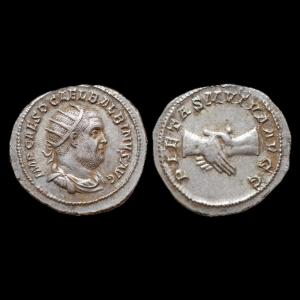
The reverse retains particularly convincing typological presence, as Geta appears standing left in military dress, holding in the right hand a branch or comparable attribute, and in the left a vertical spear, with behind him a trophy clearly legible in its essential form, at whose foot the structure of the shield can still be perceived; the legend PRINC IVVENTVTIS, distributed in sequences around the field, remains intelligible over a large part of the circumference, and the overall economy of the relief corresponds with great fidelity to the description retained by the British Museum, Numista, and specialized catalogues, all of which describe a type combining the young Caesar, military dress, the spear, and the trophy.
The silver surface presents a coherent ancient physiognomy, with relief remaining crisp on both the portrait and the reverse figure, fields showing the fine traces of an old material life without any break in reading of the type, and an irregular flan consistent with hammer striking; the small marginal tensions visible at the edge naturally follow the manufacturing logic of Rome Severan denarii and affect neither comprehension of the motif nor the coin’s overall balance. All observable characteristics—metal behavior, letter relief, border continuity, and relief organization—fully accord with the Roman series documented for RIC 18.
What favorably singularizes this specimen, in the eyes of the knowledgeable collector, lies in the combination of a very lively Caesar portrait, a broadly preserved obverse legend, an immediately identifiable PRINC IVVENTVTIS reverse, and metrology exactly compatible with published comparanda; the coin’s strength thus lies not only in bibliographic conformity, but in the clarity with which it still restores the political and iconographic function of this type.
Characteristics
Authority.
This issue belongs to Geta as Caesar, son of Septimius Severus, promoted to that rank in 198.
Mint.
Rome.
Dating.
The type is placed within AD 200–202 by Numista/OCRE, while the British Museum assigns it a very close framework, AD 199–204, securely situating the strike within Geta’s early Caesarian phase.
Denomination.
Denarius.
Metal.
Silver.
Weight.
3.20 g, fully within the published margins for the type.
Diameter.
19 mm, in agreement with the series’ reference data.
Obverse.
P SEPT GETA CAES PONT, bare-headed and draped bust right.
Reverse.
PRINC IVVENTVTIS, Geta standing left in military dress, holding a branch and a spear, with a trophy behind him.
Typological references.
Primary attribution to RIC IV.1, 18; the type is also published by the British Museum and is regularly compared, in specialist catalogues, to Cohen 157.
Historical context
This denarius belongs to the period when Geta, still Caesar, is integrated into the Severan dynastic system alongside Septimius Severus and Caracalla; biographical sources recall that he received the title of Caesar in 198, became Augustus in 209, and was eliminated in 211 amid the well-known context of fraternal rivalry. The coinage of this phase is therefore not merely “youth coinage,” but an instrument of dynastic visibility within a tightly structured succession framework.
Within this context, the reverse PRINC IVVENTVTIS carries a precise political meaning, presenting the young prince as “prince of the youth,” i.e., an exemplary heir already inserted into the vocabulary of command and military virtue; the trophy behind him further strengthens this reading by placing dynastic youth not within a decorative abstraction, but within a horizon of military value and public legitimacy.
Cultural value
The cultural interest of this piece is high, because it unites a princely portrait of early Severan style with a reverse formula whose meaning is immediately intelligible to the connoisseur; it is a denarius where the ideology of succession reads with rare clarity, without allegorical overload, through the sole presence of the young Caesar in military dress before the trophy. This doctrinal sobriety—deeply Roman—is precisely what gives this type its collecting strength.
For a cabinet oriented toward the Severans, Caesarian portraits, or PRINC IVVENTVTIS series, this specimen offers a particularly solid entry point, combining legibility, typological conformity, crisp style, and full material coherence; it therefore naturally addresses a knowledgeable collecting audience, sensitive both to the coin’s dynastic logic and to the flan’s concrete quality.
Traceability & Guarantees
From a European provenance, from an established numismatic dealer, this specimen was acquired through a specialized international transaction conducted within a recognized numismatic network and validated by reference experts, in accordance with the highest standards of the art and heritage market; examination of the present object retains only the stylistic, technical, epigraphic, and metrological characteristics effectively observable, set within the framework of recognized references for Roman imperial coinage.
Each specimen is examined, described, and accompanied by a certificate of authenticity in accordance with the standards of the art and heritage market; in the present case, the concordance between the obverse P SEPT GETA CAES PONT, the PRINC IVVENTVTIS reverse with Geta in military dress before a trophy, the Rome mint, the chronological window AD 200–202 / 199–204, the observed metrology, and the attribution to RIC IV.1 18 establishes a particularly solid numismatic identification.
Period: Before 16th century
Style: Rome and Antic Greece
Condition: Good condition
Reference (ID): 1730259
Availability: In stock