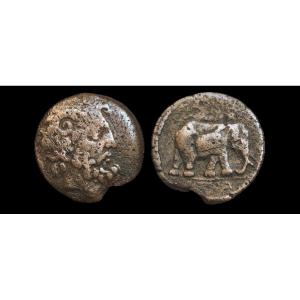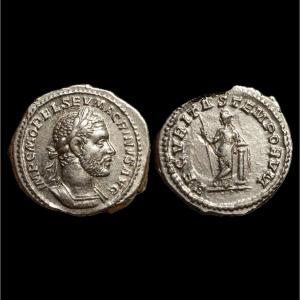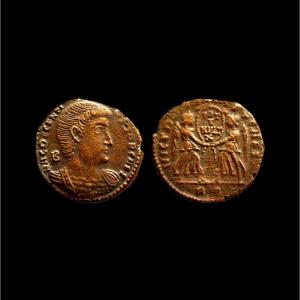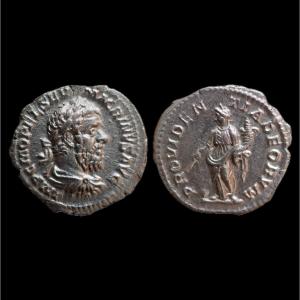


Rare Vandal 42 Nummi Of Carthage — Certificate Of Authenticity
This remarkable Vandal bronze of 42 nummi, attributed to Carthage and to the late phase of the urban coinage of the Vandal kingdom, belongs to a series immediately recognizable for its highly distinctive iconography, combining the legend KARTHAGO with a standing military figure and, on the reverse, a horse’s head above the value mark XLII; modern corpora classify it within the group MEC I 43–44, with attribution to the 523–533 coinage in the Carthage catalogues, while certain market attributions link it more specifically to the terminal phase of the kingdom under Gelimer, with reference to Hahn 22 / MIB 22. The type is moreover noted as sought-after, Numista assigning it a rarity index of 97, placing it among the late Vandal issues of strong typological personality and genuine collecting presence.
Each specimen is examined, described, and accompanied by a certificate of authenticity in accordance with the standards of the art and heritage market; this one is particularly notable for its large diameter of 26 mm and its weight of 11.27 g, both highly favorable for the series, in clear coherence with comparable specimens published around 11.53–11.54 g for 24–25 mm, giving the object a materially superior presence within the family of Vandal bronzes of Carthage.
Analysis & Expertise
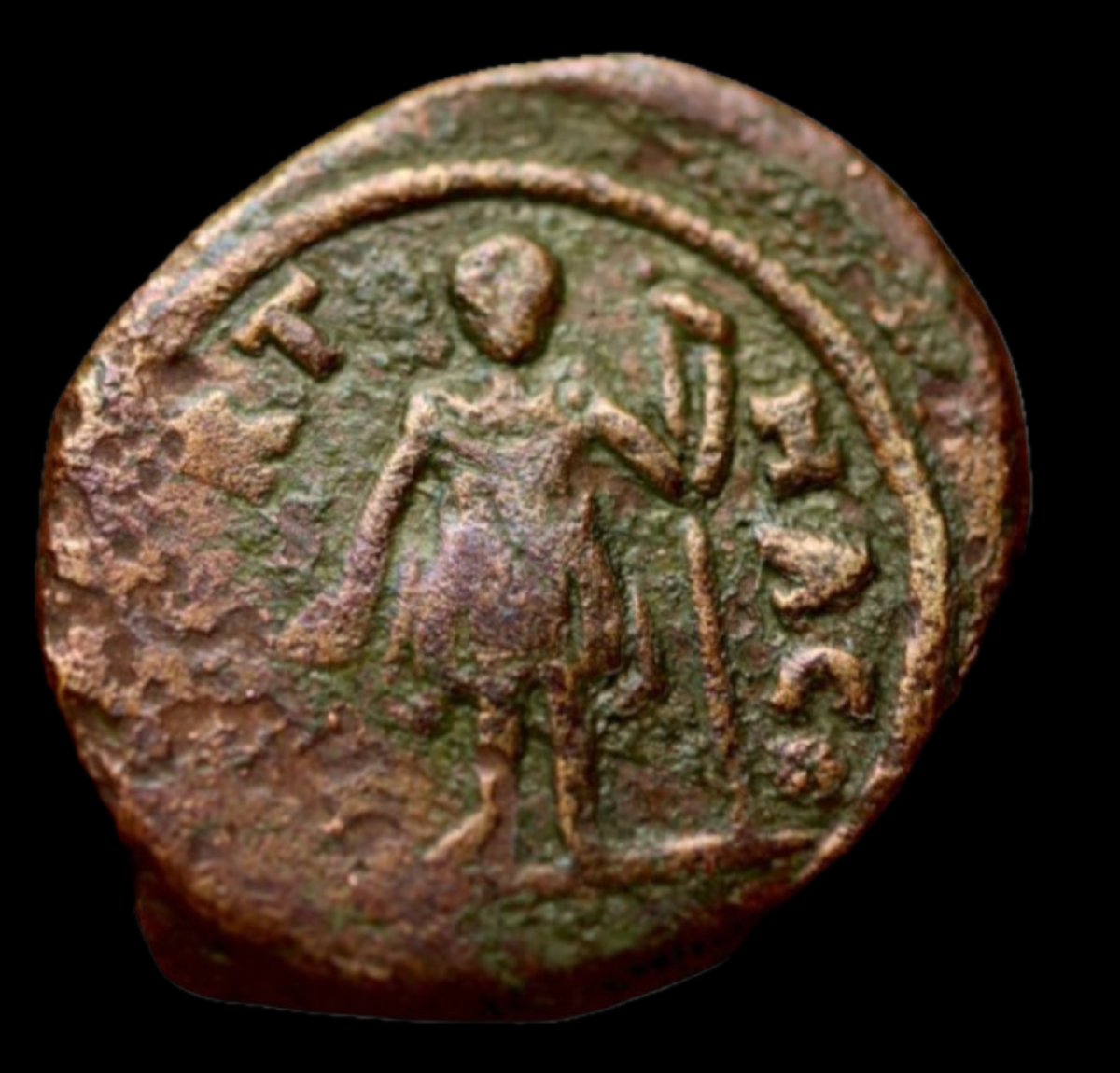
Close observation under ×10 magnification and raking light. Direct examination of the specimen shows, on the side bearing the legend KARTHAGO, a standing figure facing front, legible in its overall axis with a well-centered body, a free arm, and a spear clearly identifiable to the right of the main motif; despite ancient wear from circulation, the arrangement of the type remains immediately intelligible—an essential point for this issue, where preservation of the central silhouette largely determines the coin’s visual impact. The peripheral border can still be followed in places with continuity, the flan’s curvature remains regular, and the peripheral legend, though partially smoothed, retains enough elements to support without hesitation the reading of Carthage’s name.
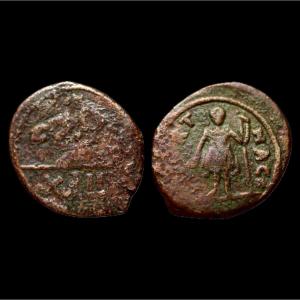
On the horse side, the equine head turned left is recognizable with strong reading authority, the line of the muzzle and neck still standing out above a clearly perceptible ground line; below, the value XLII appears firmly enough to fully confirm the denomination, and it is precisely this articulation between civic emblem and value mark that gives the piece its immediately collectible character. The reverse as a whole thus retains convincing structural legibility, particularly appreciable for a Vandal bronze that saw effective circulation.
The surface displays an old copper-brown and dark-green patina, with stable mineral deposits lodged in the recesses, a slight field granularity consistent with the metal’s age, and relief that still catches the light in the best-preserved areas; the irregular edges, natural relief transitions, and the absence of a continuous peripheral line accord with an ancient hammer strike, while the overall appearance of the metal fully matches the expected physiognomy of a large late bronze from Carthage. This ancient materiality, far from weakening the object, on the contrary lends it a tangible archaeological presence, particularly sought after in African Vandal coinage.
The numismatic interest of this specimen lies precisely in the conjunction of several qualities rarely combined with such balance in this series: a generous module, a readable XLII value, an intelligible Carthage figure, and a well-individualized horse’s head; the result is a collector’s coin that does not merely illustrate a bibliographic reference, but still preserves, in its very substance, the emblematic force of its issue.
Characteristics
Authority
This coin belongs to the Vandal coinage of Carthage, in the late phase of the Vandal city; catalogues place it within the 523–533 horizon, while certain specialized commercial attributions link it to the reign of Gelimer.
Mint
The mint is Carthage, an attribution explicitly given by the catalogues and confirmed by the type legend KART HAGO / KARTHAGO.
Dating
The type is classified by Numista and by specialized sale catalogues within 523–533, within the late Vandal municipal coinage of Carthage.
Denomination
This is a 42 nummi, a value explicitly stated by the exergual mark XLII.
Metal
The metal is bronze, in accordance with the standard numismatic repertories for this issue.
Weight
The observed weight for this specimen is 11.27 g, a very satisfactory figure for the group and particularly aligned with published comparanda around 11.53 g and 11.54 g.
Diameter
The observed diameter is 26 mm, a generous and highly enhancing format for the series.
Obverse
The obverse shows KARTHAGO around a standing soldier holding a spear, according to the description retained by the catalogues.
Reverse
The reverse shows a horse’s head above XLII, an emblematic Carthaginian type within this monetary group.
Typological references
The concordance is established with MEC I 43–44; catalogues also associate BMC Vandals 10–13, and certain specialized market attributions refer to Hahn 22 / MIB 22 under Gelimer.
Rarity
The type may legitimately be presented as rare, Numista assigning it a rarity index of 97, while specialized sale catalogues describe it as scarce.
Historical Context
This issue belongs to the last major sequence of African Vandal bronze, when Carthage remained the monetary center of the Vandal kingdom and maintained, through its civic types, a strong urban identity; catalogues indeed distinguish a late series of 42 nummi attributed to the Vandal city of Carthage between 523 and 533, just before the kingdom’s political disappearance.
The chosen iconography is particularly eloquent, for the old symbol of the horse remains central, and the British Museum catalogue already noted that the horse’s head should be understood as an emblem of Carthage; the other side, showing a figure in military dress, was likewise interpreted in this scholarly tradition as the image of a Vandal soldier, or more broadly of a warlike authority associated with the city. This visual condensation of city, armed force, and monetary value gives the object exceptional historical density for a circulating bronze.
Cultural Value
The cultural value of this piece is very real, because it unites in a single object three major legacies of ancient Africa: the memory of Carthage, Vandal sovereignty, and the persistence of an immediately legible iconographic language; the civic legend, the horse’s head, and the value mark together form a type of great visual force, speaking at once of urban identity, monetary continuity, and power.
For the collector, such a 42 nummi offers a singular appeal, because it belongs to those coins where a small number of signs in no way impoverishes the message, but concentrates it: here, everything is tightened, everything is emblematic, everything is immediately evocative—and it is precisely this economy of means, so characteristic of late Vandal coinage, that gives the piece its sober nobility and cabinet presence.
Traceability & Guarantees
From a European provenance, from an established numismatic dealer, this specimen was acquired through a specialized international transaction conducted within a recognized numismatic network and validated by reference experts, in accordance with the highest standards of the art and heritage market; its examination retains exclusively the characteristics effectively observable on the coin, set in relation to the recognized references of the Vandal corpus of Carthage, in order to provide a presentation that is solid, coherent, and fully adapted to the collector’s requirements.
Each specimen is examined, described, and accompanied by a certificate of authenticity in accordance with the standards of the art and heritage market; in the present case, the coherence between the KARTHAGO / horse’s head over XLII type, the module, the old patina, the character of the reliefs, and the bibliographic concordances establishes a particularly secure numismatic attribution.
Period: Before 16th century
Style: Rome and Antic Greece
Condition: Good condition
Reference (ID): 1730188
Availability: In stock