


Rare Denarius Of Hadrian With Felicitas — Certificate Of Authenticity
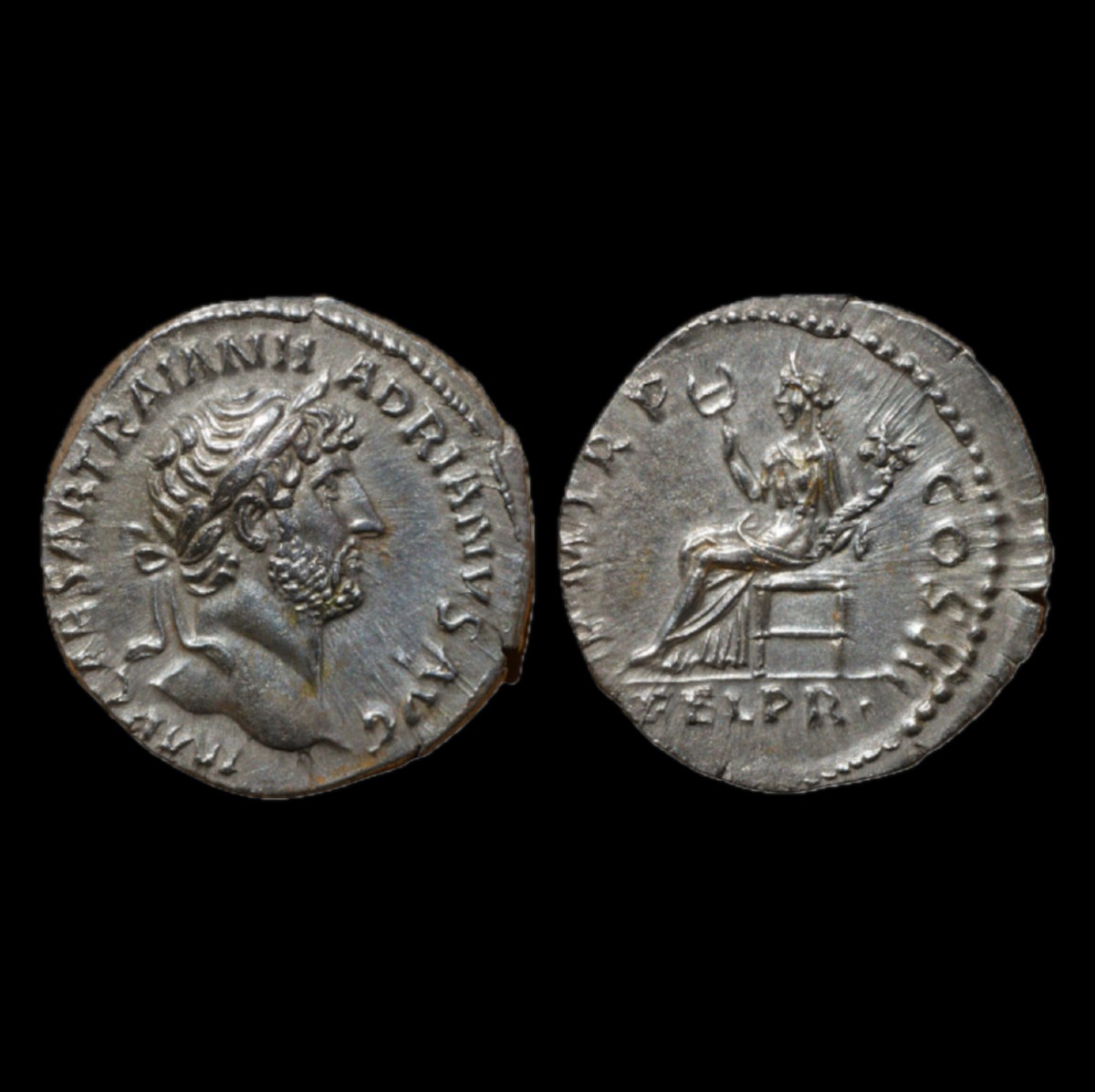
This silver denarius of Hadrian, struck at Rome circa AD 120–121, belongs to a particularly sought-after type from the early Hadrianic period, with on the obverse the titulature IMP CAESAR TRAIAN HADRIANVS AVG around a laureate head right, and on the reverse P M TR P COS III, Felicitas seated left, holding caduceus and cornucopia, with FEL P R in the exergue; the corresponding Numista entry classifies this type as a Rome denarius dated 120–121, in silver, 18.5 mm with a reference weight of 3.2 g, with references to RIC II.3, 299 and OCRE ric.2_3(2).hdn.299, while specialized commercial documentation notes, for close examples or variants within this group, a traditional attribution around RIC 120, sometimes recorded as a variant when the exergue or bust differs. The Numista rarity index reaches 94, which supports presenting the series as genuinely sought-after among collectors of imperial denarii with strong iconography.
Each specimen is examined, described, and accompanied by a certificate of authenticity in accordance with the standards of the art and heritage market; this one is immediately appealing for the balance of its flan, the fine intensity of its Hadrianic portrait, the crispness of the beaded border over a large part of the circumference, and a Felicitas reverse of particularly harmonious iconographic poise, where public prosperity, political stability, and engraving elegance are united within a compact yet highly expressive module.
Analysis & Expertise
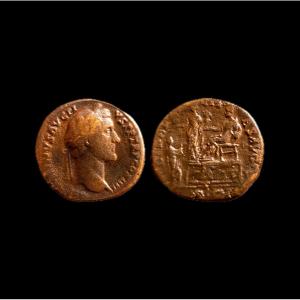
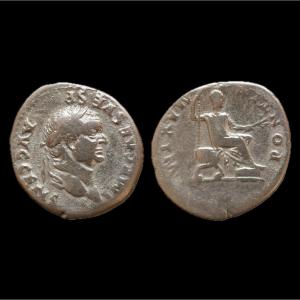
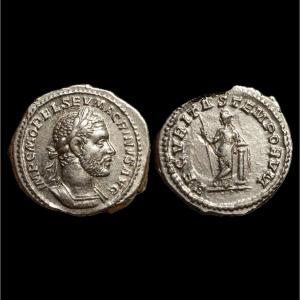
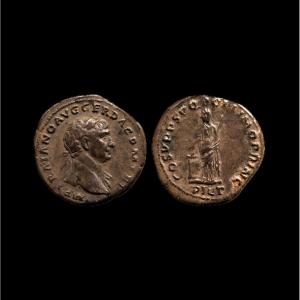
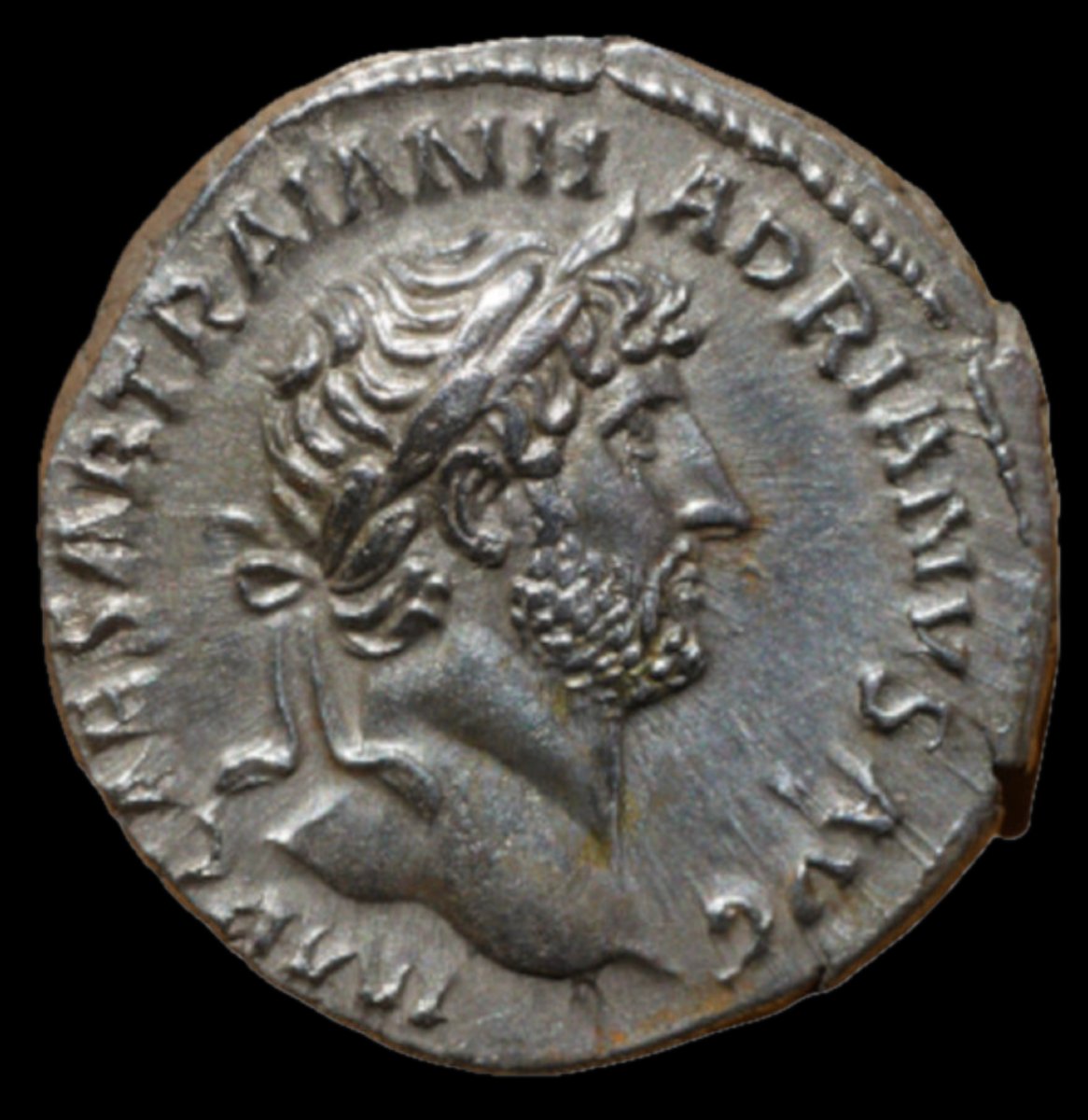
Close observation under ×10 magnification and raking light. The obverse presents a laureate head of Hadrian right of great plastic firmness, with forehead, brow ridge, eye, nasal line, mouth, and short beard clearly formed, in that sober and disciplined gravity characteristic of the finest portraits from the early reign; the hair, treated in tight locks, reads with very satisfactory precision, the laurel wreath retains clear articulation, and the solidly modeled neck gives the bust an authoritative presence highly favorable to overall legibility.
The obverse legend preserves ample continuity, with tall, clear letters well set into the field; the beaded border can still be followed around a very large portion of the circumference, giving the coin a well-ordered visual steadiness, while the centering—overall fortunate—preserves both the portrait’s breathing space and the titulature’s readability. This arrangement reinforces the dignity of the obverse, which presents striking coherence and clarity of reading for an early second-century denarius.
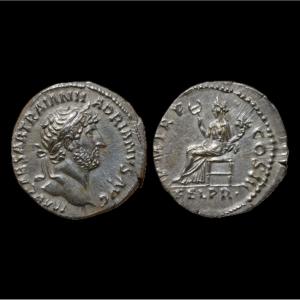
The reverse is particularly engaging, as Felicitas seated left can be recognized with remarkable immediacy: the figure clearly retains her seat and torso, the gesture of the right hand holding the caduceus, and the balancing mass of the cornucopia in the left; the exergue remains legible, and the overall construction keeps a classical sobriety that gives the type its true nobility—not through decorative excess, but through a carefully ordered economy of signs.
The silver surface shows a homogeneous ancient appearance in a sustained light-gray tone, with relief still bright on the high points of the portrait, hair, and reverse figure; slight flan irregularities, natural to an ancient hammer-struck coin, integrate harmoniously without breaking border continuity or reading stability, while the overall metal tension, the way the letters rise from the field, and the coherence of the volumes fully accord with the expected physiognomy of a Roman imperial denarius of this period.
What particularly distinguishes this specimen is the conjunction of several qualities the collector perceives at a glance: a well-set portrait, a broadly preserved legend, a Felicitas reverse that remains elegant and intelligible, and a very harmonious metallic presence; the result is a coin valued not only as a catalogued reference, but as a true cabinet piece, still capable—within its very substance—of conveying the sovereign measure of Hadrianic monetary art.
Characteristics
Authority. This issue belongs to Hadrian (Publius Aelius Hadrianus), Roman emperor from AD 117 to 138.
Mint. The mint is Rome, as retained by Numista, the British Museum, and the tradition of references associated with this type.
Dating. The strike is placed circa AD 120–121, as given by the Numista type entry and consistent with museum documentation for Hadrianic Felicitas denarii.
Denomination. Denarius.
Metal. Silver.
Weight. The stated weight for this specimen is 3.53 g, very harmoniously within the series’ metrological range, Numista giving 3.2 g as the reference weight for the type.
Diameter. The stated diameter is 18 mm, fully consistent with Numista’s reference diameter of 18.5 mm for this issue.
Technique. Hammer struck, in accordance with the Numista type entry.
Obverse. IMP CAESAR TRAIAN HADRIANVS AVG around a laureate head of Hadrian right.
Reverse. P M TR P COS III, Felicitas seated left holding caduceus and cornucopia, with FEL P R in the exergue; the British Museum also attests, for a comparable Hadrianic denarius, the Felicitas motif with these same attributes.
Typological references. Online documentation associates this type with RIC II.3, 299 and OCRE ric.2_3(2).hdn.299; in older and commercial usage, close attributions or variants are also linked to RIC 120 var., depending on differences in exergue or bust.
Rarity. The type may rightly be presented as rare and sought-after, with a Numista rarity index of 94, and specialized commercial descriptions of this group likewise qualifying it as rare.
Historical context
This denarius belongs to the early years of Hadrian’s reign, when the new prince established his monetary image after Trajan’s succession; the British Museum dates a Hadrianic Felicitas denarius to AD 119–123, struck at Rome, placing this group in the very moment when Hadrianic power sought to articulate a language of stability, prosperity, and institutional balance.
The choice of Felicitas is by no means decorative, for the exergual legend FEL P R, explained by Numista as Felicitas Populi Romani, refers to the idea of the prosperous happiness of the Roman people; the combined presence of the caduceus—sign of concord and fortunate circulation—and the cornucopia—emblem of abundance—gives the reverse a limpid political meaning, perfectly suited to a reign whose early phase needed to affirm the Empire’s happy continuity after dynastic transition.
This coin thus belongs to a particularly noble register of Hadrianic coinage, where imperial authority is expressed not through clamor, but through measure, allegory, and the promise of a fruitful order—an authentically Hadrianic tone, all the more perceptible when portrait and reverse answer one another with such clarity.
Cultural value
The cultural value of this coin is high, because it unites—within a small silver module—three dimensions Roman high numismatics prizes in combination: the imperial portrait, the personified virtue, and a condensed political formula; the object speaks not only of a reign, but of an ideal of government—ordered prosperity—made visible through the calm majesty of Felicitas.
For the collector, this type holds particular appeal as one of the most elegant expressions of early Hadrian, where the portrait’s rigor meets the reverse’s symbolic gentleness; far from being merely technical, this denarius is a civilizational object, showing Rome translating the abstract notion of public happiness into a stable, legible, and durable image.
In terms of art history, the piece belongs to that classical phase of imperial monetary art in which the sovereign’s profile attains a restrained psychological intensity without losing line purity, while the allegorical figure retains the monumental simplicity inherited from the finest Roman repertory; it is precisely this formal discipline that gives the specimen its distinction.
Traceability & Guarantees
From a European provenance, from an established numismatic dealer, this specimen was acquired through a specialized international transaction conducted within a recognized numismatic network and validated by reference experts, in accordance with the highest standards of the art and heritage market; examination of the present object retains the stylistic, epigraphic, technical, and metrological characteristics effectively observable, set in relation to the recognized references of Roman imperial coinage.
Each specimen is examined, described, and accompanied by a certificate of authenticity in accordance with the standards of the art and heritage market; in the present case, the concordance between the obverse titulature, the seated Felicitas type, the FEL P R exergue, the module, the metal, and the modern references associated with this group—especially RIC II.3, 299 and OCRE ric.2_3(2).hdn.299—establishes a particularly solid numismatic attribution.
Period: Before 16th century
Style: Rome and Antic Greece
Condition: Good condition
Reference (ID): 1730216
Availability: In stock