

Siliqua “vot Mvlt” Of Justinian I (carthage) — Certificate Of Authenticity
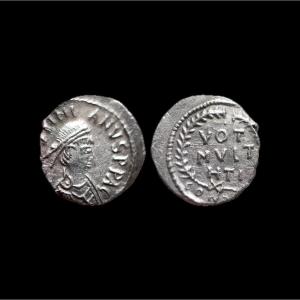
Silver coin (AR) in the name of Justinianus I (527–565), struck at Carthage within the 533–537 window: a major type among the earliest African issues following the imperial restoration, readily identified by the votive reverse VOT / MVLT / HTI placed within a wreath, and by the CONOS signature in the exergue.
Analysis & expertiseCareful observation under ×10 magnification and raking light: analysis of the photographs shows a silver coin of light gray tone, with a genuinely old sheen visible on the high points and slightly darker toning within the recesses—an appearance consistent with long, natural circulation rather than recent polishing. The surface reads as fine and compact, bearing minute contact traces (tiny striations and pinpoint marks) that fit a light module frequently handled and used.
The flan is not perfectly round: the edge displays natural irregularities and a small localized weakness along part of the perimeter, features typical of hammer striking. Centering appears slightly uneven between the two faces (a shorter peripheral sector on one side, a more open field on the other), a common trait on small African issues of this group. Within the strict limits of what the images allow to confirm, the combination of flan morphology, surface character, stylistic consistency, and typological layout aligns with the expected parameters for this Carthage series.
ObverseThe obverse conforms to type: diademed, draped and cuirassed bust right. In the images, the pearl-diadem is clearly readable as a regular sequence of small raised elements forming a structured band across the forehead. The hair is rendered in a stylized manner with short locks, while the head outline remains clean and coherent.
The profile retains sound structure despite gentle high-point wear: the eye area, nasal ridge, and chin line remain perceptible, and the transition from face to neck preserves readable relief. Drapery and cuirass planes are still distinguishable at the shoulder through layered lines that respond well under raking light.
The legend D N IVSTINIANVS PP AC is readable in segments: some letters stand out sharply, while others are softened by centering and peripheral weakness. The portrait–titulature pairing remains consistent with Justinian’s African issues in this timeframe.
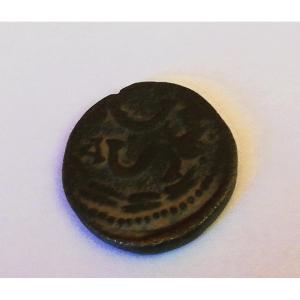
ReverseThe reverse shows a well-structured wreath, with regularly spaced leaf/segment forms framing the central inscription. Within, the votive formula appears in three lines:
VOT
MVLT
HTI
Under ×10 magnification, the letter cutting remains clean and even, with edges mildly softened by wear yet maintaining clear legibility overall. The wreath retains a strong presence, even where strike strength varies slightly across certain sectors.
In the exergue, CONOS is visible (legibility depending on angle and the outer edge), a decisive identifying element for the type. The combination “wreath + VOT/MVLT/HTI + CONOS” forms a robust typological set for attribution to Carthage in the 533–537 window, within the limits of what the photographs allow to state.
CharacteristicsAuthority: Justinian I (527–565).
Mint: Carthage.
Date: 533–537.
Denomination: Siliqua (silver) — light module, sometimes classified as a fraction in the literature.
Obverse: D N IVSTINIANVS PP AC, diademed, draped and cuirassed bust right.
Reverse: VOT / MVLT / HTI within a wreath; CONOS in the exergue.
References (cross bibliography): DOC 280 ; MIB/MIBE 51 ; Sear 253.
Weight: 1.17 g.
This issue belongs to the first years of restored Byzantine presence in Africa after the reconquest. Carthage, once again a major administrative and military center, produced coinage intended to anchor the continuity of imperial authority within local economic circuits. The formula VOT / MVLT belongs to the official language of vows (vota): it expresses the desired stability and duration of the reign—an especially meaningful statement in a period of political and monetary reorganization.
Cultural valueFor a collector, this coin offers notable strengths:
an African silver of Justinian with a distinctly specific historical profile, set apart from more common issues;
an immediately readable and highly sought votive reverse (VOT / MVLT / HTI) with strong evocative power;
an attribution supported by reference corpora, allowing clear documentation and coherent integration within a Byzantine or “Late Antique Africa” collection.
In accordance with our practices, each specimen is examined, described, and accompanied by a certificate of authenticity consistent with the standards of the art and heritage market; the study is conducted with careful observation under ×10 magnification and raking light, and is based on typological, stylistic, and metrological coherence, as well as comparison with reference corpora (DOC, MIB/MIBE, Sear).
The coin is offered with a professional European provenance; the acquisition forms part of a specialized international transaction, carried out within a recognized numismatic network and validated by expertise, in line with practices applicable to heritage objects.
Secure shippingCareful, secure, and traceable shipping, with protective packaging adapted to ancient silver, insurance, and delivery against signature depending on destination (France / international). Exact terms are confirmed at the time of order according to the delivery address.
Period: Before 16th century
Style: Rome and Antic Greece
Condition: Good condition
Reference (ID): 1716249
Availability: In stock