æ 2 Shekels λibyωn — Libyan Revolt — Certificate Of Authenticity
Major bronze of the Libyan Revolt (Carthage/Zeugitane, 241–238 BC), in the large “2 shekels” module: Herakles in lion-skin / charging bull, associated with the Greek legend ΛIBYΩN (“of the Libyans”). An emblematic crisis type, regarded as among the most difficult issues within this series.
Analysis & expertise Close examination under ×10 magnification and raking lightThe coin presents a bronze with a dark patina (grey-black to brown), with more matte areas and subtle tonal variation across reliefs and recesses. The surface displays an aged, coherent texture: minute irregularities, slight flattening on certain high points, and localized asperities, consistent with prolonged circulation and long-term metal evolution on a large bronze.
The flan is broad and thick, yet not perfectly round: a lively edge, peripheral irregularities, and small weaknesses in the rim—features expected on Punic large-module strikes. The main masses remain legible (Herakles’ profile, the bull’s forequarters), and the strike’s dynamics are still readable in the relief-to-field transitions, supporting overall consistency with an ancient production.
ObverseThe design matches the expected type: head of Herakles left, wearing the lion-skin (leonté). Despite wear, several key markers remain perceptible: the forehead line, the facial structure, and above all the lion-skin surrounding the head (the muzzle/thickness of the leonté suggested by surviving relief).
The perimeter shows an irregular rim swell; peripheral epigraphy—where present on some specimens—is frequently weakened on this module and is not the dominant reading element here, as identification rests primarily on the Herakles / leonté pairing and the style of the volumes.
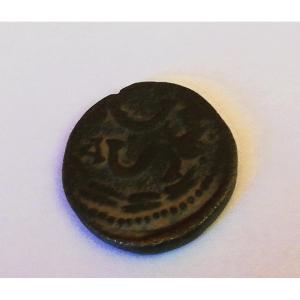
ReverseThe reverse shows a charging bull right, compact-bodied with a thrusting forepart—an especially characteristic motif of the Libyan Revolt issues. The animal’s overall line (powerful neck, chest mass, forward motion) remains readable, even where relief is more compressed.
The “M” value mark, often placed above on reference specimens, is expected: the upper field retains residual relief that may correspond to such a mark, although wear and surface condition make a crisp reading difficult.
The exergual area, where ΛIBYΩN is expected, preserves linear traces and remnants of relief compatible with an inscription, even if individual letters are not uniformly separable along the full length.
Overstrike: the reverse field shows, in places, underlying relief and residual lines that do not fully align with the bull alone—an arrangement consistent with documented overstrikes in this series, notably over an earlier “three ears of grain” type.
CharacteristicsAuthority / context: Carthage (Zeugitane), Libyan Revolt (“Mercenary War”), circa 241–238 BC
Denomination: Æ 2 Shekels
Obverse: Herakles left, wearing the lion-skin
Reverse: charging bull right; M above (expected); [ΛIBYΩN] in exergue (expected)
Particular feature: overstrike reported over the three ears of grain type (three grain ears)
References: Carradice & La Niece 141–57; MAA 66; SNG Copenhagen 244
Metrology: 29 mm; 13.75 g
Historical contextThese large bronzes belong to the Libyan Revolt (often called the “Mercenary War”), which erupted after the First Punic War when Carthage—financially strained—faced a major uprising involving mercenaries and African groups. In such circumstances, coinage becomes an instrument of political and military necessity.
The Greek legend ΛIBYΩN functions as a powerful identity marker: it clearly distinguishes these crisis issues from more regular Carthaginian coinages and contributes to the series’ exceptional historical interest.
Cultural valueFor a collector, this “2 shekels” combines features rarely found together:
Large module and high-impact iconography (Herakles / bull), immediately recognizable.
Direct historical resonance, tied to a decisive episode of Carthaginian history after 241 BC.
Technical interest: the overstrike—attested across multiple specimens—offers a concrete illustration of emergency minting practices.
The type is regularly described as rare to very rare in specialist circuits, consistent with its generally limited appearance frequency.
Traceability & guaranteesIn line with our practices, each piece is examined, described, and supplied with a certificate of authenticity consistent with art-market and heritage standards. The study is conducted with close inspection under ×10 magnification and raking light and includes checks of typological, stylistic, and metrological coherence, cross-referenced against Carradice & La Niece, MAA, and SNG Copenhagen, as well as specialist literature on Libyan Revolt coinage.
The coin comes from a professional European provenance, acquired through a specialized international transaction within a recognized numismatic network, following commonly accepted control practices.
Secure shippingShipment is tracked, insured, and delivered against signature, with protective packaging suited to ancient bronzes (individual protection, shock-resistant packing, discreet outer wrapping), ensuring controlled handling of a heritage object.
Period: Before 16th century
Style: Rome and Antic Greece
Condition: Good condition
Reference (ID): 1716813
Availability: In stock