Funerary Follis “aeternae Memoriae” — Certificate Of Authenticity
Large bronze (Æ follis) issued at Rome for Divus Constantius I (died 306), struck under Maxentius circa 311–312: a particularly sought-after consecration type, combining the dynastic titulature … DIVO CONSTANTIO COGN and a monumental reverse with a hexastyle temple surmounted by an eagle, under the legend AETERNAE MEMORIAE.
Analysis & expertiseCareful observation under ×10 magnification and raking light: examination of both sides highlights a bronze with a gray-black / dark-brown patina, marked by small localized reddish specks (stable superficial oxidations frequently observed on ancient bronzes) and showing fine granulation in the fields. The flan is broadly regular in roundness, with slight natural edge irregularities and an even wear of the reliefs, without any glaring visual break in style or texture within the strict limits of what the image allows to be established. The set “veiled portrait + consecration titulature + domed temple and eagle + mintmark” forms a coherent group of typological indicators consistent with RIC VI 252 / Drost 185.
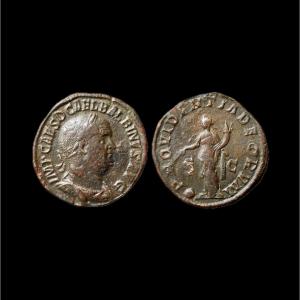
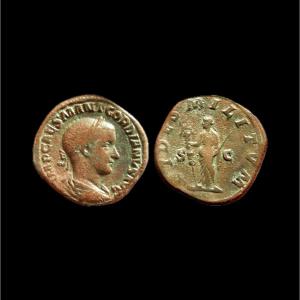
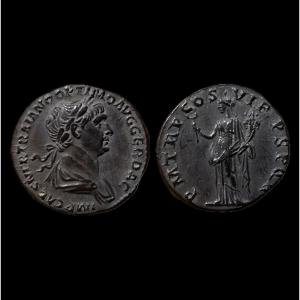
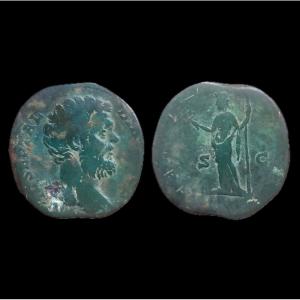
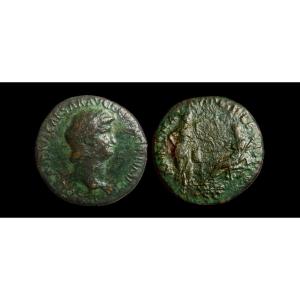
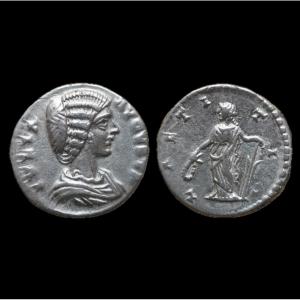
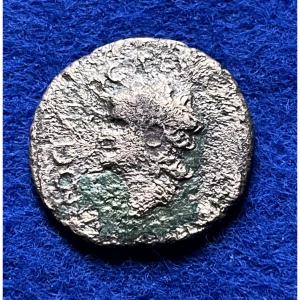
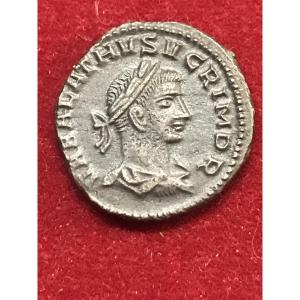
ObverseThe expected type stands out clearly: veiled head right (capite velato), a distinctive feature of funerary and consecration issues. Under raking light, the facial volumes (forehead, nose, chin) remain legible, with more pronounced wear on the high points.
The peripheral legend can be read in segments and is arranged according to the stated pattern: IMP MAXENTIVS DIVO CONSTANTIO COGN, reading being conditioned by centering and wear, a common phenomenon on bronzes of this module. The letter forms, spacing, and placement on the rim appear consistent with published specimens of the same issue.
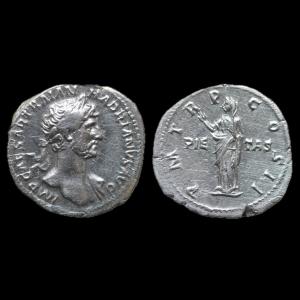
ReverseThe reverse matches the reference type: AETERNAE MEMORIAE, with a hexastyle temple surmounted by a dome and, at its summit, an eagle with wings spread, facing right with head left. The architectural structure reads clearly: stepped base, colonnade, entablature; the door area is visible, the right-hand door appearing suggested as ajar on reference specimens (a detail consistent with the standard notice, whose visibility in photographs depends on angle and wear). The exergue bears the mintmark RET, consistent with the attribution to Rome for this series.
CharacteristicsAuthority: Divus Constantius I (died 306); posthumous issue under Maxentius.
Mint: Rome; exergual mark RET.
Date: c. AD 311–312 (struck under Maxentius).
Denomination: Æ Follis.
Obverse: IMP MAXENTIVS DIVO CONSTANTIO COGN, veiled head right.
Reverse: AETERNAE MEMORIAE, eagle with wings spread atop a domed hexastyle temple, doors visible; RET in exergue.
Weight: 6.46 g
Diameter: 25 mm
References (cross bibliography): RIC VI 252 ; Drost 185.
Historical contextThis issue belongs to the dynastic memory coinages struck by Maxentius, who circulated bronzes honoring members (real or claimed) of the imperial family in order to anchor his power within a legitimate continuity. The term COGN(atus) belongs precisely to this language of kinship/alliances emphasized by the propaganda of the period.
The eagle reverse fits a well-known imperial funerary iconography: the eagle, consecrated to Jupiter, symbolizes the elevation of the deceased and his divinization, while the monumental temple materializes public memory (aeternae memoriae).
Cultural valueFor a collector, this follis offers particularly lasting attractions:
a strongly symbolic consecration typology, immediately recognizable (veiled head / eagle / temple);
an architectural scene of high legibility, sought after within the late Tetrarchic and Maxentian series;
an attribution firmly framed by RIC VI and by an abundant comparative corpus, facilitating documentation and comparison.
In accordance with our practices, each specimen is examined, described, and accompanied by a certificate of authenticity consistent with the standards of the art and heritage market; the study is conducted with careful observation under ×10 magnification and raking light, and is based on typological, stylistic, and metrological coherence, as well as confrontation with available references (RIC, Drost, illustrated parallels).
The coin is offered with a professional European provenance; the acquisition falls within a specialized international transaction, carried out within a recognized numismatic network and validated by expertise, according to practices applicable to heritage objects.
Secure shippingCareful, secure, and traceable shipping, with protective packaging, insurance, and delivery against signature depending on destination (France / international). The exact terms are confirmed at the time of order according to the delivery address.
Period: Before 16th century
Style: Rome and Antic Greece
Condition: Good condition
Reference (ID): 1715821
Availability: In stock