Caracalla — Silver Denarius With Serapis — Certificate Of Authenticity
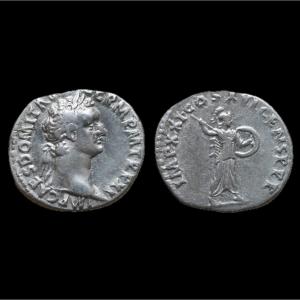
Silver denarius struck at Rome (AD 216), pairing the laureate, bearded portrait of Caracalla with a reverse showing Serapis standing: an emblematic type, firmly referenced (RIC IV 280c; RSC 348).
Analysis & expertiseThis denarius issue, struck at Rome in AD 216, belongs to the series in which Caracalla associates his imperial image with divinities of broad protective and universal significance—here Serapis, the Graeco-Egyptian god whose cult enjoyed wide diffusion across the Empire.
Close observation under ×10 magnification and raking lightThe coin displays a light grey silver tone with a gentle sheen, the high points catching the light (laurel, facial contours, drapery). The fields retain a consistent micro-texture, with fine linear traces and minute contact marks consistent with controlled ancient circulation.
The flan is generally well formed, showing minor peripheral irregularities and small localized weaknesses typical of hammer striking; the beaded border remains perceptible around much of the circumference. Within the strict limits of a non-destructive visual examination, the ensemble—metal, relief, letterforms, and surface continuity—remains consistent with an ancient strike matching this type.
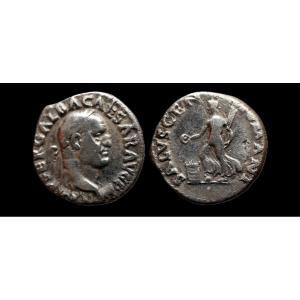
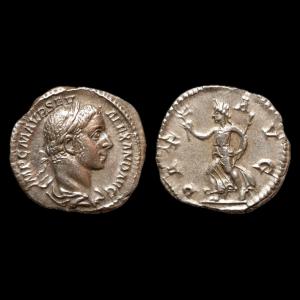
ObverseThe obverse matches the expected type: laureate, bearded head right, in late Severan style, the beard rendered in short locks and the modelling well established (eye, brow, nose bridge, lips, chin). The laurel wreath reads in clear segments, enhancing the portrait’s impact.
The legend ANTONINVS PIVS AVG GERM is largely continuous around the rim, with only minor localized softening consistent with normal edge wear.
ReverseThe reverse shows Serapis standing, facing, head turned left, wearing the polos/modius. The gesture is highly characteristic: the right hand is raised in a gesture of salute/affirmation, while the other hand holds the sceptre, whose vertical line structures the composition. The figure remains immediately identifiable, and the main volumes (head with modius, raised arm, drapery, sceptre) retain a confident reading.
The legend P M TR P XVIIII COS IIII P P encircles the type with good coherence, anchoring the issue in TR P XIX, and therefore within the AD 216 dating.
SpecificationsAuthority: Caracalla (198–217)
Denomination: Denarius (AR)
Mint: Rome
Date: AD 216
Obverse: ANTONINVS PIVS AVG GERM — laureate, bearded head right
Reverse: P M TR P XVIIII COS IIII P P — Serapis standing, head left, right hand raised, holding sceptre
References: RIC IV 280c; RSC 348
Metrology: 19.5 mm; 3.31 g
Serapis on Caracalla’s coinage has often been linked to the eastern sequence and the ideological climate of AD 215–216, a period in which the emperor multiplies messages of protection, religious authority, and legitimacy. As a syncretic divinity designed to speak across cultural horizons, Serapis offers precisely such a language: stability, salvation, and spiritual power—particularly effective within a vast and diverse Empire.
Cultural valueFor collectors, this denarius combines highly attractive features:
a vigorous, late portrait of Caracalla on a classic module;
a Serapis reverse that is instantly legible (modius, sceptre, raised-hand gesture), sought after for its strong Graeco-Egyptian identity;
a secure attribution, with the pairing of legends + type firmly anchored in RIC and RSC and readily comparable to published specimens.
In accordance with our practices, each specimen is examined, described, and accompanied by a certificate of authenticity consistent with the standards of the art and heritage market. The study is conducted under ×10 magnification and raking light and includes checks of typological, stylistic, epigraphic, and metrological coherence against the reference works (RIC / RSC) and documented comparanda.
The coin comes from professional European provenance, acquired through a specialized international transaction within a recognized numismatic network, validated according to standard market practice.
Secure shippingTracked shipment with signature and insurance, in protective packaging (appropriate capsule/sleeve, shock padding, discreet outer packing), ensuring controlled circulation of a heritage object.
Period: Before 16th century
Style: Rome and Antic Greece
Condition: Good condition
Reference (ID): 1716809
Availability: In stock