


Rare Janiform As Of Murena — Certificate Of Authenticity
This remarkable Republican as of L. Licinius Murena, struck at Rome between 169 and 158 BC, belongs to one of the major series of Middle Republican Roman bronze coinage, with on the obverse the laureate head of Janus surmounted by the value mark I, and on the reverse a prow right, with MVRENA above, the value mark in front, and ROMA below; this attribution corresponds to Crawford 186/1, Sydenham 373, RBW 792, as well as Babelon Licinia 1, and it agrees with the descriptions published by Numista, WildWinds, Forum Ancient Coins, Heritage, and Nomos for this precise monetary type. The Numista entry for the type further gives reference characteristics of 28.26 g for 32 mm, exactly matching the data communicated for the present specimen, and assigns it a rarity index of 100, allowing it to be presented clearly as a rare issue and particularly attractive to collectors of named Republican bronzes.
Each specimen is examined, described, and accompanied by a certificate of authenticity in accordance with the standards of the art and heritage market; this one immediately draws attention for its large diameter of 32 mm, its mass of 28.26 g, very favorable for the series, and for the presence of an emblematic Republican type in which the traditional Janus / prow scheme is already combined with the moneyer’s name, a point of notably historical interest for the collector.
Analysis & Expertise
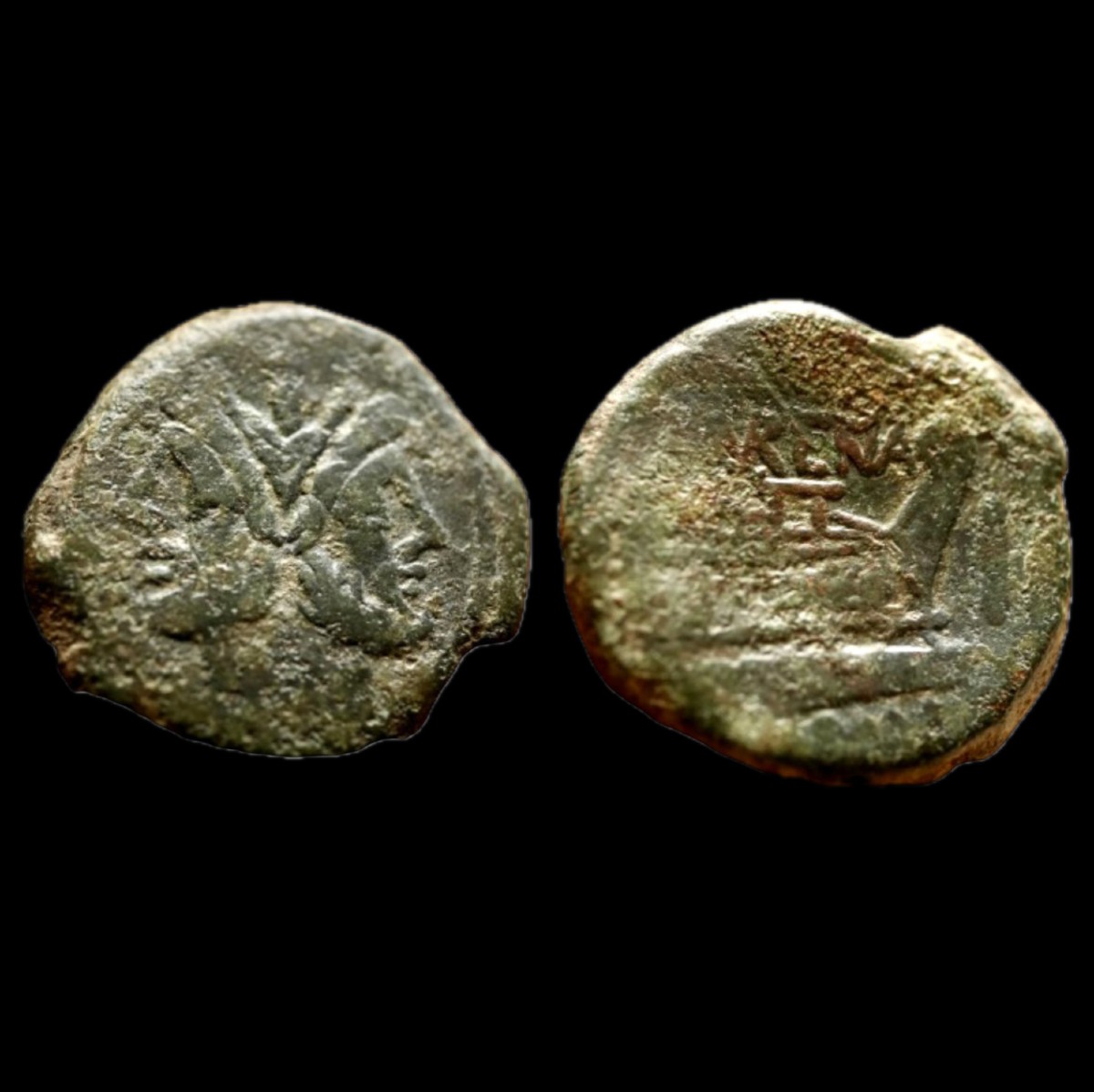
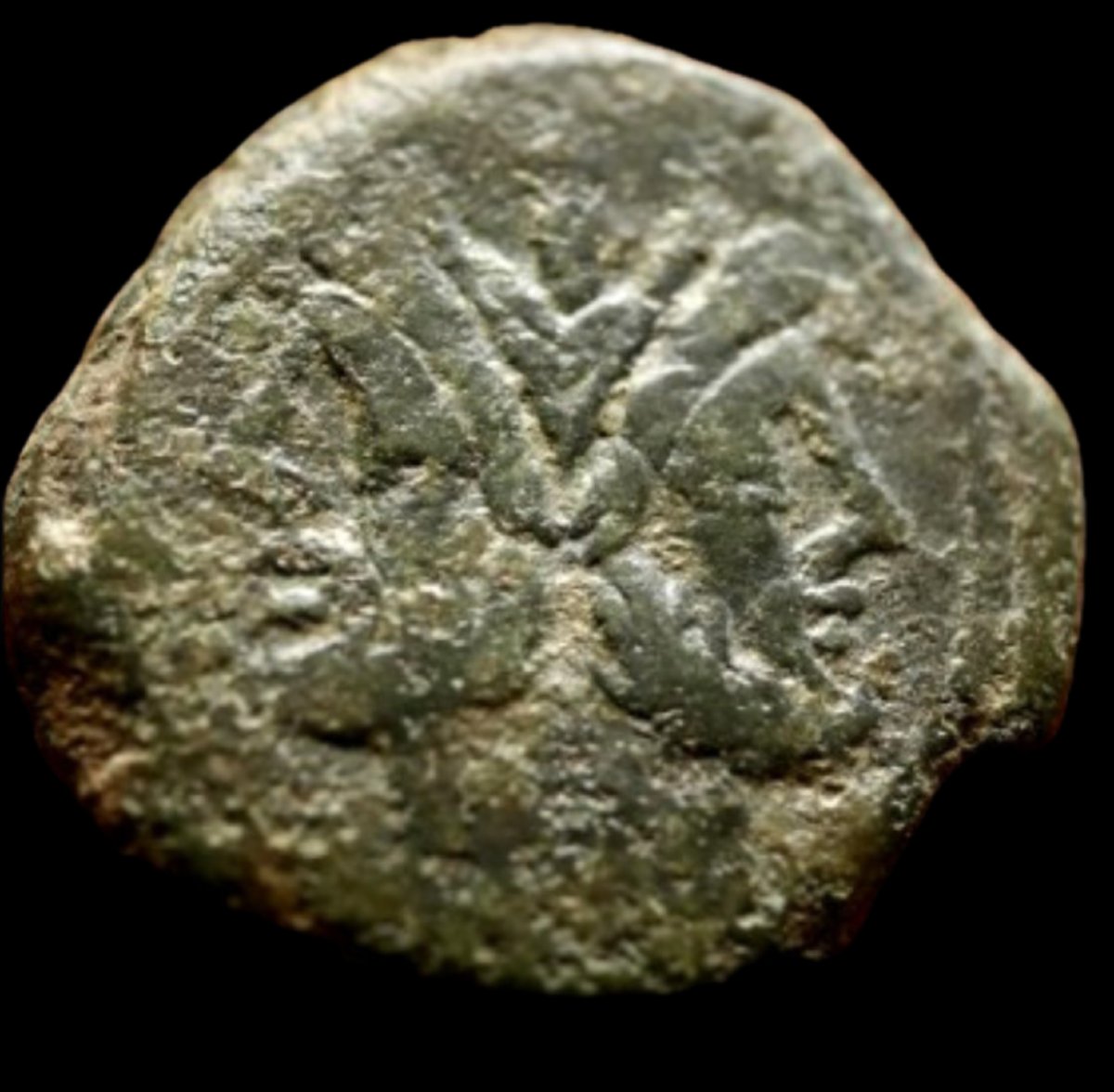
Close observation under ×10 magnification and raking light. Direct examination of the obverse highlights the characteristic janiform structure of the type, whose principal volumes remain legible despite regular ancient wear, with one face still intelligible in its forehead, eye, nasal line, and mouth, while the other side of the motif can be recognized within the bifrons mass proper to Janus; the laureate wreath, though softened, retains its logic of placement at the top of the head, and the overall arrangement of the obverse remains sufficiently clear to fully support the typological identification of the issue.
The reverse retains, with real reading authority, the prow turned right, whose essential lines remain perceptible—especially the forward structure of the ship, deck lines, and the lower base of the motif; the legend MVRENA, placed above according to the canonical layout of the type, can still be grasped in its overall placement even where certain letters are more softened, while the inscription ROMA below—expected for this issue—remains within the reverse’s visual economy and confirms its coherence.
The bronze surface shows an old olive-brown patina with green nuances, with fine and stable granularity in the fields, relief naturally softened by circulation, and irregular edges fully consistent with Republican hammer striking; relief transitions, the rise of the preserved letters, flan morphology, and the overall continuity of volumes fit very satisfactorily within the expected physiognomy of a struck Republican as, as described in the repertories for Crawford 186/1.
What gives this specimen a particularly convincing collecting presence is the conjunction of several concretely sought-after qualities: a large flan, strong metrology, a janiform obverse still well set in its mass, a prow reverse that is immediately identifiable, and above all the presence of the name MVRENA, which moves the coin from the traditional anonymous scheme to an issue clearly attributable to a specific moneyer.
Characteristics
Monetary authority
The issue belongs to L. Licinius Murena, a moneyer active between 169 and 158 BC; the British Museum indicates that he may have been an ancestor of the future consul of 62 BC, and notes that his coins bear the mark MVRENA, often with ligature of the initial group.
Mint
The mint is Rome, an attribution concordantly given by the British Museum, Numista, Heritage, Nomos, and Forum Ancient Coins for this Crawford 186/1 type.
Dating
The strike is placed between 169 and 158 BC, a chronology repeated by the British Museum, Numista, WildWinds, Heritage, and Nomos.
Denomination
This is an as, a bronze denomination of the Roman Republican system; Numista specifies for this entry that it still belongs to the denarius system of 10 asses.
Metal
Bronze.
Weight
The observed weight for this specimen is 28.26 g, exactly matching the Numista type entry.
Diameter
The observed diameter is 32 mm, identical to the published measurement for this reference.
Technique
Hammer struck, with irregular round shape and variable orientation, in accordance with the technical characteristics recorded by Numista.
Obverse
Laureate head of Janus, with the value mark I above.
Reverse
Prow right, MVRENA above, value mark I in front, and ROMA below.
Typological references
Identification is based on Crawford 186/1, Sydenham 373, RBW 792, with market and scholarly equivalence to Babelon Licinia 1 and BMC Rome 808.
Rarity
The type may be presented with full justification as rare, Numista assigning it a rarity index of 100.
Historical context
This issue belongs to a phase of Republican coinage in which Rome’s large bronze still retains the traditional Janus / prow scheme, the fundamental type of the Republican as; modern numismatic literature recalls that this is the most familiar model of Republican bronze struck after 211 BC, with the value mark I and the iconographic pairing of the bifrons god and a ship’s prow. In Murena’s case, the scheme also receives a decisive personalization through the appearance of the moneyer’s name on the reverse, giving the coin a particular status within the evolution of Roman issues.
The British Museum places the activity of L. Licinius Murena precisely between 169 and 158 BC, noting that he was probably an ancestor of an important branch of the gens Licinia; this naming above the prow participates in the slow rise in visibility of Republican moneyers, while remaining fully anchored in Rome’s oldest civic forms.
Cultural value
The cultural value of this piece is particularly high, because it unites in a single object three dimensions that immediately speak to the collector of the Roman Republic: the survival of the great civic Janus type, the naval symbolism of the prow, and the explicit appearance of the name MVRENA, which ties the issue to an identifiable monetary personality; it is thus both a traditional coin and a “signature” coin, significantly enhancing its interest.
For a cabinet devoted to Republican bronzes, such a specimen has particular force, since named asses of this period are less abundant in strong presence than the great anonymous bronzes, and the combination of large module, robust metrology, and a fundamental iconographic type gives the coin an authority far above that of an ordinary bronze. The high rarity index published by Numista further confirms this privileged position in the perception of contemporary collectors.
Traceability & Guarantees
From a European provenance, from an established numismatic dealer, this specimen was acquired through a specialized international transaction conducted within a recognized numismatic network and validated by reference experts, in accordance with the highest standards of the art and heritage market; examination retains the stylistic, technical, epigraphic, and metrological characteristics effectively observable on the coin, set within the framework of recognized references for Roman Republican coinage. The coherence between the Janus / prow type, the expected legends, the weight and diameter data, and the references Crawford 186/1, Sydenham 373, RBW 792, and Babelon Licinia 1 establishes a particularly solid numismatic attribution here.
Each specimen is examined, described, and accompanied by a certificate of authenticity in accordance with the standards of the art and heritage market; the expertise of the present object is based on careful material observation, comparison with the corpora, and the comparanda published by specialist houses and collections.
Period: Before 16th century
Style: Rome and Antic Greece
Condition: Good condition
Reference (ID): 1730243
Availability: In stock