


Rare Consecration Sestertius — Certificate Of Authenticity
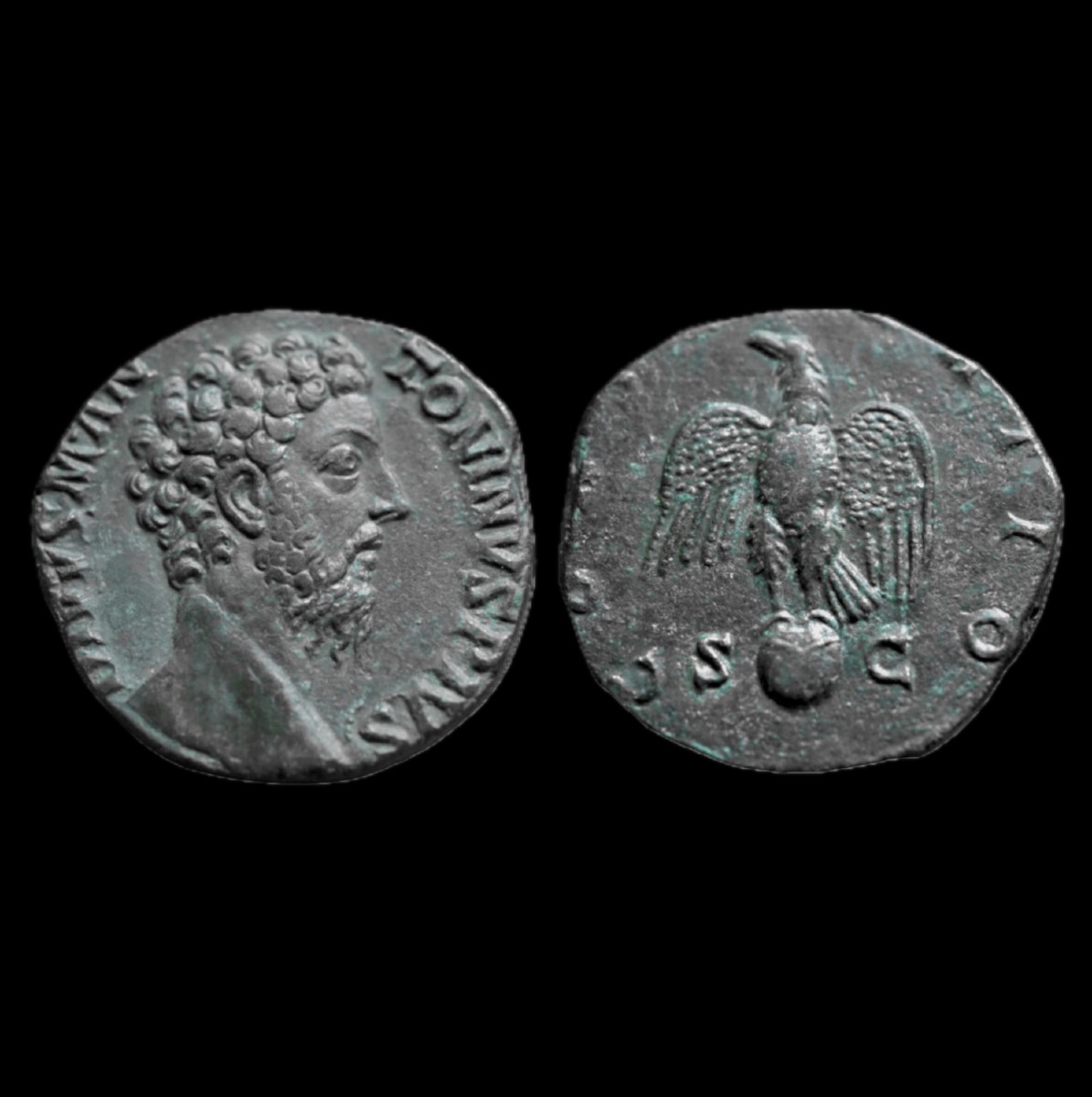
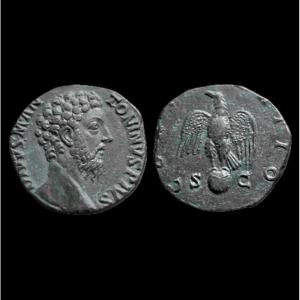
This posthumous sestertius of Divus Marcus Aurelius, struck at Rome in AD 180 under Commodus, belongs to one of the most immediately recognizable consecration types in large imperial bronze, with on the obverse the legend DIVVS M ANTONINVS PIVS around a bare head right, and on the reverse CONSECRATIO, accompanied by an eagle standing right on a globe, head turned left, with S-C in the lower fields; this attribution corresponds to RIC III (Commodus) 654, with concordances BMCRE 385 and Cohen 89, and is confirmed by the British Museum as well as by modern numismatic repertories. The type may moreover be aptly presented as rare and sought-after, Numista assigning it a rarity index of 97.
Each specimen is examined, described, and accompanied by a certificate of authenticity in accordance with the standards of the art and heritage market; this one immediately draws attention for its broad 31 mm module, its weight of 26.7 g, and an overall physiognomy highly favorable to collecting, the documented standard for this reference being given by Numista around 23.3 g for 30 mm, with an observed variation of 19.9 to 26.87 g and 21 to 32 mm, placing the specimen in the upper part of the attested range for the type.
Analysis & Expertise
Close observation under ×10 magnification and raking light. Direct examination of the obverse reveals a bare head of the deified Marcus Aurelius turned right of particularly convincing presence, whose curly hair retains a legible organization, with tight, well-individualized locks above the forehead and around the ear, while the eye, nasal line, mouth, and beard remain clearly structured, giving the portrait that serene gravity perfectly suited to a consecration issue; the peripheral legend can be followed around a very large part of the circumference, and the border, still perceptible in segments, gives the obverse a particularly satisfying visual steadiness.
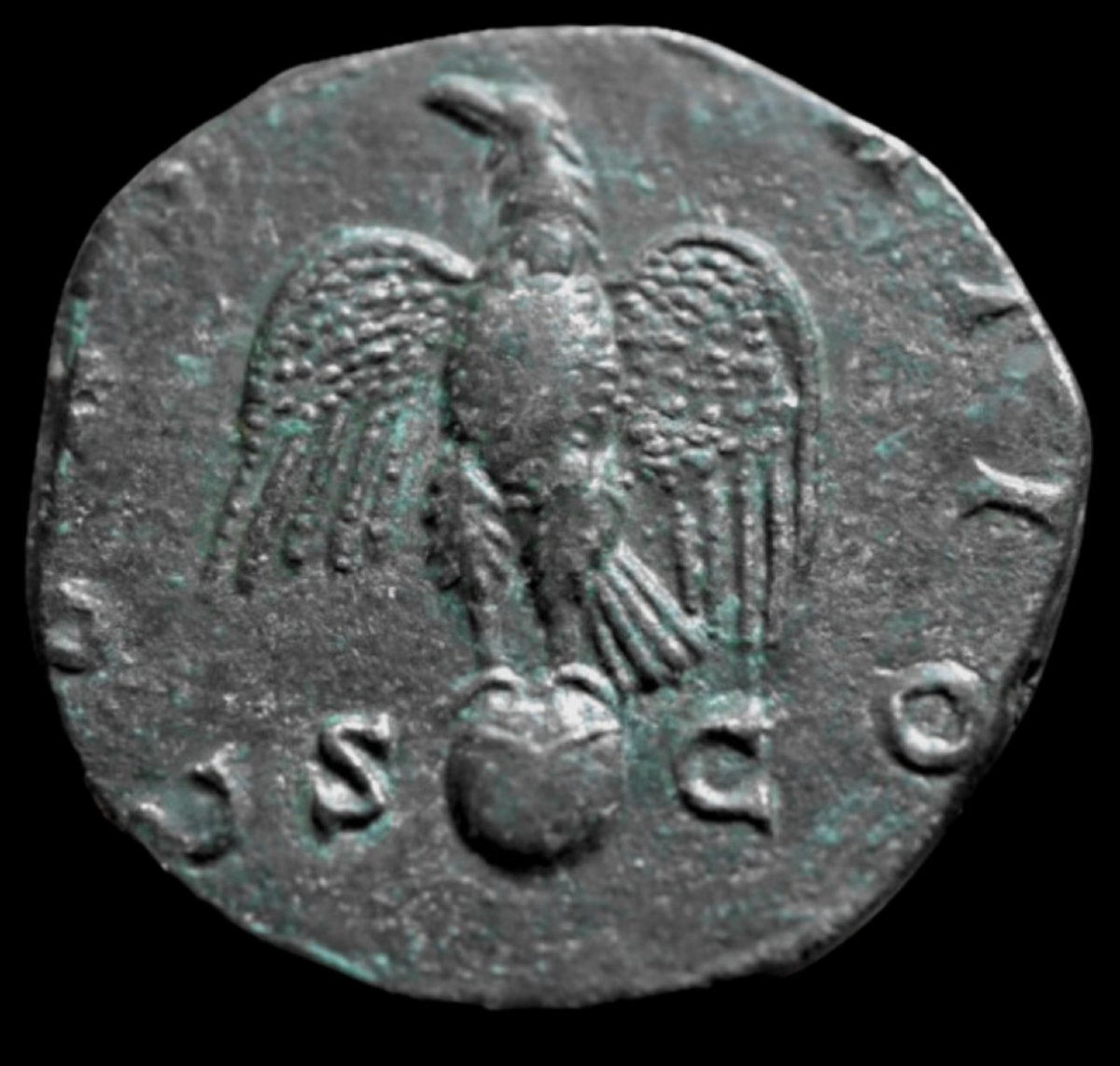
The reverse retains a very remarkable symbolic force, as the eagle with widely spread wings, set upon the globe, reads with an immediacy that is one of the type’s great attractions; the bird’s chest, the drawing of the wings, the turned head, and the stance on the globe remain sufficiently asserted to give the scene its full accent of funerary majesty, while the letters S-C, still clearly perceptible in the lower fields, reinforce the reverse’s institutional authority. The legend CONSECRATIO, though naturally softened in places, remains recognizable with an overall reading that is highly coherent.
The surface displays a deep, well-established ancient green patina, nuanced by darker tones on the reliefs and in the recesses, with a stable and harmonious overall aspect that strongly enhances the volumes of both the portrait and the eagle; a few natural edge and flan irregularities—fully compatible with an ancient hammer-struck large bronze—integrate into the object without breaking its legibility or presence, while letter modeling, relief continuity, and the balance of the whole accord very favorably with the expected morphology for this Rome coinage.
What particularly distinguishes this specimen is the conjunction of several qualities the collector expects from a posthumous large bronze of this importance: a well-set portrait, an immediately intelligible reverse iconography, a characterful green patina, and metrology highly favorable to the series; the result is a coin that does not merely illustrate a bibliographic reference, but still preserves, in its very substance, the solemnity proper to issues of deification.
Characteristics
Authority.
This issue belongs to Commodus as the issuing authority, in memory of the deified Marcus Aurelius; the British Museum explicitly classifies this sestertius under Commodus, with production at Rome in AD 180.
Mint.
The mint is Rome, as concordantly given by the British Museum and Numista for this reference.
Dating.
The strike belongs to AD 180, i.e., the very beginning of Commodus’ sole reign, immediately after the death of Marcus Aurelius.
Denomination.
Sestertius, the large circulating bronze denomination of the Roman imperial monetary system.
Metal.
Catalogued as bronze / copper alloy, as retained by the British Museum and Numista.
Weight.
The recorded weight for this specimen is 26.7 g, a particularly satisfactory figure for the type, Numista indicating for this reference a standard mass of 23.3 g and an observed variation reaching 26.87 g.
Diameter.
The recorded diameter is 31 mm, fully consistent with the reference diameter of 30 mm and the documented range of 21 to 32 mm for this issue.
Obverse.
DIVVS M ANTONINVS PIVS, bare head of Marcus Aurelius right.
Reverse.
CONSECRATIO, eagle standing right on globe, head left, with S-C in the lower fields; this is the description retained by the British Museum, Numista, and WildWinds for RIC 654.
Typological references.
Identification rests on RIC III (Commodus) 654, with concordances BMCRE 385 and Cohen 89.
Rarity.
The type may be presented with full justification as rare: Numista assigns it a rarity index of 97, confirming its sought-after position within the corpus of posthumous Antonine bronzes.
Historical context
Marcus Aurelius died in AD 180, at the end of a reign that remains among the most significant in imperial history, and Commodus—already associated with power since 177—then succeeded as sole emperor; Britannica recalls that Marcus Aurelius died in 180 and that Commodus continued the principate alone from that date. In this precise context, the consecration issues struck at Rome take on their full meaning, since their function was to give imperial memory an official, visible, and durable monetary form.
The choice of the eagle on globe belongs to the highest vocabulary of Roman apotheosis: the eagle signifies the celestial translation of the deceased prince, while the legend CONSECRATIO makes the act of divinization explicit; the British Museum describes the reverse precisely as an eagle standing on a globe, and Numista translates CONSECRATIO S C as the consecration decreed by the Senate. The coin must therefore be understood not as a simple commemorative piece, but as an official support for the sacred memory of Marcus Aurelius.
Cultural value
The cultural value of this sestertius is high, because it unites within a single object three dimensions among the noblest in Roman imperial coinage: the memory of a philosopher-emperor, the political ritualization of divinization, and the monumental force of the Roman large bronze; it is not merely a circulating coin, but a material witness to the way Rome transformed the passing of a prince into public eternity.
For the collector, such a specimen has a very particular appeal, because it combines the legibility of a posthumous portrait, the powerful emblem of the eagle on globe, and an ancient green patina that gives the object an immediately tangible archaeological presence; the whole belongs to that category of sestertii remembered less for decorative excess than for the purity and authority of their idea.
Traceability & Guarantees
From a European provenance, from an established numismatic dealer, this specimen was acquired through a specialized international transaction conducted within a recognized numismatic network and validated by reference experts, in accordance with the highest standards of the art and heritage market; examination retains the stylistic, epigraphic, technical, and metrological characteristics effectively observable on the coin, set within the framework of recognized references for Roman imperial coinage.
Each specimen is examined, described, and accompanied by a certificate of authenticity in accordance with the standards of the art and heritage market; in the present case, the concordance between the obverse titulature DIVVS M ANTONINVS PIVS, the CONSECRATIO reverse with eagle on globe, the flan data, and the references RIC 654, BMCRE 385, and Cohen 89 establishes a particularly solid numismatic attribution.
Period: Before 16th century
Style: Rome and Antic Greece
Condition: Good condition
Reference (ID): 1730226
Availability: In stock