Herennius Etruscus — Principi Ivventvtis — Certificate Of Authenticity
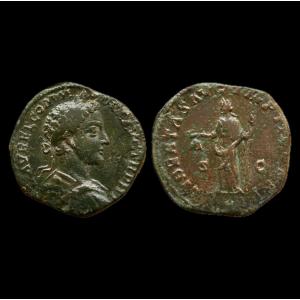
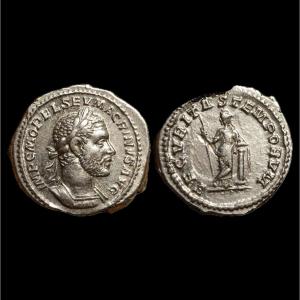
This sestertius of Herennius Etruscus (Caesar, AD 250–251), struck at Rome under Trajan Decius, belongs to the most emblematic legitimation series of the prince’s very brief career: on the obverse, the titulature Q. HER. ETR. MES. DECIVS. NOB. C around a youthful portrait; on the reverse, the formula PRINCIPI IVVENTVTIS, showing Herennius in short dress and chlamys, holding a spear/lance and a command baton, framed by S–C (senatorial issue). The ensemble corresponds to RIC IV (Trajan Decius), 171 var., as described in standard specialist references.
Close observation under ×10 magnification and raking lightThe coin displays a stable dark brown–black patina, enlivened by coppery highlights and warm brown-red nuances on the highest points (old friction zones), with a few localized lighter accents that animate the fields without breaking overall coherence. The surface shows a regular fine granulation and circulation-consistent traces, while the relief—though softened by progressive wear—retains strong typological readability: portrait, legend segments, S–C, the prince’s stance, and his attributes.
The flan appears naturally “alive,” with minor edge undulations and peripheral weaknesses characteristic of mid-3rd-century large bronzes; certain rim areas are slightly weaker or more irregular, without affecting the key identifying features. Within the limits of visual examination, nothing suggests prioritizing a modern manufacture: relief-to-field transitions remain natural, the texture is coherent, and the overall structure is consistent with a hammer strike.
ObversePortrait: bare-headed, draped bust right, rendered in the period’s typical manner: short hair, well-set profile volumes, and a still clear reading of the eye and nasal ridge. The bust retains convincing presence despite wear, supporting strong cabinet appeal.
Legend: the titulature Q HER ETR MES DECIVS NOB C is visible in peripheral segments; several letters stand out sharply, while others soften near areas where the flan is weaker—common for this module.
ReverseType: Herennius standing facing, head turned left, in a short tunic and chlamys; he holds a spear/lance and a baton (authority and rank attributes). The letters S–C appear to either side in the field, as strictly expected for a senatorial sestertius. The figure remains readable: the lance’s vertical axis, the stance, and the chlamys line are still distinguishable, even if finer details are softened.
Legend: PRINCIPI IVVENTVTIS is partially legible around the rim; what remains is consistent with the centering and surface condition, and the lettering keeps sufficient relief to anchor identification.
SpecificationsAuthority: Herennius Etruscus, Caesar under Trajan Decius (250–251)
Mint: Rome
Denomination: Æ Sestertius
Obverse: Q. HER. ETR. MES. DECIVS. NOB. C — draped bust right, bare head
Reverse: PRINCIPI IVVENTVTIS — Herennius standing, holding lance and baton; S–C in field
References: RIC IV (Trajan Decius) 171 var. (commercial concordances also cite 171a depending on attribute/garment detail variants)
Raised to Caesar in AD 250 and promoted to Augustus in 251, Herennius Etruscus embodies Trajan Decius’ dynastic attempt in a critical military context on the Danube. His death alongside his father during the Gothic campaign, in the context of the battle of Abrittus (251), gives his coinage particular historical weight: these issues witness a dynastic trajectory abruptly cut short at the heart of the 3rd-century crisis.
The formula PRINCIPI IVVENTVTIS (“to the Prince of the Youth”) belongs to a traditional Roman honorific language meant to make the heir visible and to prepare succession; its presence on the reverse gives this type direct political charge and immediate readability.
Cultural valueFor collectors, this sestertius brings together major, enduring strengths:
a Caesar’s portrait on a large bronze, highly meaningful within Decius’ dynastic series;
an official representational reverse (Princeps Iuventutis) with command attributes and S–C, an immediately “museum-like” iconography;
a type often described as sought-after / scarce in the specialized numismatic market, valuable for building a coherent 3rd-century dossier.
In accordance with our practices, each specimen is examined, described, and accompanied by a certificate of authenticity consistent with the standards of the art and heritage market. The study is carried out under ×10 magnification and raking light and includes checks of typological, stylistic, and epigraphic coherence against RIC and recognized market/collection comparanda.
The coin comes from professional European provenance, acquired through a specialized international transaction within a recognized numismatic network, following control practices consistent with professional standards.
Secure shippingTracked shipment with signature and insurance, using protective packaging suited to numismatics (shock padding and discreet outer packing). Logistical terms are adjusted to the destination country to ensure controlled circulation of a heritage object.
Period: Before 16th century
Style: Rome and Antic Greece
Condition: Good condition
Reference (ID): 1716805
Availability: In stock