

Rare Vandalic Siliqua Of Honorius — Certificate Of Authenticity
This silver siliqua, struck at Carthage in the name of Honorius within the framework of Vandal pseudo-imperial coinage, belongs to a series recognized by the principal specialized corpora, notably BMC Vandals 6–9, MEC I 1–3, and the study by Cécile Morrisson and James H. Schwartz on Vandal silver coinage in the name of Honorius; numismatic documentation generally places this group within a horizon ranging from 440 to 490, while the study by Morrisson and Schwartz narrows the principal issue more specifically to 470–480, i.e., at the end of Geiseric’s reign or at the beginning of Huneric’s.
Each specimen is examined, described, and accompanied by a certificate of authenticity in accordance with the standards of the art and heritage market; the specimen presented here stands out for its clear iconographic reading, a small module characteristic of the series, and a particularly convincing visual presence for a late African coinage whose historical significance extends far beyond the purely monetary data.
Analysis & Expertise
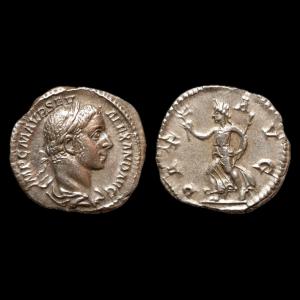
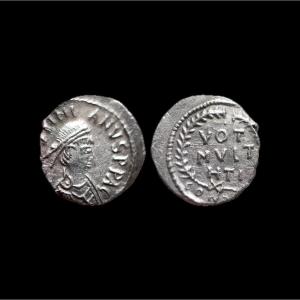
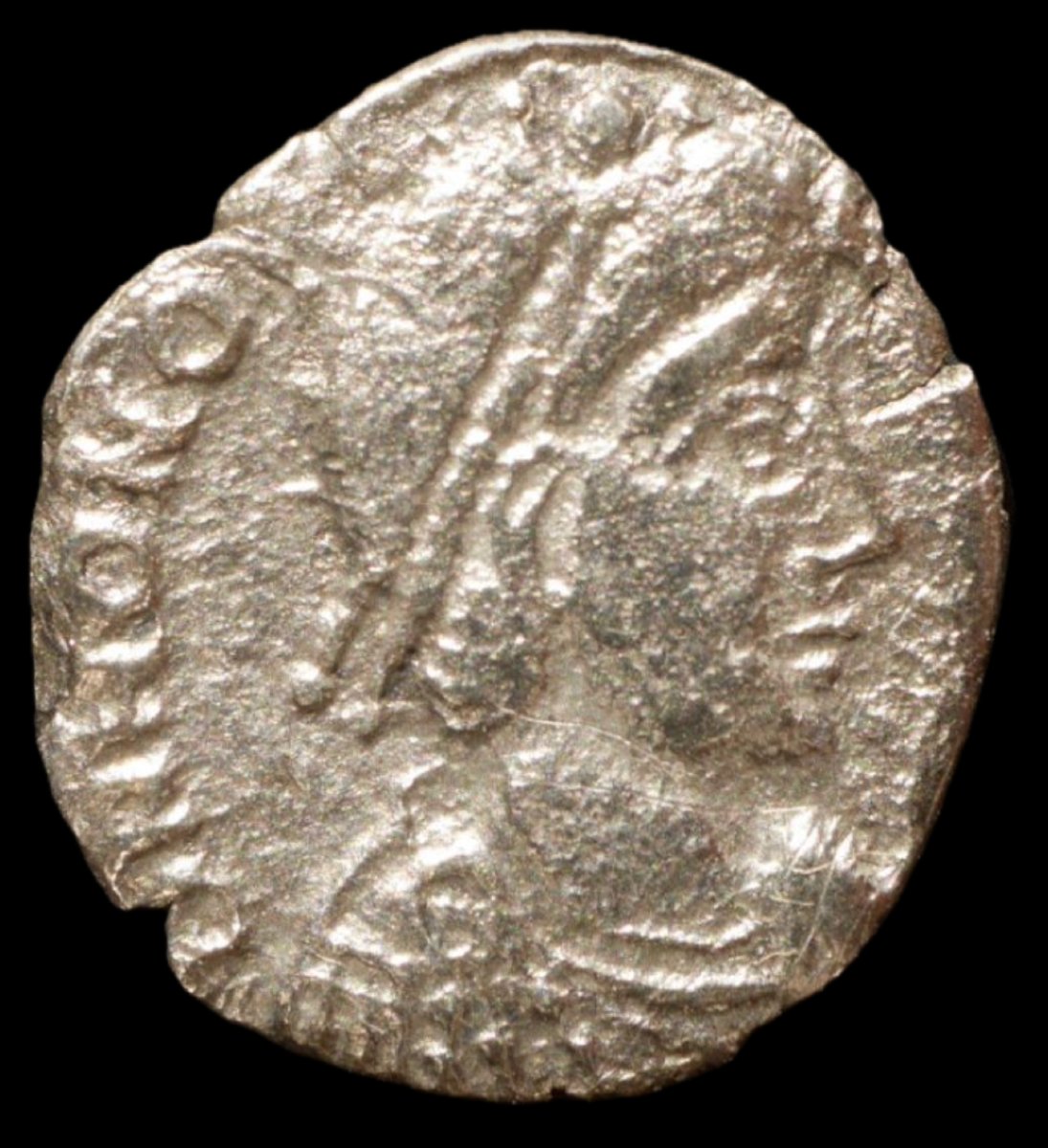
Close observation under ×10 magnification and raking light. Direct examination of the coin shows, on the obverse, a diademed bust right, whose pearl diadem, facial structure, neckline, and arrangement of drapery remain clearly perceptible, with the restrained and taut stylization that belongs to the visual language of African Vandal coinage inspired by late imperial prototypes; the periphery still preserves several raised letters, arranged in accordance with the expected epigraphic type in the name of Honorius, without any need, for understanding the piece, to force a reading beyond what the object securely delivers.
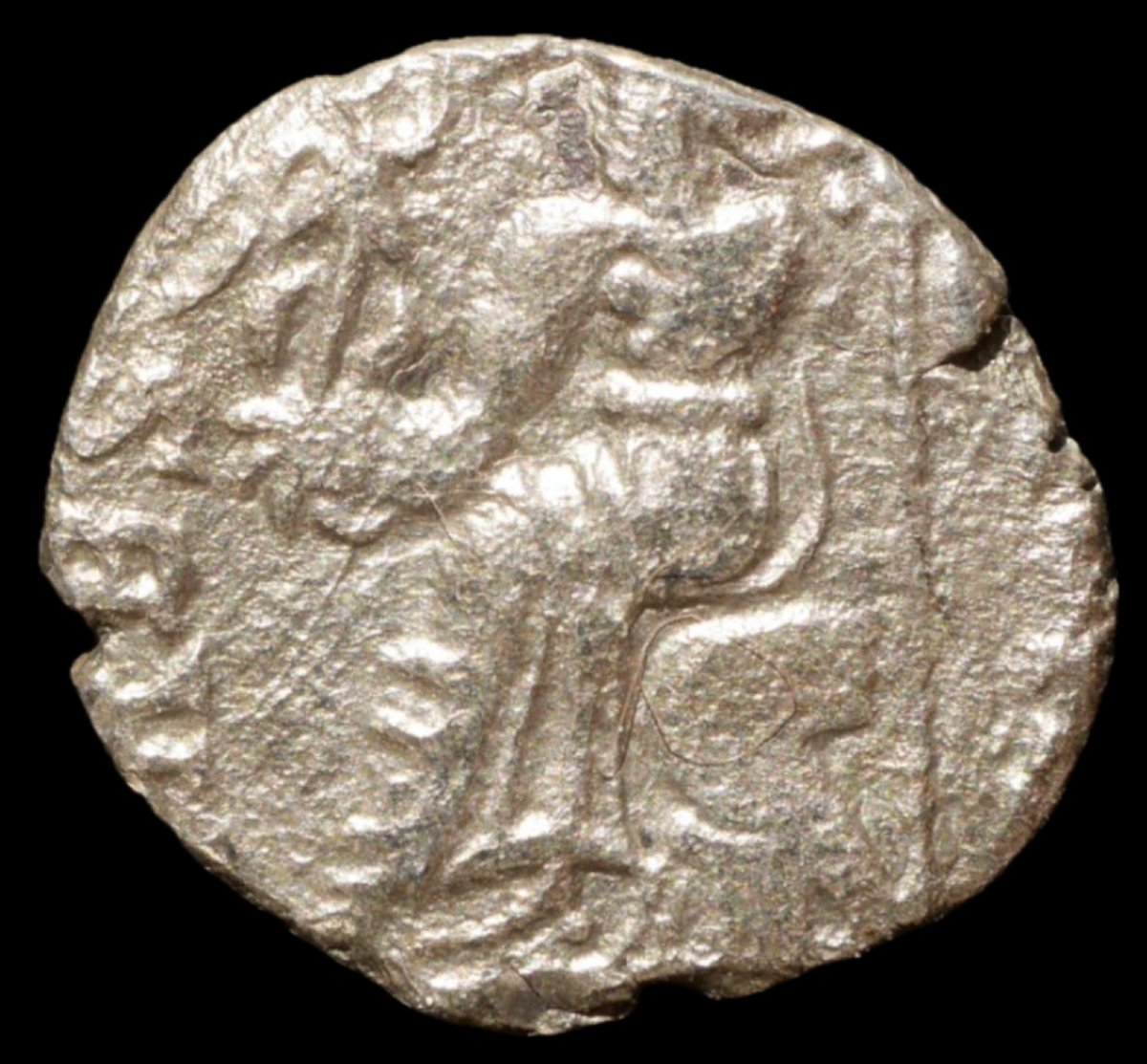
On the reverse, the composition can be recognized with strong reading authority, since the seated Roma figure left appears coherently with the published type, accompanied by the long vertical spear that structures the entire field, while the overall modeling, despite the concentration of relief on a reduced module, retains an immediately intelligible presence fully consistent with the scheme of the VRBS ROMA series known for Carthage.
The silver surface shows an old and homogeneous appearance, with softened but not dissolved relief, evident ancient circulation without loss of the type’s identity, as well as an irregular and compact flan fully consistent with the hammer-striking technique noted for this issue; inspection of the edges, fields, and material transitions reveals no continuous peripheral line or seam that might suggest casting, while the small contour irregularities and metal tensions fall naturally within the expected physiognomy of an ancient African siliqua.
The interest of this specimen lies precisely in this combination—highly sought after by knowledgeable collectors—of numismatic legibility, crisis-era archaizing module, effective presence of the portrait, and immediate recognition of the seated Roma reverse, such that the coin is not merely an instance of a documented type, but an object that still preserves, in its very substance, the tangible imprint of an African workshop of major historical importance.
Characteristics
Authority / Issue
This coin belongs to the Vandal kingdom, within an issue struck in the name of the emperor Honorius, according to the pseudo-imperial system adopted at Carthage by Vandal authority to place its monetary production within the visual continuity of Roman sovereignty.
Mint
The attribution to Carthage rests on the tradition of the specialized corpora and on the typological coherence of the series, as described by Numista, CNG, and the reference literature.
Dating
The series is generally placed within a broad framework ranging from 440 to 490, with a narrowing often retained around 470–480 in the study by Morrisson and Schwartz.
Denomination
This is a siliqua, i.e., a small silver denomination within the late tradition of Roman coinage.
Metal
The metal of the series is given as silver by specialized catalogues, which corresponds to the general appearance of the observed specimen.
Weight
The observed weight for this specimen is 1.35 g; this figure fits coherently within the documented weight dispersion for these issues, as the literature and published comparanda show specimens of varied weights, notably 1.12 g, 1.37 g, and 1.75 g, confirming the flexible yet recognized metrology of the group.
Diameter
The observed diameter is 15 mm, a measurement fully compatible with the published references for this Vandal Carthage siliqua.
Obverse
The obverse shows a diademed bust right, draped and of late imperial tradition, consistent with the type in the name of Honorius described by the corpora.
Reverse
The reverse belongs to the VRBS ROMA type, with Roma seated left, holding her spear, according to an iconographic formula characteristic of this African series.
Typological references
Documentary concordances are established with BMC Vandals 6–9, MEC I 1–3, and Morrisson & Schwartz, ANSMN 27, type 5 var., references that firmly frame the identification of the specimen.
Condition
The overall state offers an appreciable reading of the portrait, a convincing recognition of the reverse, and an old surface consistent with circulation and the small size of the denomination, without visual alteration of a kind that would prevent identification or diminish the object’s historical interest.
Historical Context
After the Vandal conquest of Africa and the capture of Carthage in 439, the kingdom founded by Geiseric appropriated part of Rome’s institutional language, notably through certain monetary issues that retained imperial names, traditional types, and prestige formulas; these siliquae in the name of Honorius belong precisely to this zone of apparent political continuity, where real power is no longer Roman, yet the monetary form remains deliberately Roman in order to ensure intelligibility, circulation, and legitimacy.
The choice of the name Honorius and the VRBS ROMA reverse is not incidental, as it manifests the persistence of an imperial memory that Vandal authority does not destroy, but re-employs; the object thus carries a dual meaning—both inheritance from Rome and African appropriation of monetary sovereignty—which explains the sustained attention it receives from specialists of Late Antiquity and the so-called barbarian kingdoms.
Cultural Value
The cultural value of this piece is considerable, because it concentrates, within a very small module, an entire civilizational shift: the passage between the Western Roman Empire and the Vandal kingdom of Africa, not through a brutal rupture of forms, but through a transfer of power under still-Roman signs; for a collector, it is therefore not only a coin, but a material document on the survival of Rome’s emblems in a recomposed political world.
The series further deserves to be explicitly presented as sought-after, since Numista assigns it a rarity index of 93, and specialized sale results are documented, notably at Roma Numismatics and CNG, confirming sustained interest from the scholarly market for this precise type.
From the standpoint of the history of monetary art, this siliqua participates in the sovereign aesthetic of simplification characteristic of Late Antiquity, where the imperial portrait is no longer pursued for naturalistic illusion, but for the density of its sign; one may think here, by cultural analogy, of the transformation of forms also observable in late antique art, from official Late Empire reliefs to fifth-century African prestige objects, where symbolic hierarchy progressively outweighs imitation of the real.
Traceability & Guarantees
From a private European collection, this specimen was acquired through a specialized international transaction conducted within a recognized numismatic network and validated by reference experts, in accordance with the highest standards of the art and heritage market; this traceability is part of a professional approach in which typological coherence, bibliographic conformity, and careful examination of the material are brought together under a single requirement of seriousness.
Each specimen is examined, described, and accompanied by a certificate of authenticity in accordance with the standards of the art and heritage market; the expertise of the present object rests on direct observation, comparison with published references, and careful analysis of the iconographic, stylistic, and technical characteristics visible on the coin itself, following a rigorous and stable description protocol.
Period: Before 16th century
Style: Rome and Antic Greece
Condition: Good condition
Reference (ID): 1730150
Availability: In stock