Carthage Dynastic Follis (ktg) — Constans II — Certificate Of Authenticity
This bronze follis (denomination 40 nummi) attributed to Constans II (641–668), struck at Carthage around 662–667, belongs to the most emblematic dynastic series of the African mint. The obverse associates the ruler with his eldest son Constantine, while the reverse combines the value mark M with Heraclius and Tiberius, the two other sons linked to power—an explicitly dynastic program fully consistent with the chronology and titulature of the late reign.
Careful observation under ×10 magnification and raking light (from the photographs): the coin shows an old patina in very dark brown to brown-black, nuanced by reddish tones and small localized verdigris accents, typical of long-term evolution in a copper-alloy. Wear is firm yet generally even, with relief still readable in mass (silhouettes, major symbols, borders), and the edge displays slight flan irregularities consistent with Byzantine African bronzes often struck on imperfect flans. Within the strict limits of visual examination, the surface character (continuous relief-to-field transitions, no obvious signs of uniform casting or a continuous peripheral “seam”) remains compatible with ancient manufacture, and the overall layout matches published examples of the series.
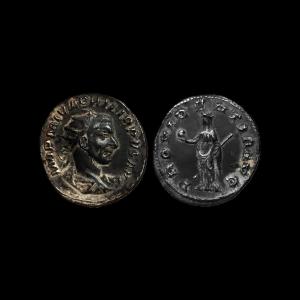
Obverse (dynastic type)The obverse is recognizable as the expected type: two standing emperors, the principal figure (Constans) identifiable by a long beard and stylized attire, accompanied by Constantine in court dress (chlamys). A cruciform sign between the heads can be perceived in residual relief despite wear.
Under raking light, wear is more concentrated on the highest points (faces, shoulders, lower legs), while the principal volumes (heads, torsos, vertical stance of the figures) remain sufficiently structured to support identification of the dynastic module.
Reverse (value mark and mint)The reverse follows the reference structure: a large central “M” (40 nummi), with two small figures placed to either side (Heraclius and Tiberius), a monogram above, and the mint signature KTG in the exergue (legibility varying with angle and wear, but the overall arrangement corresponds to the series).
The field shows a continuous patina with slightly duller zones and stabilized micro-oxidations; the “M + flanking figures + KTG exergue” framework remains distinctive and decisive for attribution to Carthage.
SpecificationsAuthority: Constans II (641–668)
Denomination: Æ Follis (40 nummi, “M”)
Mint: Carthage, signature KTG
Date: 662–667 (late issue of the African mint for Constans II)
Type:
Obverse: Constans (long beard) and Constantine standing, dynastic type
Reverse: large M flanked by Heraclius and Tiberius; monogram above; KTG below
Diameter: 22 mm
Weight: 8.97 g
References (cross bibliography): DOC II 147.6; MIB III 194; Sear (SB) 1055
Historical contextFrom the mid to late 7th century, the Byzantine Empire reinforced legitimacy through dynastic issues: Constans II progressively associated his sons with power (Constantine co-emperor from 654; Heraclius and Tiberius elevated thereafter), and this institutional reality is directly reflected in the coinage iconography.
The choice of Carthage as mint is highly significant: Byzantine Africa was then a major administrative and military center (the Exarchate of Carthage), until its fall at the end of the 7th century. This bronze—both utilitarian and political—belongs to an active regional economy in a context of mounting military pressure across the Mediterranean.
Cultural valueFor collectors, this follis offers particularly sought-after qualities:
explicit dynastic iconography (father + son on the obverse; the brothers on the reverse), immediately contextualizable;
the African mint of Carthage (KTG), clearly identifiable and historically charged;
attribution securely framed by the major corpora (DOC, MIB, Sear) and readily comparable to published examples, facilitating documentation and integration in a collection.
In accordance with our practices, each specimen is examined, described, and accompanied by a certificate of authenticity consistent with the standards of the art and heritage market; the study is conducted under ×10 magnification and raking light, with typological, stylistic, and metrological consistency checked against the references (DOC / MIB / Sear) and published comparanda.
The coin comes from professional European provenance, acquired through a specialized international transaction within a recognized numismatic network, following control and validation practices commonly accepted by professional market participants.
Secure shippingShipment is carried out with tracking, signature, and insurance, using protective packaging suited to numismatics (padding, shock protection, discreet outer packing). Exact terms (carrier, insurance level, timing) are confirmed according to the destination country and delivery address.
Period: Before 16th century
Style: Rome and Antic Greece
Condition: Good condition
Reference (ID): 1716331
Availability: In stock