Campgate Nummus — Antioch (?) — Certificate Of Authenticity
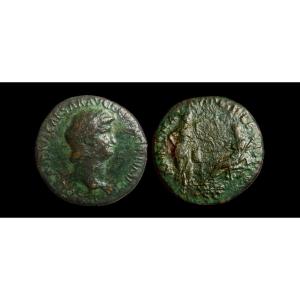
Large late Roman bronze (Æ), immediately recognizable by its monumental reverse depicting a campgate flanked by two towers and topped by a star—an emblematic Constantinian-type issue in small bronze, sought after for its “architectural” impact and direct readability.
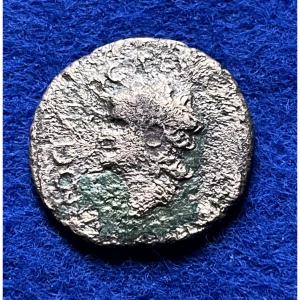
Analysis & expertiseCareful observation under ×10 magnification and raking light (from the photographs): the coin appears on a flan that is generally regular, with a slightly uneven perimeter (minor edge weaknesses and gentle undulations) consistent with a hammer-struck bronze of this module. The patina reads as warm brown to olive-brown, with green patches (stabilized copper oxidation) and small localized reddish specks (superficial alterations commonly seen on ancient bronzes), forming an overall coherent and stable surface.
Under raking light, the fields show a fine micro-texture and minor contact traces consistent with ancient circulation; the relief, though moderately worn, keeps a clear hierarchy: imperial profile on the obverse, the gate architecture on the reverse, the star above, and the exergual baseline. Within the strict limits of non-destructive visual review, there is no obvious indicator of modern manufacture (no “cast” look, natural relief-to-field transitions, coherent style and composition).
Identification note: the photographs show a bronze campgate type, not a silver antoninianus of Philip I; the expertise below therefore corresponds to the coin actually visible in the images.
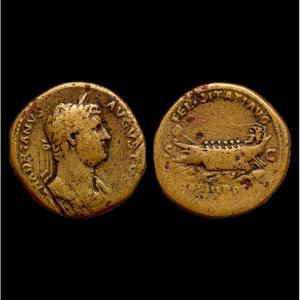
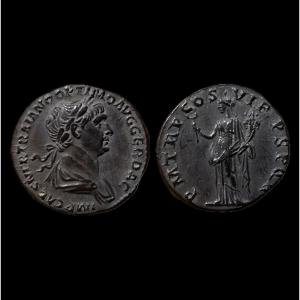
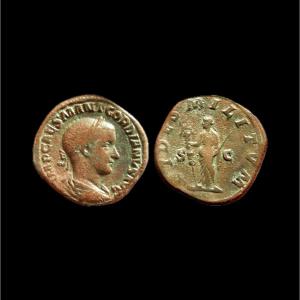
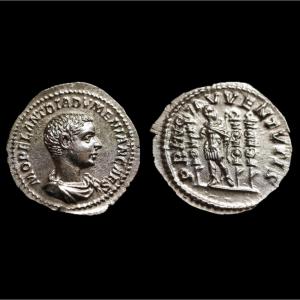
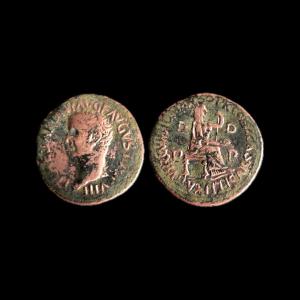
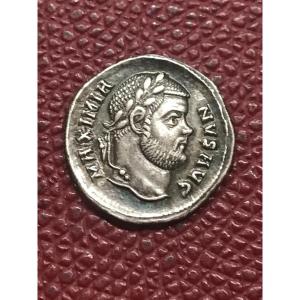
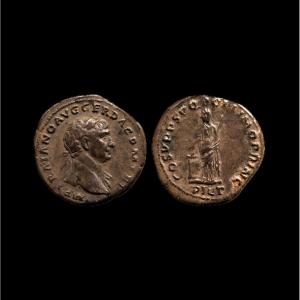
ObverseThe obverse shows a right-facing imperial portrait, in late Roman style: laureate/diademed head (reading dependent on angle), with a well-structured profile (forehead, nose, chin) and a neck/drapery line readable in volume.
The surrounding legend is partially legible: an imperial titulature is clearly present, but several letters are softened by centering and edge condition; letter shapes remain regular and consistent with official issues of the period.
ReverseThe reverse is typologically very distinctive: a frontal campgate with two towers, masonry rendered in courses, a clearly defined central doorway, and a star above (a key diagnostic feature).
The circular legend appears in segments; the exergue shows a partially readable mintmark whose structure suggests ANT…, visually compatible—subject to clearer reading—with Antioch (a mint commonly abbreviated in this manner on campgate reverses). The scene remains clear despite wear: tower outlines, doorway frame, star, and the exergual zone.
SpecificationsAuthority: Late Roman Empire (Constantinian period — precise attribution depends on full legend reading).
Denomination: Nummus / small bronze (Æ).
Mint: Antioch (?) — exergue reading suggesting ANT… (to be confirmed).
Obverse: imperial bust right, legend partially legible.
Reverse: two-towered campgate, star above; mintmark in exergue.
Metrology: not provided (weight/diameter).
The campgate type belongs to the visual language of the 4th century: a military-architectural image expressing protection, order, and permanence. The star above strengthens the symbolic register (favorable sign / issue marker), while the broad production of such bronzes reflects the massive needs of daily circulation across the late Empire.
Cultural valueFor collectors, this coin offers enduring appeal:
a monumental and instantly recognizable reverse (campgate + star);
an attractive, nuanced patina (brown/green with small reddish specks), giving strong “cabinet” presence;
a highly representative type of late Roman circulating coinage, ideal within a “Late Rome / Constantinian era” set.
In accordance with our practices, each specimen is examined, described, and accompanied by a certificate of authenticity consistent with the standards of the art and heritage market. The assessment is conducted under ×10 magnification and raking light and is based on typological, stylistic, and material coherence within the strict limits of non-destructive analysis.
The provenance is professional European; the acquisition forms part of a specialized international transaction within a recognized numismatic network and validated by expertise.
Secure shippingFrance: Colissimo, with signature and insurance (€20).
Abroad: UPS, with signature and insurance (€35).
Reinforced packaging, shock protection, systematic tracking.
Period: Before 16th century
Style: Rome and Antic Greece
Condition: Good condition
Reference (ID): 1716329
Availability: In stock