

Diadumenian Caesar — Silver Denarius, Ad 217–218 — Princ Ivventvtis — Certificate Of Authentici
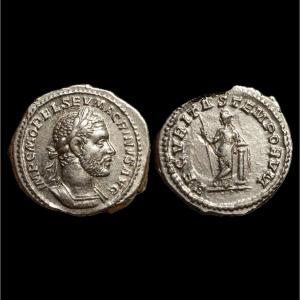
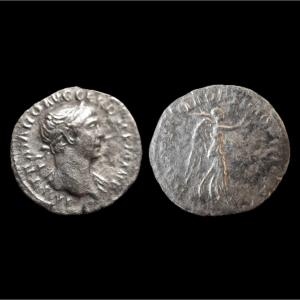
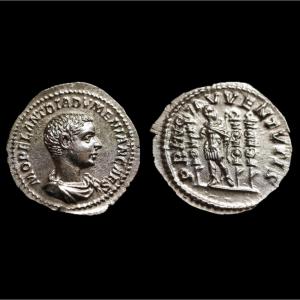
Severan denarius struck for Diadumenian as Caesar (son of Macrinus), notable for the sharpness of its youthful portrait and the still well-structured reading of the reverse “PRINCE OF THE YOUTH.”
Analysis & expertise Close observation under ×10 magnification and raking light (based on the photographs)The specimen is struck on a regular silver flan, with a slightly irregular perimeter and a small rim weakness/notch visible (notably on the reverse), features compatible with ancient hammer striking and the material life of a denarius in circulation.
The surface shows light gray silver with cabinet reflections, with fine field lines and micro contact marks consistent with old handling. The relief catches the light well: tightly rendered curls, the outline of the eye, and the nasal ridge on the obverse; on the reverse, the standing figure, vexillum, and standards remain readable. Within the strict limits of visual examination, the continuity of volumes and the character of the fields remain consistent with ancient manufacture, with no visual indicator compelling a cast hypothesis.
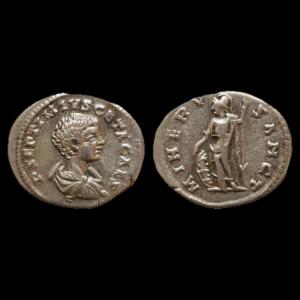
ObverseLegend: M OPEL ANT DIADVMENIAN CAES surrounding a youthful bare-headed bust, draped right.
The portrait is particularly expressive: hair rendered in compact locks/curls, a wide-open eye, a crisp profile (forehead–nose–chin), and drapery readable at the neck, with relief still strong despite normal high-point wear. The legend can be followed broadly, with a few localized softenings due to centering and the rim.
ReverseType: PRINC IVVENTVTIS — Diadumenian standing, facing, head right, holding a vexillum and a scepter; two military standards raised in the field above a ground line.
The composition is immediately recognizable: the vexillum is well placed in hand, the scepter remains perceptible, and the two standards are distinct in the right field. Despite a small marginal flan weakness, the overall reverse structure remains clear, and the “PRINC IVVENTVTIS” titulature is largely legible in segments.
Surface readingSilver in a white-gray tone with a discreet cabinet patina; fields showing micro-striations and fine contact traces, with no visible artificial uniform smoothing. The beaded border (pearl rim) appears in places, and slight flan stresses at the edge (tiny micro-fissures/irregularities) are noted—features commonly encountered on Severan denarii and compatible with ancient striking.
Grade of preservationSuperb / Extremely Fine (EF): strong relief on both obverse and reverse, very readable portrait, typologically powerful and immediately identifiable reverse, legends largely preserved, with generally harmonious centering despite a marginal weakness.
SpecificationsAuthority: Diadumenian, Caesar (217–218)
Mint: Rome (probable)
Date: c. AD 217–218
Denomination / metal: Denarius, silver (AR)
Weight: 3.54 g (metric consistent with the period’s issues)
Obverse: M OPEL ANT DIADVMENIAN CAES — bare-headed, draped bust right
Reverse: PRINC IVVENTVTIS — Diadumenian standing with vexillum and scepter; two standards in right field
References: Cohen 3; BMC Macrinus 87; RIC Macrinus 102
Grade: EF, stable silver patina, sharp relief
Raised to Caesar by Macrinus in 217, Diadumenian embodies the officially presented heir of the regime. The title PRINC IVVENTVTIS (“Prince of the Youth”) follows the honorific tradition granted to heirs as symbolic heads of the equestrian order, while the standards on the reverse emphasize the military dimension and the expected loyalty of the troops. These issues are brief and precede Macrinus’ fall to Elagabalus (218), strengthening the historical and numismatic interest of these denarii.
Formal and material assessment of the specimenStrike structure consistent: relief formed by continuous volumes, natural relief-to-field transitions; beaded border visible in segments.
Coherent mint style: compact youthful portrait, energetic treatment of curls, short neck drapery; readable military reverse (vexillum + two standards).
Homogeneous silver: sound surface, discreet cabinet patina; micro-marks consistent with ancient circulation and handling.
Typology and metrology: consistent with the cited references (Cohen, BMC, RIC).
An emblematic piece from a rapid political transition, this denarius combines a highly expressive youthful portrait with a programmatic reverse (PRINC IVVENTVTIS) linking dynastic legitimacy and military language. A collection choice that is both documentary and aesthetic, immediately legible in display or study.
Traceability & guaranteesProvenance: private collection, attested by certificate of authenticity.
Authenticity: certificate provided + expert report document.
Sale: specialized international transaction within a recognized numismatic network, validated by reference experts, in line with the highest standards of the art and heritage market.
Reinforced packing (shock protection, discreet outer packaging) and shipment against signature, fully insured, with tracking. Dispatch via Colissimo or Chronopost depending on destination and logistical constraints.
Period: Before 16th century
Style: Rome and Antic Greece
Condition: Good condition
Reference (ID): 1716333
Availability: In stock