Rare Triumphal Sestertius Of Commodus — Certificate Of Authenticity
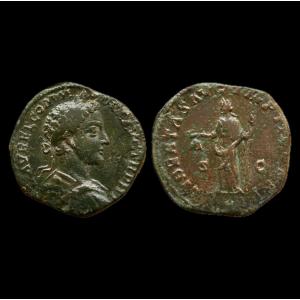
This rare sestertius of Commodus, still Caesar under Marcus Aurelius, struck at Rome in AD 177, belongs to a particularly expressive commemorative type devoted to Roman successes on the Germanic front, and more specifically to the reverse TR P II COS / S C / DE GERM, with a central trophy flanked by two seated captives; the attribution to RIC III, no. 1555 fully accords with the obverse titulature IMP CAES L AVREL COMMODVS GERM SARM and with the reverse iconography described in the specialized repertories, while current numismatic documentation notes this type as rare, with a Numista rarity index of 100, and comparable specimens published in the specialized trade under the same reference.
Each specimen is examined, described, and accompanied by a certificate of authenticity in accordance with the standards of the art and heritage market; the present piece is immediately appealing for the nobility of its broad module, the vigor of its youthful laureate portrait, and above all the historical force of its victory reverse, where the military trophy, the captives, and the inscription DE GERM condense—within the very substance of Roman bronze—an entire language of imperial domination and triumphal memory.
Analysis & Expertise
Close observation under ×10 magnification and raking light. Direct examination of the obverse reveals a laureate, draped, and cuirassed bust right whose overall structure is preserved with strong reading authority: the laurel wreath remains clearly articulated, the hair locks retain a visible rhythm around the forehead and nape, the eye is still firmly set in relief, and the line of the nose, mouth, and chin forms an energetic youthful profile fully consistent with Commodus’ iconography in his Caesarian phase; the deliberately powerful neck, as well as the beginning of the drapery and cuirass, preserve a convincing material presence that strengthens the coin’s overall quality.
The obverse peripheral legend develops in a particularly satisfactory manner for this type, with extended readability of IMP CAES L AVREL COMMODVS GERM SARM, whose letters—tall and well formed—remain largely perceptible around the circumference; centering proves favorable in that it preserves the essential titulature as well as the portrait’s breathing space, while the border can still be followed in regular segments, giving the obverse a very appreciable visual steadiness in a demanding commercial context.
The reverse commands the collector’s attention with singular force, because the victory scene remains very legible in both its principle and its structuring details: the central trophy rises clearly in the middle of the field, with its vertical shaft firmly set and its lateral appendages still discernible; on either side, the two seated captives appear coherently at the base, in a posture of submission emblematic of Roman triumphal language; the letters S C remain visible in the fields, and the exergue DE GERM can be recognized with sufficient firmness to fully support the type attribution.
The surface displays an old dark-green and copper-brown patina, with warmer metal highlights on the projecting reliefs, creating a contrast particularly favorable to reading the portrait and the trophy; slight ancient encrustations, localized and stable, integrate naturally into the piece’s material life without breaking the relief’s coherence or disturbing the understanding of the type, while the continuity of volumes, the suppleness of transitions, and the edge configuration fully accord with an ancient hammer strike, as expected for a large official Roman bronze.
The interest of this specimen lies precisely in this combination—uncommon on a second-century victory sestertius—of a well-preserved portrait, ample legend, immediately intelligible reverse, and an old patina of fine presence; the result is an object that is not limited to a catalogue reference, but still preserves, in its own materiality, the political and military gravity of the issue.
Characteristics
Authority
The issue belongs to Commodus in his capacity as Caesar, under the reigning authority of Marcus Aurelius, within the framework of Rome’s official imperial coinage.
Mint
The mint is Rome, as retained by specialized catalogues for this reference number.
Dating
The strike is placed in AD 177, in accordance with the titulature TR P II COS and the reference documentation attached to the type.
Denomination
This is a sestertius, a large circulating bronze denomination of the Roman imperial monetary system.
Metal
The type is catalogued in bronze, fully confirmed by the appearance of the observed specimen.
Weight
The recorded weight for this specimen is 25.34 g, a very satisfactory mass for a large imperial bronze of this format and consistent with specialized examples published under the same reference.
Diameter
The observed diameter is 32 mm, a particularly appealing dimension that gives the reverse scene its full visual breadth.
Obverse
The obverse bears the legend IMP CAES L AVREL COMMODVS GERM SARM around a laureate, draped, and cuirassed bust right.
Reverse
The reverse shows TR P II COS, with S C in the fields, DE GERM in the exergue, and a trophy between two seated captives at its base.
Typological reference
The identification is based on RIC III, 1555, a reference repeated by Numista and by comparable specialized specimens.
Rarity
The type should clearly be presented as rare: the Numista entry assigns it a rarity index of 100, while market descriptions likewise qualify it as rare under the same reference.
Historical context
This coin belongs to the decisive years of the Marcomannic Wars, a vast cycle of conflicts led by Marcus Aurelius against the peoples of the Danube and the Germanic world, after which Roman successes gave rise to an intense political and monetary staging; synthetic sources recall that Marcus Aurelius and Commodus celebrated a joint triumph on 23 December 176 for victories over the Germans and Sarmatians, which directly illuminates the presence, on the issues of 177, of the titles GERM and SARM, as well as the reverse DE GERM.
The present sestertius thus belongs to a moment of very high dynastic density, for Commodus—still Caesar when this type was struck—already appears associated with the victorious language of the Antonine principate; it is not merely a circulating coin, but an instrument of political memory, intended to inscribe in Rome’s public space the image of a legitimate heir already enveloped in his father’s military glory.
The choice of a trophy flanked by captives answers one of the most powerful schemes of Roman triumphal iconography, as it conveys not only victory but the visible reduction of the adversary; through this compact staging, Rome transforms the military event into a lasting sign, immediately intelligible to the ancient gaze as well as to the modern collector’s eye.
Cultural value
The cultural value of this piece is of the first order, because it unites in a single object the dynastic youth of Commodus, the victory propaganda of Marcus Aurelius, and the great visual tradition of trophies and captives that runs through Roman political art; such a sestertius belongs to that category of coins which, while remaining strictly numismatic, function almost like miniature historical reliefs.
For the collector, the charm of this type also lies in the tension it carries between princely portrait and martial reverse: on the obverse, the heir still appears within the institutional discipline of the Caesar; on the reverse, the language of triumph already places him within the horizon of victorious sovereignty; this articulation gives the object a particular historical depth that far exceeds mere catalogue rarity.
From the standpoint of art history, this coin belongs to the Roman civilization of the High Empire, in that Antonine moment when the image of power intimately combines portrait, titulature, and the theatre of victory; one may think here, for cultural illumination, of the historical sculpture of the age of Marcus Aurelius, and in particular of the great triumphal reliefs as well as the Column of Marcus Aurelius, where the Danubian war likewise receives a monumental translation of the same symbolic order as that summarized—on the scale of coinage—by this remarkable sestertius.
Traceability & Guarantees
From a European provenance, from an established numismatic dealer, this specimen was acquired through a specialized international transaction conducted within a recognized numismatic network and validated by reference experts, in accordance with the highest standards of the art and heritage market; examination of the present object retains exclusively the elements effectively observable on the coin, set within the framework of recognized bibliographic and typological references, in order to offer a firm, precise presentation consistent with sector practice.
Each specimen is examined, described, and accompanied by a certificate of authenticity in accordance with the standards of the art and heritage market; in the present case, the overall coherence between module, style, titulature, reverse construction, old patina, and concordance with RIC III 1555 establishes a particularly solid numismatic attribution.
Period: Before 16th century
Style: Rome and Antic Greece
Condition: En l'etat
Reference (ID): 1730173
Availability: In stock