



Diorama Ox-drawn Cart In Terracotta, China, Northern Qi Dynasty, Tl Test & Certificate
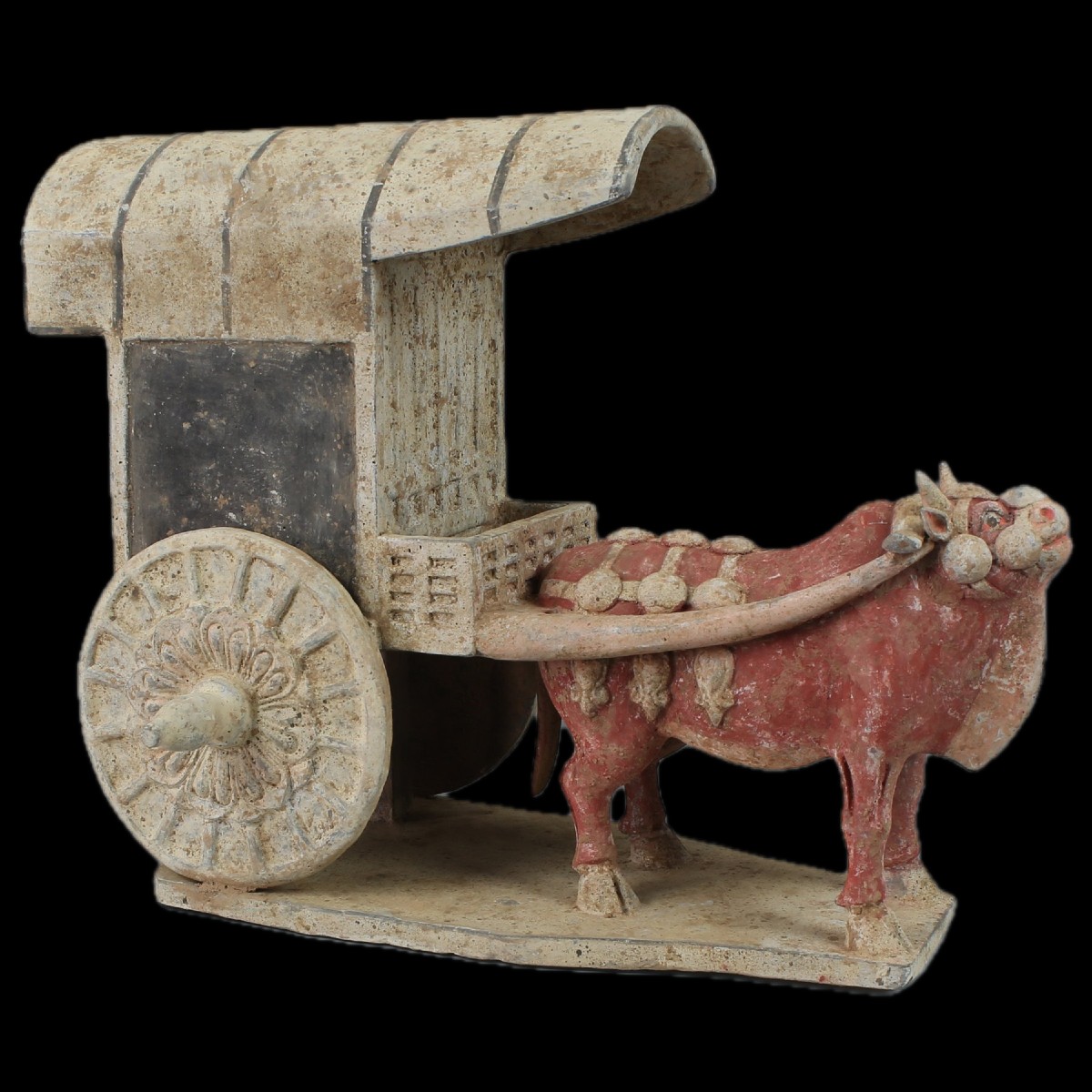
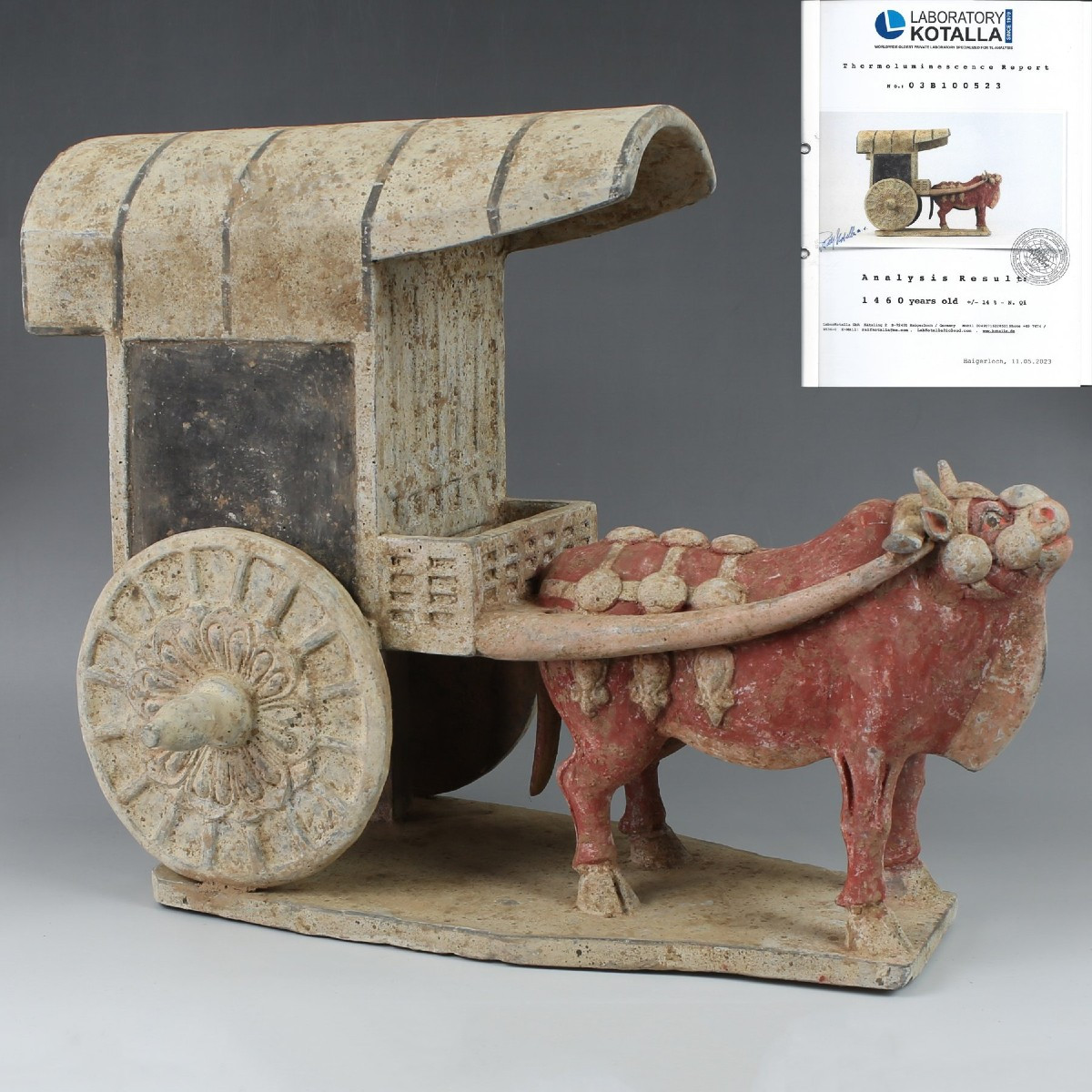
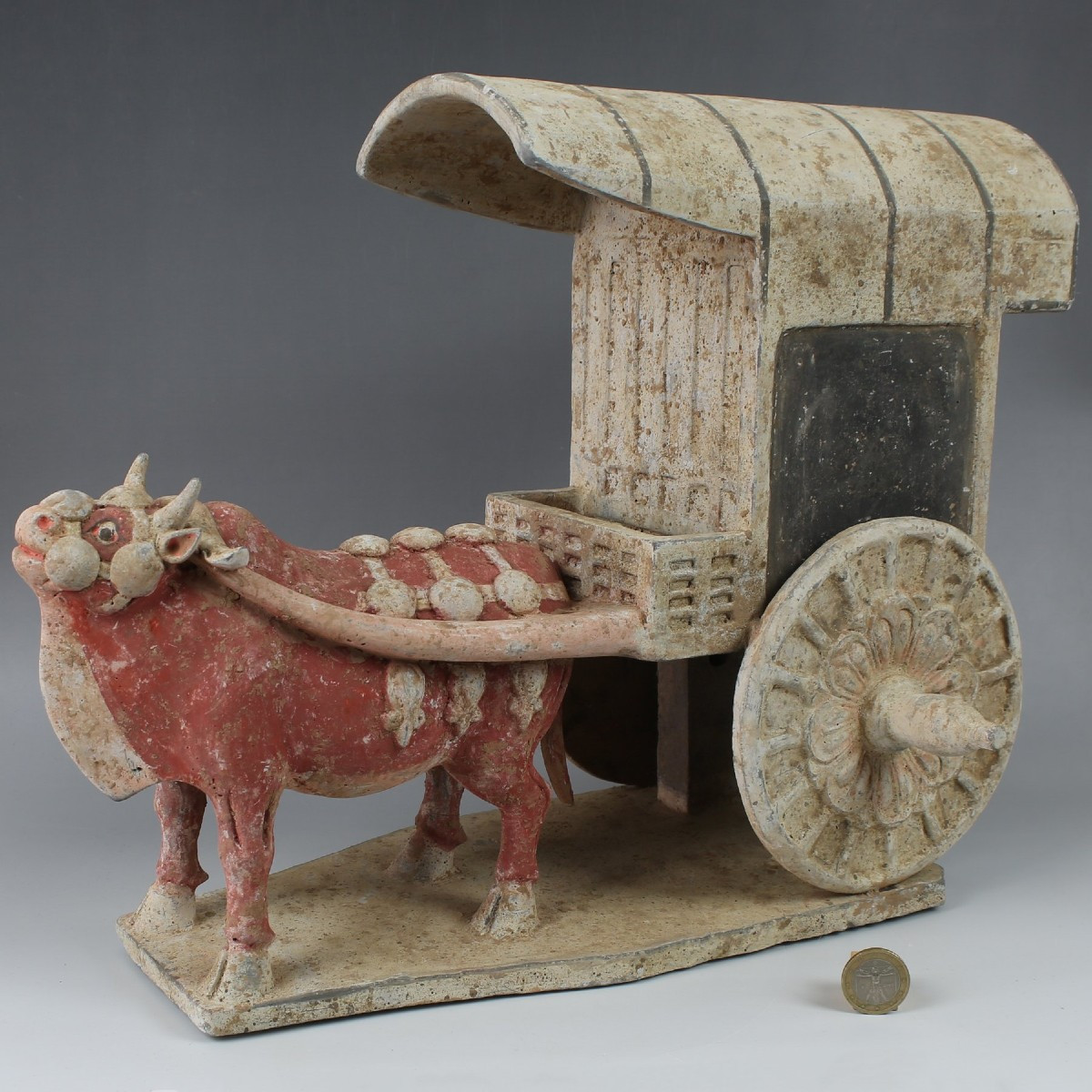
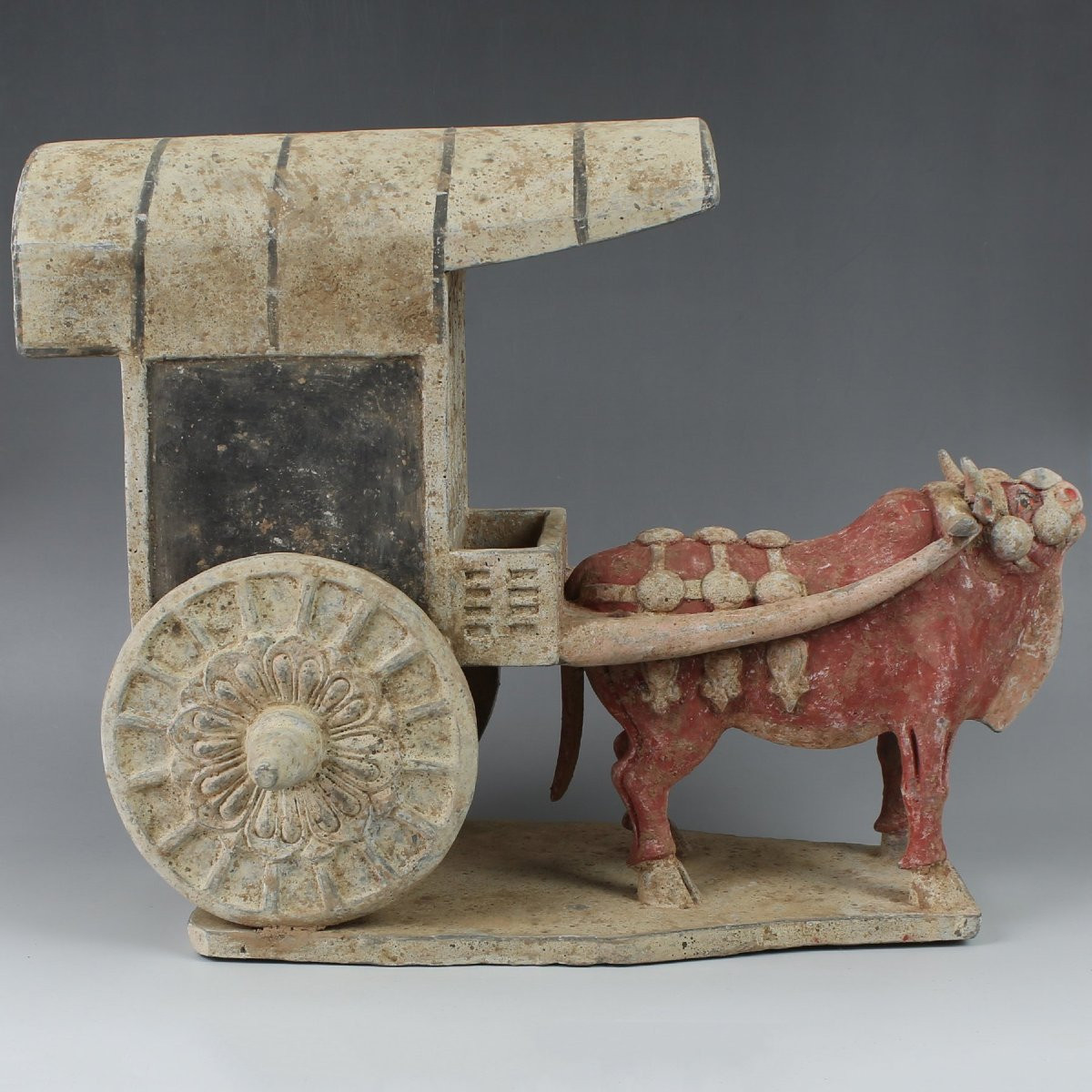
Exceptional funerary terracotta diorama depicting an ox pulling a covered cart, perfectly aligned with the repertoire of mingqi models from the Northern Qi dynasty. The piece stands out for its coherent preservation, extensive surviving polychromy and unusually clear sculptural detail, well above the average examples typically seen on the market.
Attribution and authenticity are supported by three converging factors:
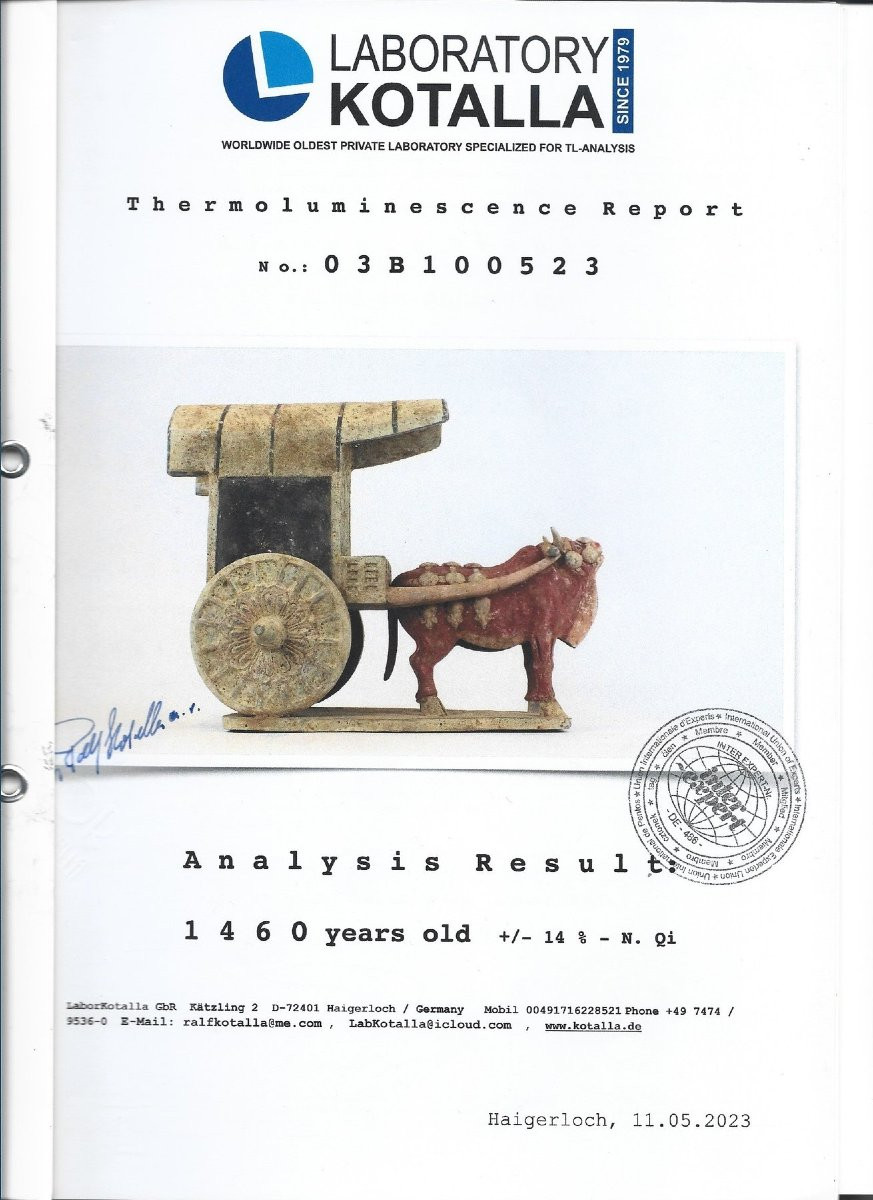
• Scientific confirmation: Thermoluminescence test (Kotalla Laboratory, ref. 03B100523) gives an age of c. 1,460 years ± 14%, fully consistent with a 6th-century firing during the Northern Qi period.
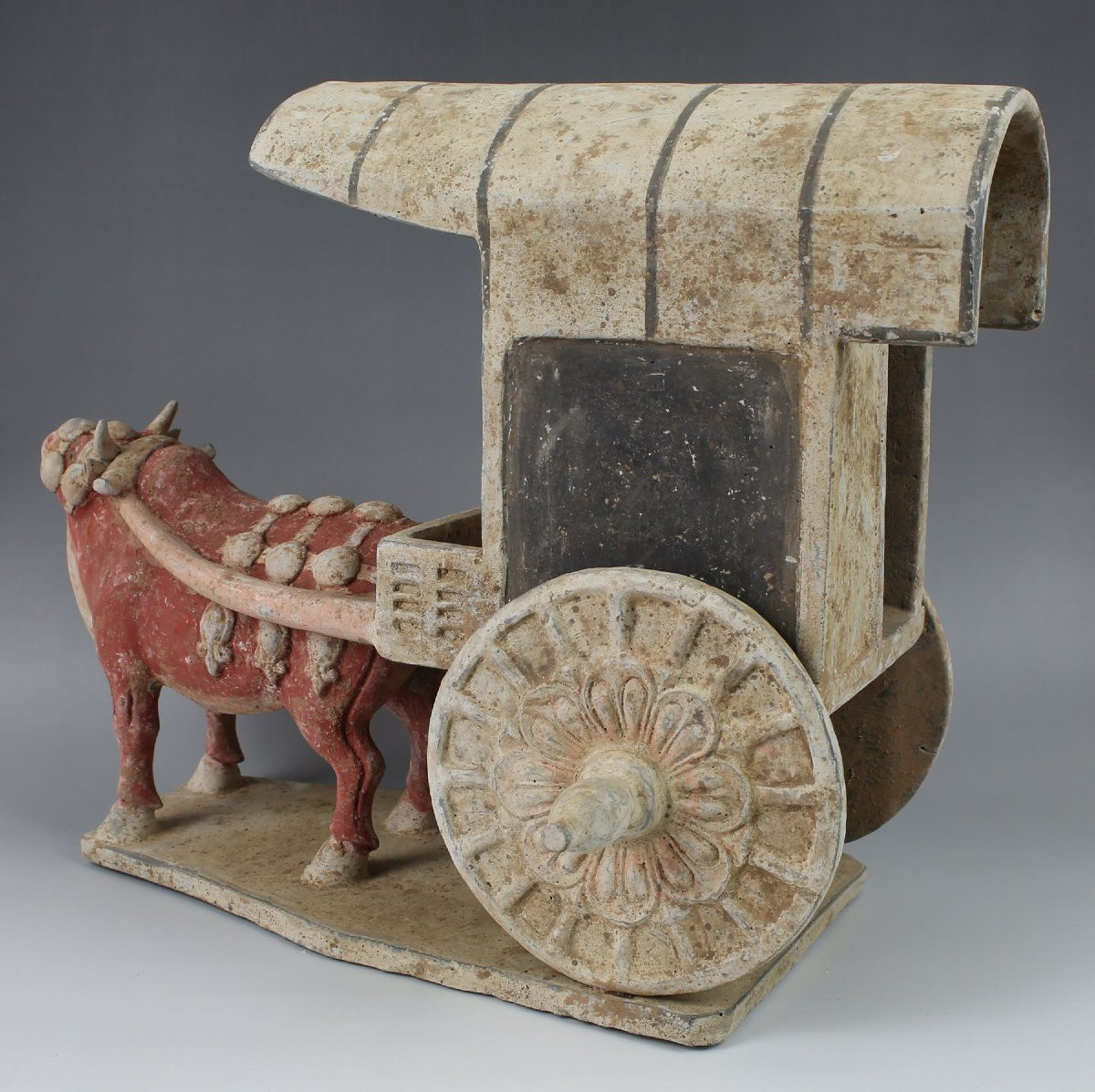
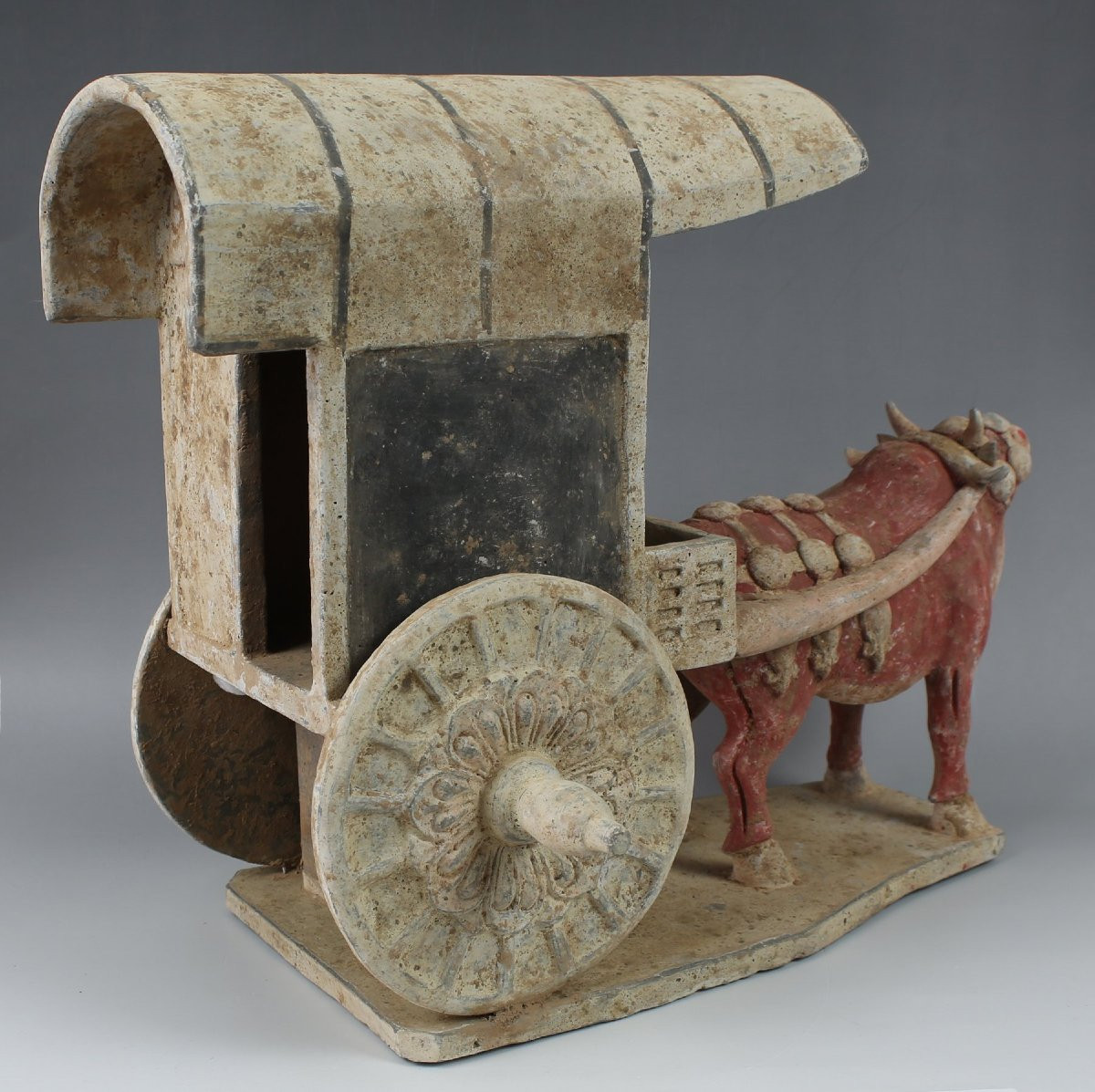
• Stylistic coherence: The arched canopy, large rosette wheels, high-sided cart body and the powerful red-painted ox correspond closely to museum-held comparanda and published reference models.
• Material authenticity: Continuous patina, mineral encrustations, natural micro-erosions, pigments anchored deeply in the terracotta matrix, and absence of visible heavy restorations.
Altogether, this is an authentic and carefully preserved example of high sculptural and narrative quality — more than a simple funerary model, it approaches a small-scale ceremonial scene.
CharacteristicsObject: Ox-drawn cart diorama (mingqi funerary model)
Material: Molded and modelled terracotta with mineral cold-painted polychromy
Culture: Chinese
Period: Northern Qi Dynasty, ca. AD 550–577
Dimensions: approx. 305 × 155 × 393 mm
Condition: Good overall condition – coherent surface wear, minor losses, well-preserved ancient polychromy
Provenance: Former Belgian private collection (pre-1990), later Dutch gallery
Documents included: Certificate of authenticity, TL test (Kotalla), older gallery certificate, export licence if required
This diorama belongs to the vast world of mingqi, the “spirit objects” placed in tombs to accompany the deceased into the afterlife. From the Han to the Tang dynasties, models of houses, granaries, carts, livestock and attendants proliferated, reflecting the idea of the tomb as a miniature household.
The Northern Qi dynasty (AD 550–577) occupies a pivotal artistic moment: still influenced by the rigid aesthetics of the Northern Wei, yet anticipating the later Tang vitality, it merges Chinese sedentary traditions with Xianbei nomadic motifs and witnesses the spread of Buddhism and increased refinement in decorative arts.
Ox-drawn carts symbolise agricultural wealth, social rank and, metaphorically, the eschatological journey. Their original polychromy strengthened their presence in the tomb, transforming the burial chamber into a theatrical reconstruction of lived experience.
Formal & Material Analysis1. Overall compositionSet on a slightly irregular rectangular base with ancient softened edges. The ox stands firmly in front, balancing visually with the high-sided, covered cart behind it. The ensemble creates a stable, highly expressive silhouette ideal for display.
2. The oxPowerful modelling: full chest, short neck, rounded volumes typical of regional funerary sculpture rather than anatomical realism.
Red mineral pigment with natural crackling, abrasions on relief points showing underlying clay.
Decorated harness with hemispherical studs in pale pigment.
Expressive head: rounded muzzle, open nostrils, protruding eyes with light highlights, short horns with minor ancient chips.
Wheels: large, nearly as tall as the cart body, each with a deeply carved radiating rosette; softened relief indicates slow, ancient erosion.
Cart body: one side painted dark grey-black with mineral encrustations; the opposite side carved with vertical grooves suggesting wooden slats.
Canopy: wide arched roof projecting forward, with dark painted stripes indicating structural ribs; ancient chips reveal natural clay colour beneath.
Beige-sand patina scattered with brown and grey mineral spots.
Heavier earth deposits under the cart and around the base, typical of long burial.
Subtle tool marks under the base and around the canopy confirm ancient manufacture.
No visible modern joins or intrusive restorations.
This piece offers several levels of interest:
• Documentary value: Accurate depiction of a covered transport cart, providing insight into mobility, economy and funerary ideology in 6th-century northern China.
• Aesthetic value: Strong contrast between the red ox and the cream-black cart, enhanced by sculpted rosette wheels; a dynamic interplay of circular and rectilinear forms.
• Rarity: Complete cart-and-ox dioramas of this scale and preservation are considerably rarer than isolated mingqi figurines.
• Museum-level quality: Comparable to examples in major institutional collections.
Provenance:
– Belgian private collection (pre-1990)
– Dutch gallery (with historical certificate)
Scientific analysis:
– Thermoluminescence test, Kotalla Laboratory (03B100523), average age 1,460 years ± 14%
Documents provided:
– Current certificate of authenticity
– TL test report (Kotalla)
– Older gallery certificate
– Export licence for destinations outside the EU (if legally required)
As a regulated archaeological cultural object, export outside the EU (USA, Asia, etc.) requires a formal export licence. Processing time may range from 6 weeks to 3 months, depending on the administrative review.
Due to size, weight and fragility (ancient polychromy, horns, studs, wheel hubs), shipping is prudently limited to the EU, UK and nearby countries via specialist art transport with reinforced packing and secure, door-to-door delivery.
Accepted Payment Methods– Bank transfer (preferred)
– Credit card via secure payment link
– Cheque (shipping only after full clearance)
Please contact us to confirm your preferred payment method so we may organise the transaction smoothly.
Period: Before 16th century
Style: Asian art
Condition: Good condition
Reference (ID): 1695522
Availability: In stock