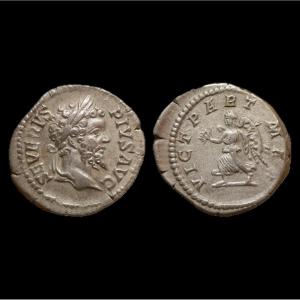


Septimius Severus — Denarius Vict Part Max, Ric Iv.1 295 — Certificate Of Authenticity
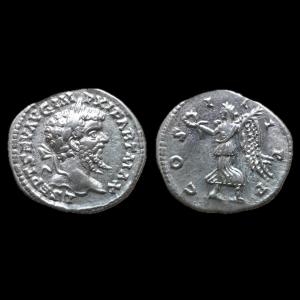
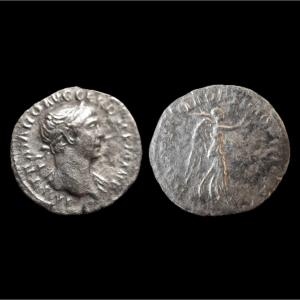
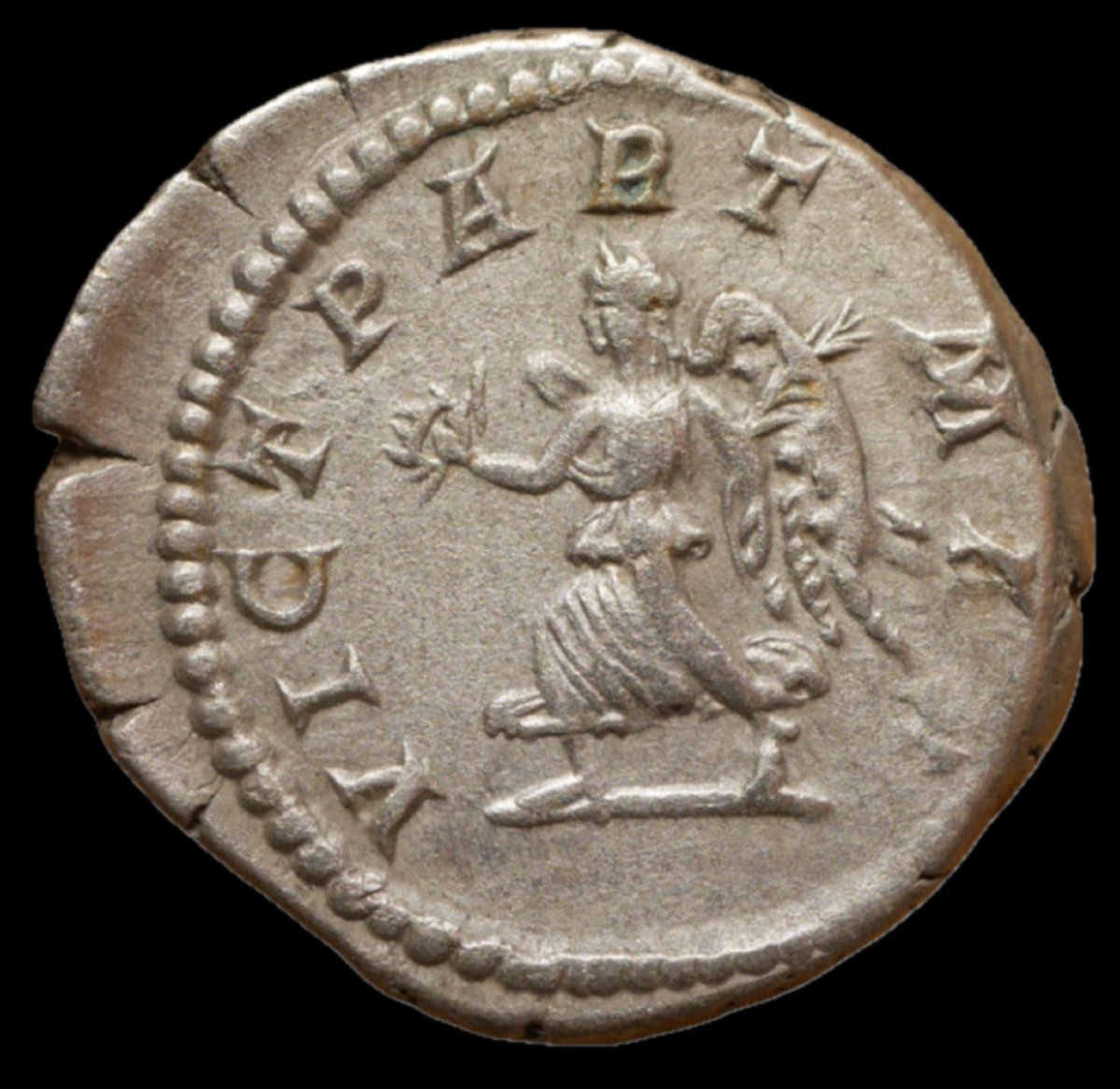
This silver denarius of Septimius Severus, struck at Rome and catalogued as RIC IV.1, 295, belongs to the series bearing on the obverse SEVERVS PIVS AVG and on the reverse VICT PART MAX, with Victory advancing left, holding a wreath and a palm, a type firmly recorded by Numista / OCRE as a Roman silver denarius of AD 202–210, 19 mm in diameter with a reference weight of 3.3 g; the specimen presented here, at 3.00 g for 19 mm, therefore fits with complete coherence within the typological and metrological parameters expected for this issue. Each specimen is examined, described, and accompanied by a certificate of authenticity in accordance with the standards of the art and heritage market.
Analysis & Expertise
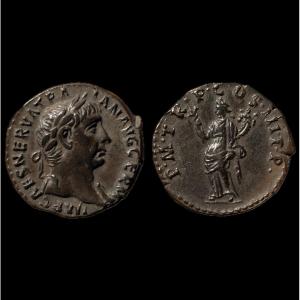
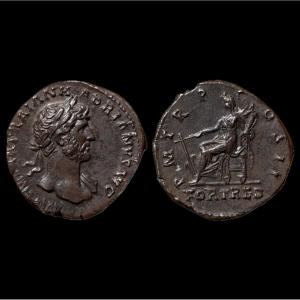
Close observation under ×10 magnification and raking light. The obverse shows a laureate head of Septimius Severus right whose structure remains very satisfactorily legible, with short hair rendered in tight locks, a laurel wreath clearly identifiable in its spread, a regular forehead, a well-opened eye, a frank nasal line, a firmly drawn mouth, and a short, curly beard still well held in its mass; the legend SEVERVS PIVS AVG remains broadly intelligible around the circumference, and the beaded border, well preserved over a large part of the circle, gives the obverse a strike quality particularly appreciable for a Severan denarius that truly circulated. The type description published by Numista corresponds exactly to this obverse scheme.
The reverse retains clear iconographic readability, with a winged, draped Victory advancing left, holding in the extended right hand a wreath and carrying in the left an inclined palm, according to a reverse formula Numista describes in precisely these terms; the legend VICT PART MAX remains legible in coherent segments and structures the field effectively, while the goddess’ silhouette remains sufficiently firm to preserve full comprehension of the type. This point is particularly important for this issue, since the coin’s interest largely rests on the combined legibility of the imperial portrait and the victorious reverse formula.
The silver surface presents a coherent ancient appearance, with relief still crisp on the high points of the portrait and of Victory, a regular residual brightness on the areas best brought out by the strike, and fine old handling marks that integrate naturally into the material life of an ancient denarius; the flan, slightly irregular in shape, fully matches the manufacturing mode indicated by Numista for this type—namely hammer striking—and the small marginal tensions visible at the edge remain compatible with the material logic of this Roman coinage. All observable characteristics—border, letter relief, relief behavior, and flan structure—thus accord very convincingly with the series documented under RIC 295.
What favorably distinguishes this specimen for the knowledgeable collector is the combination of a well-set portrait, a broadly preserved obverse titulature, an immediately identifiable VICT PART MAX reverse, and metrology exactly within the published range, Numista noting for this type a variation of 2.69 to 3.948 g and 17.6 to 21.42 mm. It is therefore a technically coherent and typologically very secure specimen, whose legibility fully supports presentation quality.
Characteristics
Authority.
This issue belongs to Septimius Severus, emperor from AD 193 to 211.
Mint.
Rome, explicitly indicated by Numista for this reference.
Dating.
Numista’s typological entry places this type within AD 202–210.
Denomination.
Denarius.
Metal.
Silver.
Weight.
3.00 g, fully compatible with the published range for the type.
Diameter.
19 mm, exactly matching the reference diameter indicated for this issue.
Technique.
Hammer struck on an irregular round flan.
Obverse.
SEVERVS PIVS AVG, laureate head of Septimius Severus right.
Reverse.
VICT PART MAX, winged and draped Victory advancing left, holding a wreath in the right hand and a palm in the left.
Typological references.
Catalogued as RIC IV.1 295, with the OCRE reference ric.4.ss.295_denarius; the specialized market reference consulted likewise lists it as RIC 295.
Historical context
The reverse legend VICT PART MAX is explicitly translated by Numista as Victoria Parthica Maxima, i.e., a formulation of “greatest Parthian victory,” clearly placing the issue within Septimius Severus’ triumphal language; it is therefore a denarius of victorious propaganda, where Victory’s image and the titulature condense a political message of military success. The coherence of this message is confirmed by the typological notice itself, which identifies the reverse unambiguously as Victory advancing with wreath and palm.
Within Severan coinage, this type belongs to a family of Roman denarii whose message effectiveness rests on a simple, strong articulation between imperial portrait and triumphal allegory; the use of Victory as personification, coupled with PART MAX, gives the coin an immediately legible doctrinal force for the informed admirer of the reign. Specialized comparanda describe the same type with the same combination of legend and figure.
Cultural value
The cultural interest of this coin lies in the clarity with which it expresses—on a small silver module—an imperial policy of victory and military legitimization; the denarius does not merely bear a portrait, it states a program: that of a victorious prince whose authority is relayed by the winged figure of Victory and by the explicit mention of Parthian superiority. This alliance of iconographic legibility, epigraphic efficiency, and sober engraving fully corresponds to what the best Rome denarii under Septimius Severus can achieve.
For a cabinet oriented toward the Severans, military-propaganda denarii, or technically well-established victory-legend types, this specimen offers an evident appeal—not through artificial emphasis, but through the quality of its typological conformity, the good bearing of its portrait, and the sustained legibility of its reverse. Numista assigns it a rarity index of 84, placing it in a well-followed collecting zone of real interest, without removing it from the stable documentary logic of the type.
Traceability & Guarantees
From a European provenance, from an established numismatic dealer, this specimen was acquired through a specialized international transaction conducted within a recognized numismatic network and validated by reference experts, in accordance with the highest standards of the art and heritage market; examination retains only the stylistic, technical, epigraphic, and metrological characteristics effectively observable on the coin, set within the framework of Septimius Severus’ Roman VICT PART MAX type and compared with the available typological documentation.
Each specimen is examined, described, and accompanied by a certificate of authenticity in accordance with the standards of the art and heritage market; in the present case, the concordance between the obverse SEVERVS PIVS AVG, the reverse VICT PART MAX, the Rome mint, the observed metrology, the manufacturing technique, and the attribution to RIC IV.1 295 establishes a particularly solid numismatic identification.
Period: Before 16th century
Style: Rome and Antic Greece
Condition: Good condition
Reference (ID): 1730267
Availability: In stock