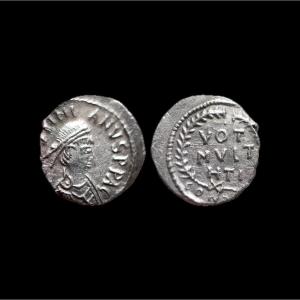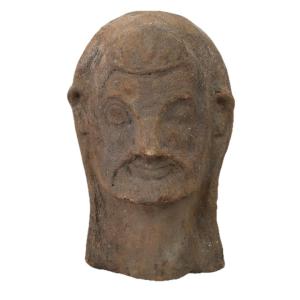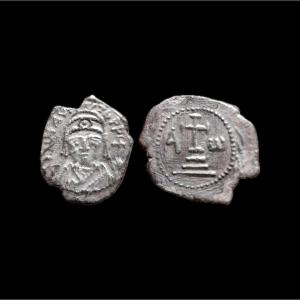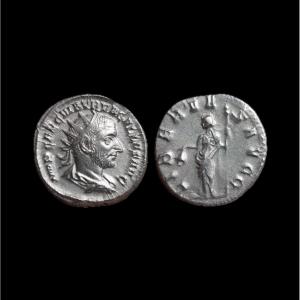
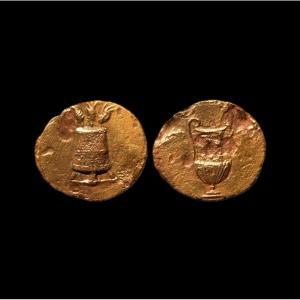


Roman Tessera “modius & Kantharos” — With Certificate Of Authenticity
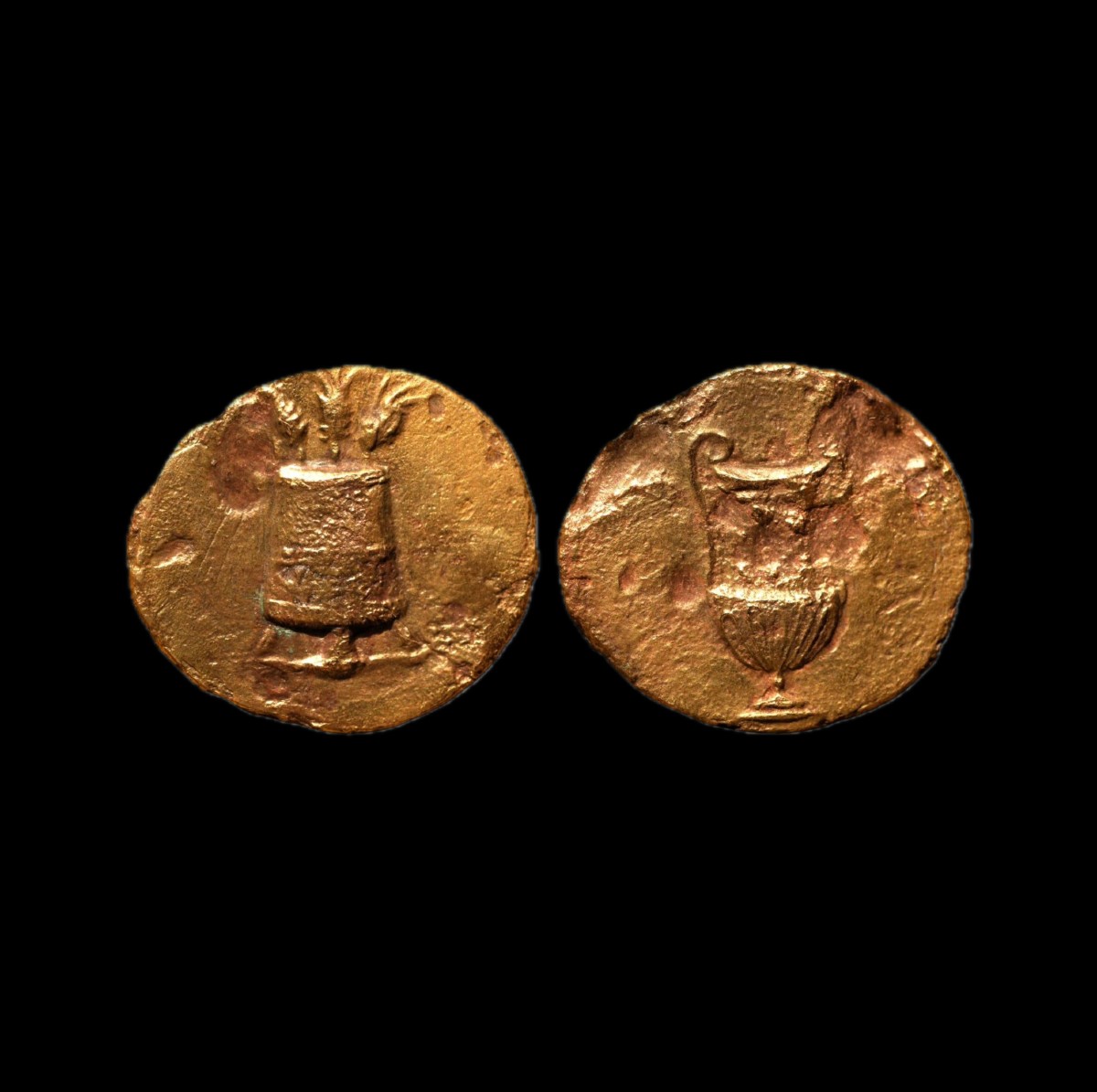
Within the particularly sought-after family of small anonymous issues in copper alloy, commonly described as quadrans or tessera, and generally placed, according to cataloguing tradition, within a horizon extending from the end of the 1st century to the middle of the 2nd century AD, this specimen stands out for the evocative strength of an iconographic pairing that is at once simple, immediately legible, and subtly “speaking” to the collector—namely the modius (grain measure) filled with three ears of wheat and the kantharos (wine vessel), a combination explicitly noted in the cited references (Cohen VIII 55; Göbl 100; Mazzini pl. LXXIX, 55; Lambros 1612) and regularly described as rare in comparative market notices and archival records.
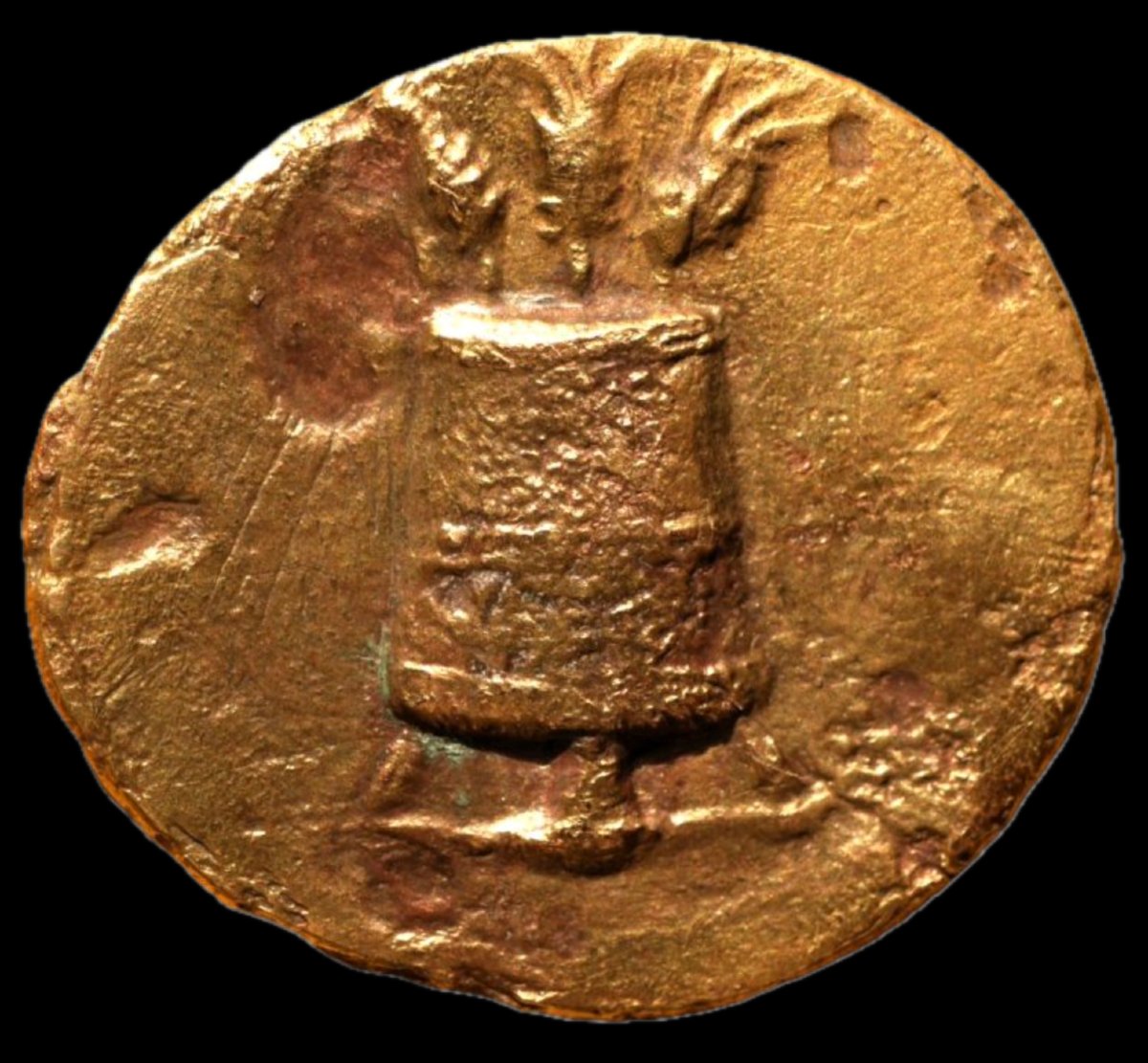
Analysis & expertiseCareful examination under ×10 magnification and raking light, applied to the photographs provided with sustained attention to the relief topography, the behavior of the fields, and the overall coherence of the flan, highlights—on the modius side—a “measure”-type container with a clearly structured body, whose surface shows a material grain and micro-texture catching the light in a discontinuous manner; the upper rim reveals, above the lip, three upright ears of wheat whose silhouettes, though partly softened by circulation, remain sufficiently individualized to support a secure reading of the expected motif and to align it, by type concordance, with the published descriptions for this series.
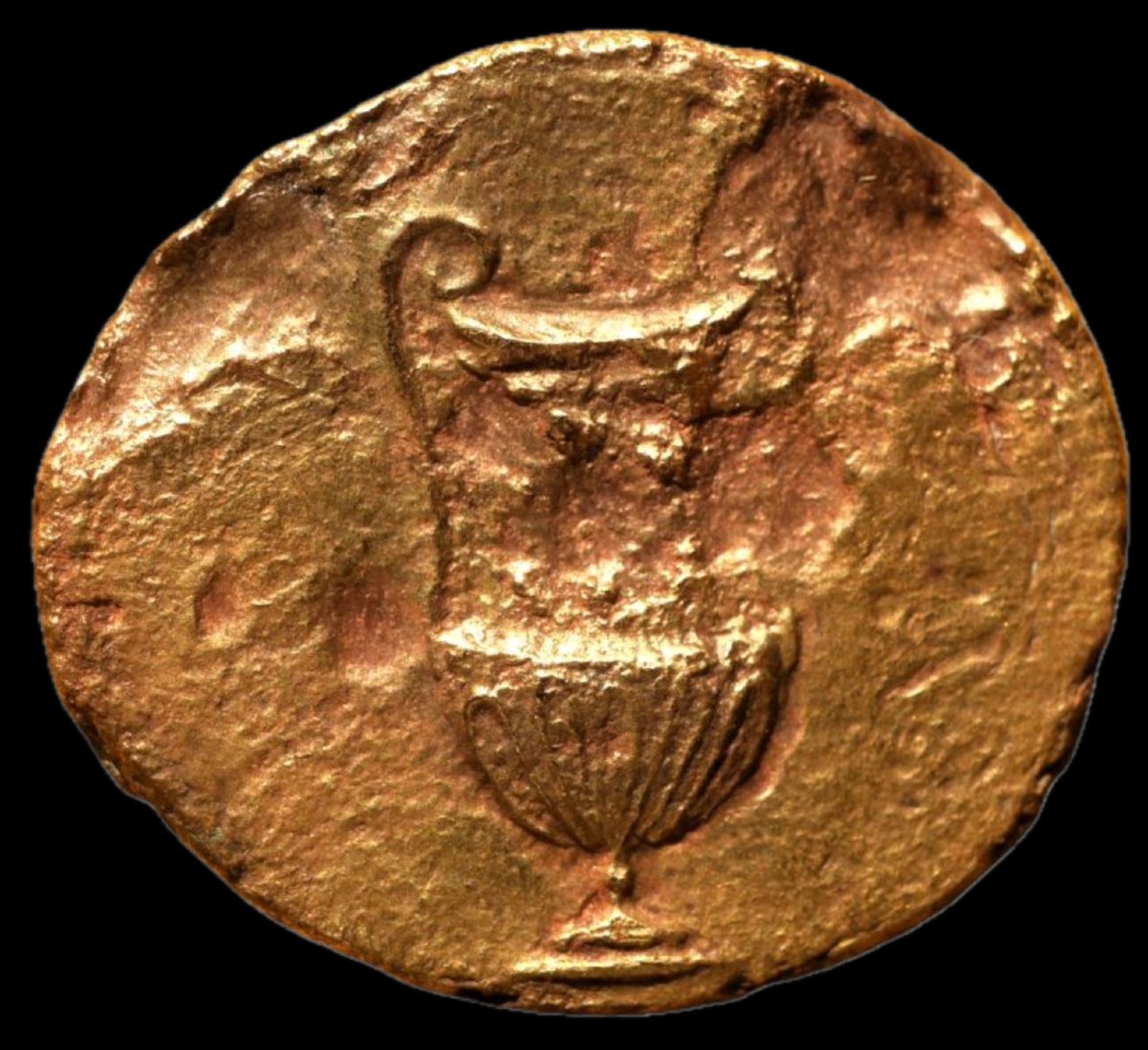
On the kantharos side, examination brings out a drinking vessel with high handle(s), one of which—clearly visible—draws a broad arc with a characteristic upper return; the cup and its foot, although crossed by slight areas of softening and by a few surface irregularities typical of ancient copper alloys, retain the essential geometry, thus offering the eye that immediate recognition of the kantharos as defined by ancient ceramic and iconographic tradition, a vessel deeply associated with the sphere of wine and ritual conviviality.
The metallic surface, golden to brown in appearance, with warmer nuances in places and small chromatic heterogeneities reading as the normal life of an ancient copper alloy, displays a visually stable, coherent patina across the fields; the flan, noticeably irregular—with a few thicker peripheral areas and slight edge flattening—retains a very “true” material presence, consistent with what is frequently observed on small-module anonymous tesserae, whose manufacture and use favored practical circulation over geometric perfection.
Finally, the absence of a clearly readable legend in the photographs, together with the fully “type-driven” character of both motifs, accords entirely with the documentary habitus of this series, often described as anepigraphic, and regularly placed among anonymous groups attributed, by typological caution, to a broad period extending from Domitian to Antoninus Pius according to numismatic cataloguing practice.
SpecificationsUsual denomination and cataloguing date range: anonymous quadrans or tessera, generally placed within approx. AD 96–161, according to the usage of catalogues and comparative sale archives.
Metal and module: copper alloy (Æ), 17.5 mm and 3.26 g, metric values reported for this specimen and consistent with the orders of magnitude observed on close comparanda.
Type, modius side: modius (measure) containing three ears of wheat, a particularly characteristic agricultural and annona-related motif.
Type, kantharos side: kantharos (drinking vessel), a motif explicitly attested in notices describing this iconographic pairing.
References: Cohen VIII 55; Göbl 100; Mazzini pl. LXXIX, 55; Lambros 1612—an ensemble of citations regularly repeated in collection and market descriptions for this type.
Rarity: rare
Historical contextIn imperial Rome of the 1st–2nd centuries, monetary and para-monetary circulation was accompanied by auxiliary objects—tesserae, tokens, small anonymous bronze issues—whose exact function could vary by context, but whose iconography often organized itself around a vocabulary of subsistence and abundance; thus, the modius filled with ears of wheat, an image of a concrete measure and a promise of supply, naturally belongs to the imaginative world of the Annona and distributions, while the kantharos, a wine vessel, introduces a symbolic counterpoint tied to conviviality, the table, and social ritual.
It is further established, through commented sales documentation, that these tesserae with the modius / cantharus pairing are among the rare types for which an archaeological context has been discussed, several examples having been reported in 1st–2nd century contexts at Lepcis Magna in North Africa—a valuable datum which, without turning the piece into a “site coin,” strengthens the general historical footing of the series.
Cultural valueFor a collector, the appeal of this tessera lies both in its iconographic legibility, which allows immediate identification of the theme without relying on a legend, and in the cultural density of this dialogue between grain and wine—that is, between the two sensory pillars of Mediterranean civilization—of which Roman art knew how to make, through a few well-chosen signs, a précis of prosperity and stability; the bibliographic mention (Cohen, Göbl, Mazzini, Lambros) gives the object a “reference” foundation that nourishes, for the enthusiast, the learned pleasure of typology and reasoned comparison.
Traceability & guaranteesEach specimen is examined, described, and accompanied by a certificate of authenticity consistent with the standards of the art and heritage market; careful observation under ×10 magnification and raking light forms an integral part of the descriptive method, which relies for attribution on visible characteristics (types, style, organization of the relief) and on published bibliographic concordances, so that the client receives a piece presented with rigor of vocabulary and a fully verifiable typological coherence.
The provenance is European, from an established numismatic dealer, and the acquisition is carried out through a specialized international transaction, conducted within a recognized numismatic network and validated according to the demanding practices of the art and heritage market, lending the process the solidity of traceability expected by informed collectors.
Period: Before 16th century
Style: Rome and Antic Greece
Condition: Good condition
Reference (ID): 1720622
Availability: In stock