Memorial Follis Of Divus Romulus (rep) — Certificate Of Authenticity
Commemorative bronze issue struck at Rome under Maxentius (circa 310–311), dedicated to Divus Romulus († 309), featuring the celebrated domed sanctuary reverse crowned by the consecration eagle (AETERNAE MEMORIAE). Reference type RIC VI Rome 257, commonly noted as scarce.
Analysis & Expertise Close examination under ×10 magnification and raking lightThe coin is a bronze with a layered, ancient patina, dominated by a well-established deep green, accompanied by reddish-brown (coppery) tones and darker areas in the recesses. The surface shows a continuous fine micro-granulation with small, localized asperities, consistent with a long material history (circulation followed by stable patina development).
The flan is naturally irregular, with a slightly undulating rim and a localized peripheral weakness; this “living edge” is consistent with late Roman strikes from the Rome mint. Reliefs remain structurally legible (portrait, reverse architecture, letter placement), and the strike logic is intact: clear relief-to-field transitions and letter edges still present, without a uniformly smoothed appearance.
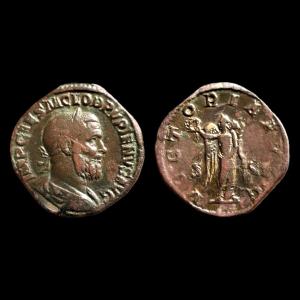
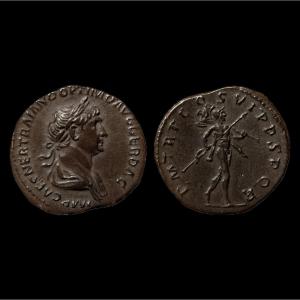
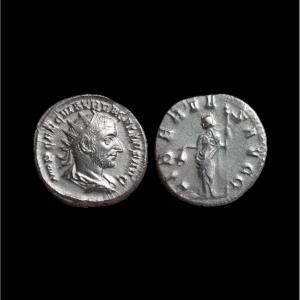
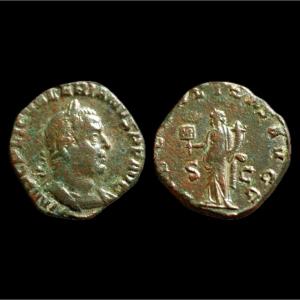
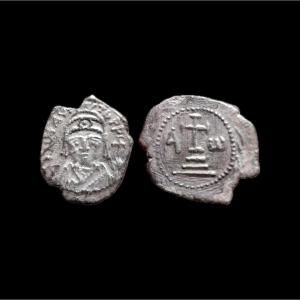
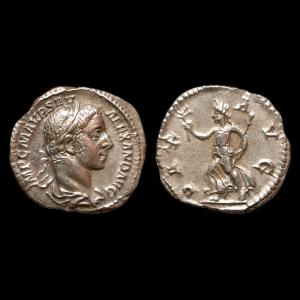
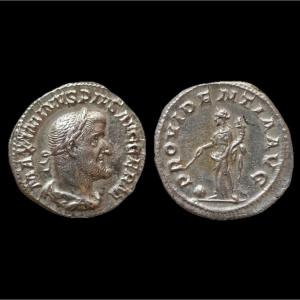
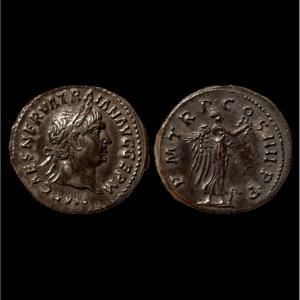
ObverseThe obverse matches the expected type: bare head right of the deified Romulus, with modelling still perceptible despite the patina (forehead, eye, nose, and mouth read in volume). The nape and the beginning of the bust are still suggested, reinforcing the portrait’s presence.
The legend DIVO ROMVLO N V BIS CONS is identifiable in segments around the rim: several letters stand out clearly, while others are softened by thicker patina and a slight flan weakness at the edge—an entirely typical configuration for these consecration bronzes.
ReverseThe reverse is immediately characteristic of the memorial programme: a domed sanctuary/edicule shown frontally, with a door marked centrally and an “architectural” treatment in panels/masonry registers that gives the monument a strong graphic reading. At the top, the consecration eagle (symbol of apotheosis) anchors the composition and unmistakably signals the AETERNAE MEMORIAE series.
The legend AETERNAE MEMORIAE encircles the monument; legibility varies by sector, yet the sequence of letters and the overall layout remain coherent. In the exergue, the mintmark REP appears in the expected arrangement for this Rome issue (mint and officina), a decisive element for attribution to RIC VI Rome 257.
SpecificationsAuthority: Divus Romulus (son of Maxentius), died 309; posthumous issue under Maxentius
Denomination: Æ follis / nummus
Mint: Rome
Date: circa 310–311
Obverse: DIVO ROMVLO N V BIS CONS, bare head right
Reverse: AETERNAE MEMORIAE / REP, domed sanctuary, door indicated; eagle on the dome (facing right, head left)
Reference: RIC VI Rome 257
Weight: 5.82 g
Diameter: 25 mm
The early death of Valerius Romulus in 309 led to his consecration, and under Maxentius it prompted a tightly controlled public message in which dynastic memory became a political instrument. The AETERNAE MEMORIAE reverses condense this programme: the domed monument embodies official commemoration, while the eagle expresses consecration and the elevation of the deceased.
The architecture depicted is frequently associated with Maxentian monuments linked to Romulus—whether the dynastic complex on the Via Appia or commemorative initiatives within Rome itself. This close pairing of “monument + coin” is precisely what makes the series so compelling for the visual and political history of the early 4th century.
Cultural ValueFor a collector, this follis offers several major strengths:
a consecration issue with an explicit message (AETERNAE MEMORIAE) that is immediately contextualisable;
a highly museum-like architectural reverse, emblematic of Maxentius’ monumental language;
an attribution firmly anchored in RIC, with the REP mintmark facilitating typological comparison within related variants.
In accordance with our practice, each specimen is examined, described, and supplied with a certificate of authenticity consistent with art-market and heritage standards. The study is carried out under ×10 magnification and raking light, with checks for typological, stylistic, epigraphic, and metrological coherence through comparison with standard references (RIC) and available parallels.
The coin comes from a professional European provenance, acquired through a specialised international transaction within a recognised numismatic network, following the standard validation practices expected for heritage objects.
Secure ShippingShipping is conducted with tracking, signature, and insurance, using protective packaging (individual protection, shock-resistant padding, discreet outer packaging) to ensure fully controlled transport of an ancient numismatic object.
Period: Before 16th century
Style: Rome and Antic Greece
Condition: Good condition
Reference (ID): 1716812
Availability: In stock