Rare Vetranio Maiorina With Chi-rho — Certificate Of Authenticity
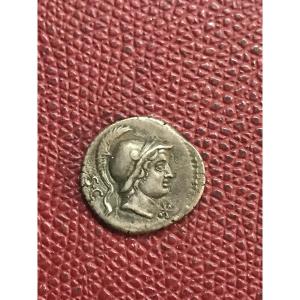
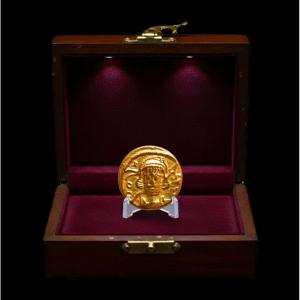
Bronze of Vetranio (usurpation of AD 350), struck at Thessalonica between March 1 and December 25, 350, notable for its CONCORDIA MILITVM reverse in which the emperor is shown with two standards bearing the Chi-Rho (Christogram): a particularly sought-after type, both political and religious, issued in a context of imperial crisis and the reshaping of military loyalties.
Analysis & expertiseCareful observation under ×10 magnification and raking light: examination of both sides highlights a bronze coin with an overall stable gray-black patina, with small localized reddish specks (superficial oxidations commonly seen on ancient bronzes) and regular surface granulation. The reliefs show even wear, with areas of weakness linked to centering and circulation. The flan displays natural edge irregularities (a typical module for mid-4th-century AE), with no immediately discordant visual anomaly of style, composition, or lettering within the strict limits of what observation allows to be established.
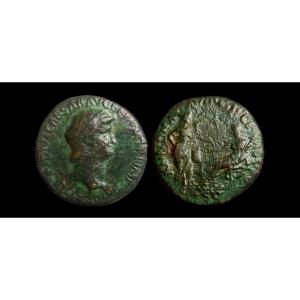
ObverseThe type matches the expected model for Vetranio: diademed, draped, and cuirassed bust right. The beaded diadem is discernible in segments, and the facial volumes (forehead, nose, chin) remain legible despite more pronounced wear at the center, which is common for these circulation bronzes.
The peripheral legend can be read in sequences and is arranged in accordance with the reference titulature: D N VETRANIO P F AVG, legibility varying by area and centering. Under raking light, the separation between relief and field remains clear on several structural points (diadem line, bust outline, folds of the drapery), contributing to typological coherence.
ReverseThe reverse conforms to the classic scheme: CONCORDIA MILITVM, the emperor in military dress standing facing, head left, holding a standard in each hand; on the banners, the Chi-Rho (Christogram) remains perceptible above head level, a major distinctive feature of the issue.
In the field, the presence of a star and the letters A – B can be distinguished, arranged according to the traditional layout of this type. In the exergue, the mintmark is of TS… structure, compatible with Thessalonica (officina notation/variant such as ·TSA· or ·TSΔ· depending on the issues; the reading ·TSΔ· corresponds to the information provided).
The combination “CONCORDIA MILITVM + two Chi-Rho standards + Thessalonica mintmark” forms a particularly characteristic set of indicators, useful for attribution and comparison.
CharacteristicsAuthority: Vetranio (usurper), AD 350
Mint: Thessalonica
Denomination: Maiorina / AE
Obverse: D N VETRANIO P F AVG, diademed, draped and cuirassed bust right
Reverse: CONCORDIA MILITVM, emperor standing facing, head left, holding two standards with Chi-Rho on the banners; star in the field; A – B; exergue ·TSΔ·
Weight: 6.11 g
Diameter: 24 mm
References (cross bibliography): RIC VIII Thessalonica 131 ; LRBC 1657 (corresponding type)
Rarity: issue regularly noted as rare for Vetranio at Thessalonica (RIC 131)
Vetranio is proclaimed emperor in 350, at a moment of major fracture: after the death of Constans and the rise of Magnentius, the Empire enters a phase of rapid recomposition of alliances. The message CONCORDIA MILITVM is not decorative: it aims to display the army’s unity around the new power, an essential condition for political survival.
The use of the Chi-Rho (Christogram) on the standards belongs to the symbolic language of the 4th century, in which Christian signs take their place within state iconography and the imaginary of imperial legitimacy, especially in periods of tension.
Cultural valueFor a collector, this maiorina offers strong and highly “documentary” interest:
An extremely brief reign, hence a historically concentrated and sought-after coinage.
A reverse with immediately legible iconography: two standards with Chi-Rho, a central theme for the history of armies and symbols of the 4th century.
A type firmly framed by RIC VIII, facilitating comparison with reference specimens and the building of a coherent numismatic dossier.
In accordance with our practices, each specimen is examined, described, and accompanied by a certificate of authenticity consistent with the standards of the art and heritage market; the study is conducted with careful observation under ×10 magnification and raking light, and is based on stylistic, typological, and metrological coherence, as well as comparison with the corpora.
The coin comes from a professional European provenance, from an established numismatic circuit; the acquisition falls within a specialized international transaction, carried out within a recognized network and validated by reference participants, according to practices applicable to heritage objects, while recalling that authentication relies on a set of material and comparative indicators.
Secure shippingCareful, secure, and traceable shipping, with protective packaging, insurance, and delivery against signature depending on destination (France / international). The exact terms are confirmed at the time of order according to the delivery address.
Period: Before 16th century
Style: Rome and Antic Greece
Condition: Good condition
Reference (ID): 1715785
Availability: In stock