100 Nummia Silver Of Carthage — Justin II — Certificate Of Authenticity
A major rarity from the African mint, identifiable by its front-facing helmeted bust and imperial monogram: a typology securely framed by standard references (MIB / Sear).
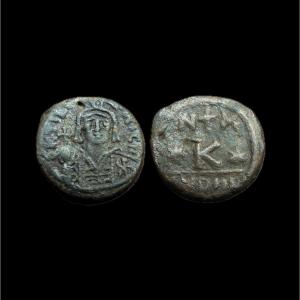
Analysis & expertiseThis 100 Nummia silver coin attributed to Justin II (565–578), struck at Carthage, belongs to a highly sought-after small-module issue whose rarity lies as much in the metal as in its typological combination: a front-facing helmeted portrait on the obverse, and the monogram of Justin II on the reverse, surmounted by a cross and completed below by the letter C (value mark for 100).
Close observation under ×10 magnification and raking lightThe piece shows a light grey silver with a discreet yet clear metallic sheen along the relief edges. The surface retains a continuous micro-texture (fine striations and minute contact marks), consistent with long-standing handling and circulation. The flan is naturally irregular, with edges that are not perfectly circular and minor peripheral weaknesses—features frequently encountered on small African Byzantine fractions.
Relief remains “crisp” in its essentials: the helmet’s outline, the stylized Byzantine facial rendering, and the geometric strokes of the reverse monogram. Within the strict limits of non-destructive visual examination, the ensemble (relief, texture, coherence of line and edge structure) remains consistent with an ancient strike of this group, with no element compelling a modern manufacture reading.
ObverseThe type matches the standard model: a front-facing helmeted and cuirassed bust, rendered in a deliberately condensed yet energetic style. The helmet reads through its volumes (marked crown, lateral edges), while the frontal face follows a characteristically Byzantine construction (pellet-like eyes, simplified nose and mouth), with the bust articulation still perceptible through layered planes.
The peripheral legend is only partially preserved / partly off-flan, a common occurrence on this module; for the type, the expected abbreviated titulature is DN IVSTINVS PA, and attribution rests primarily on the association of the front helmeted bust with the monogram reverse and C value mark.
ReverseThe reverse displays the monogram of Justin II, built from geometric strokes (verticals and crossing diagonals), with a cross placed above. In the lower area, the letter C—the value mark—fits the established typology even when the flan’s irregular edge can affect readability depending on the zone.
Under raking light, the monogram’s lines read by clean edges, with a clear visual hierarchy between the central sign, the upper cross, and the lower value mark. Despite the small size, the design remains immediately identifiable.
SpecificationsAuthority: Justin II (565–578)
Denomination: 100 Nummia (silver, AR)
Mint: Carthage
Obverse: DN IVSTINVS PA (expected for the type); front-facing helmeted and cuirassed bust
Reverse: monogram of Justin II; cross above; C below
Weight: 0.53 g
References: MIB 34; Sear 392B
Rarity: Very rare
Justin II succeeded Justinian I in 565, inheriting an empire that remained vast yet increasingly strained by military and financial pressures—factors that help explain the diversity of regional coinages. Within this framework, Carthage continued to serve as a key monetary center for Byzantine Africa, and its output includes distinctive series such as these small silver issues bearing monograms.
Numismatic literature also notes that the precise interpretation of certain African silver value systems has been discussed in reference scholarship, which reinforces the scientific interest of the series and the importance of rigorous, specimen-by-specimen documentation.
Cultural valueFor collectors, this coin concentrates qualities rarely combined in such a small module:
a front-facing helmeted imperial iconography, strongly “Byzantine” and immediately recognizable;
a reverse with an imperial monogram, both scholarly and graphically powerful, completed by the cross and the C value mark;
an African mint (Carthage) prized for its distinctive issues, encountered less frequently than the major eastern series.
In accordance with our practices, each specimen is examined, described, and accompanied by a certificate of authenticity consistent with the standards of the art and heritage market. The study is conducted under ×10 magnification and raking light and includes verification of typological, stylistic, and epigraphic coherence against reference works (MIB / Sear) and published comparanda.
The coin comes from professional European provenance, acquired through a specialized international transaction within a recognized numismatic network, following control and validation practices commonly accepted by professional market participants.
Secure shippingTracked shipment with signature and insurance, in protective packaging suited to a small module (protective capsule/sleeve, shock padding, discreet outer packing), ensuring controlled circulation of a heritage object.
Period: 16th century
Style: Rome and Antic Greece
Condition: Good condition
Reference (ID): 1716806
Availability: In stock