




Monumental Han Court Lady + Tl Test – Certificate Of Authenticity
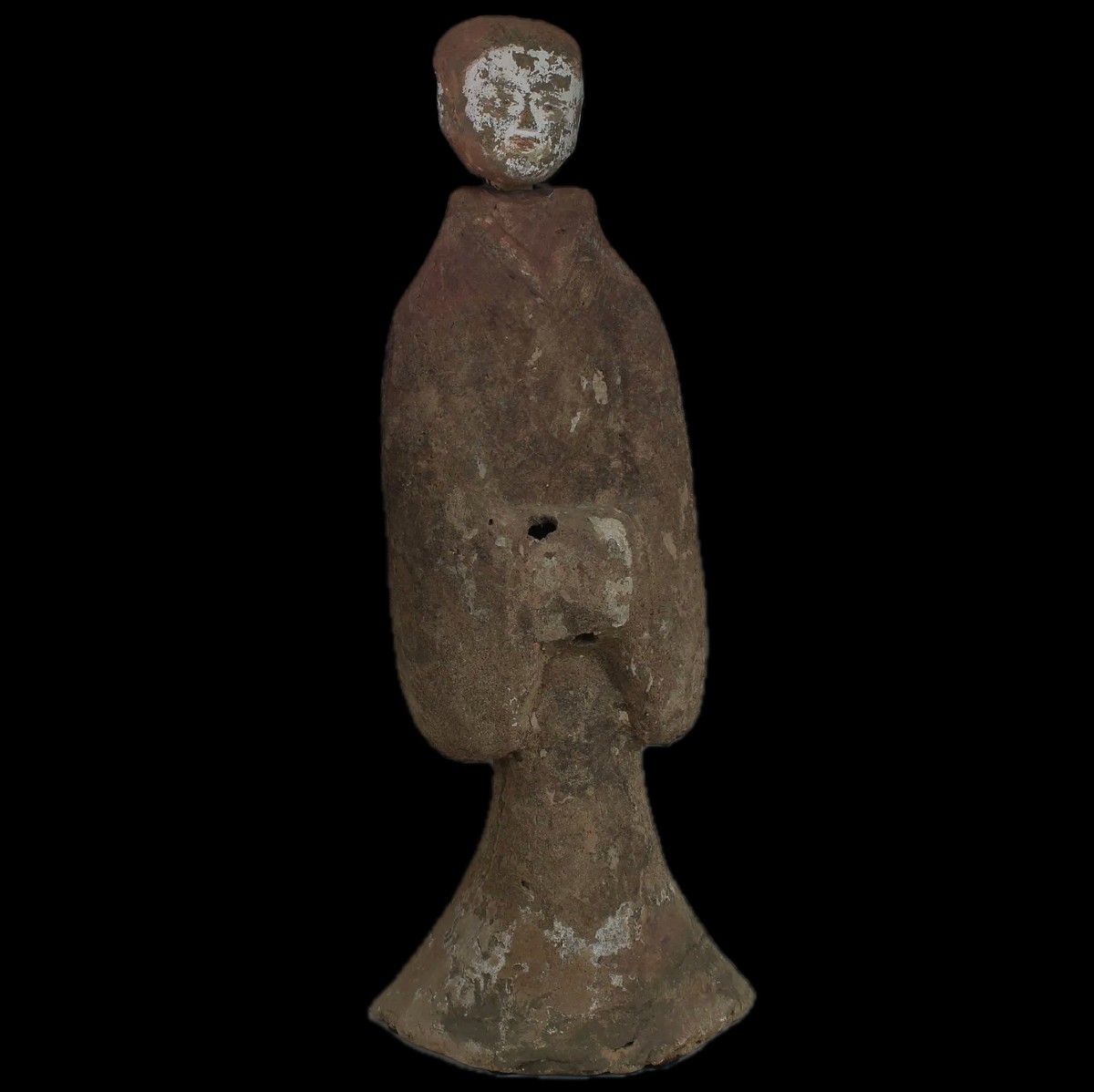
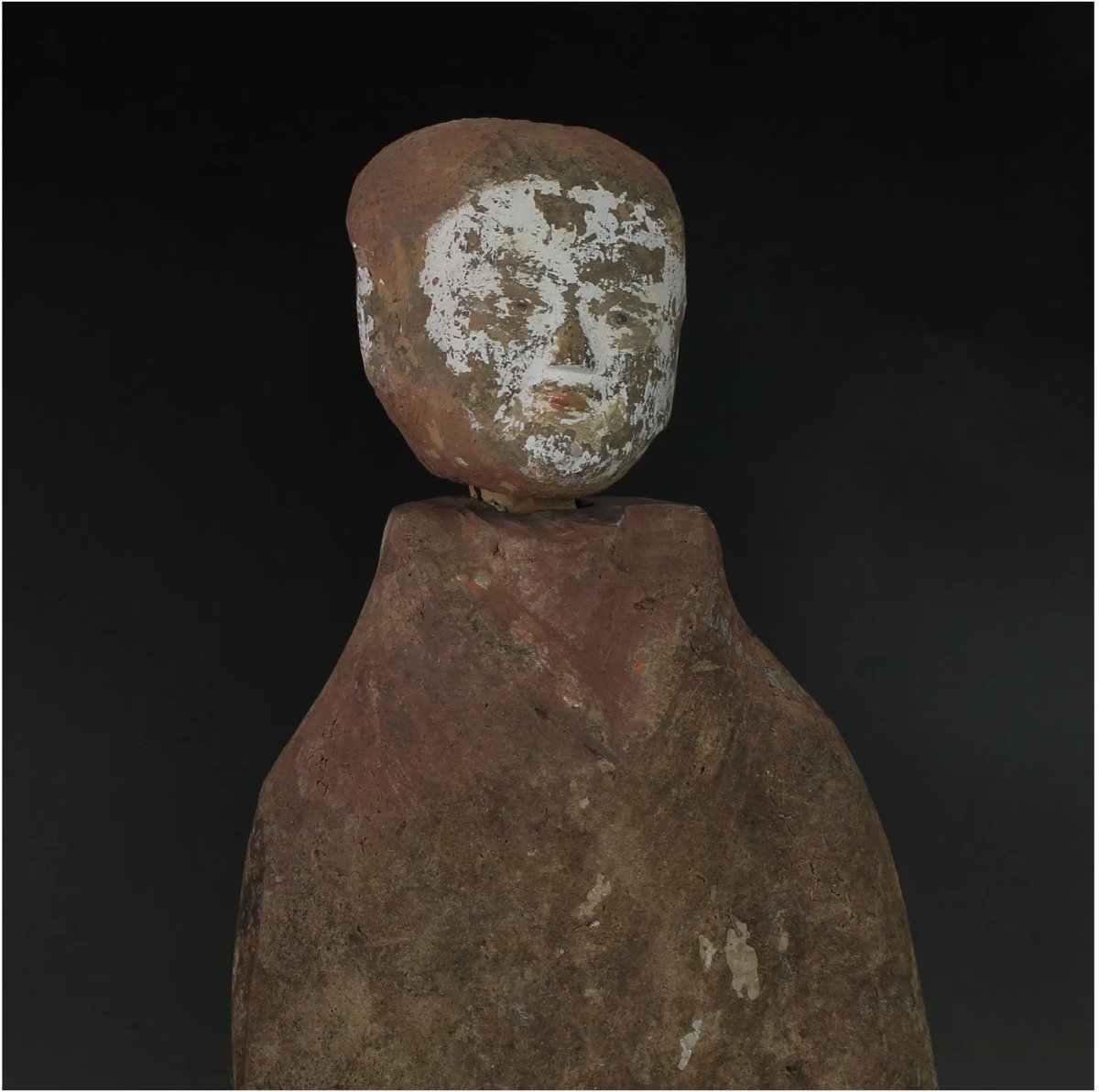
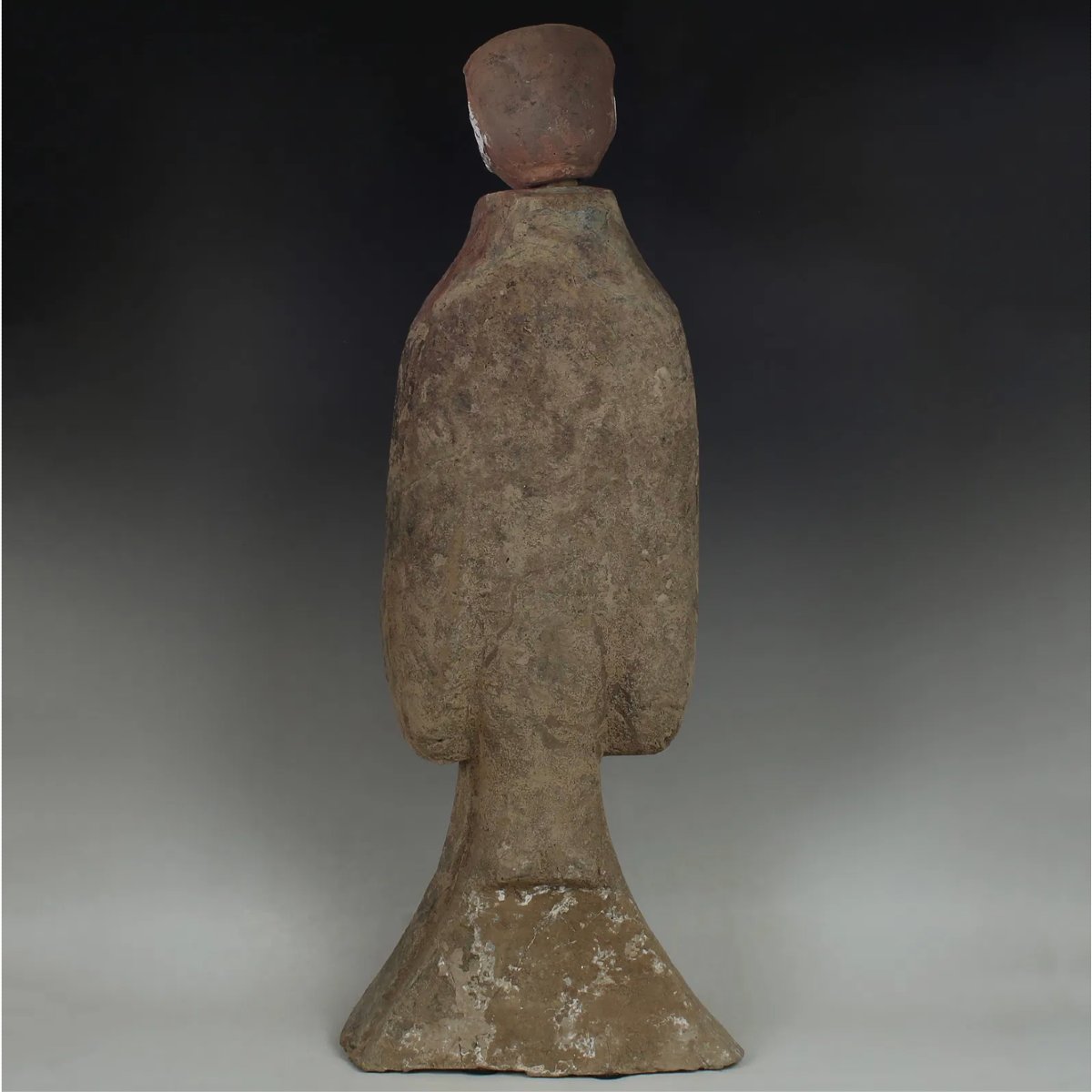
This monumental funerary statuette (75.5 cm) is an emblematic work of mingqi ("spirit objects") statuary from the Han Dynasty. Depicting a court lady in an attitude of protocolar reverence, it is distinguished by an architectural, columnar stylization, where the body disappears beneath the volume of the garment to emphasize the dignity of the posture. The authenticity of this piece is sealed by irrefutable scientific validation: a Thermoluminescence (TL) test from the QED laboratory, confirming that the last firing of the clay dates back to the Han period (approx. 2,000 years ago). The surface retains notable vestiges of the original polychromy, particularly the white pigment on the face, a rare survival offering a striking contrast with the raw terracotta.
Characteristics
Object: Large Funerary Statuette (Mingqi) - Court Lady.
Culture: Chinese, Han Dynasty.
Period: 206 BC – 220 AD.
Material: Grey terracotta, remains of polychrome pigments (white, red, black).
Dimensions: Height: 755 mm | Width: 295 mm | Depth: 158 mm.
Condition: Good state of conservation; natural weathering of the polychromy; detachable head (period assembly technique).
Scientific Validation: Thermoluminescence (TL) test included, performed by QED Laboratory (Ref. QED1549/FC-0109), confirming the antiquity of the firing.
Provenance: Former private French collection (Toulouse), formed in the 1980s.
Documentation: Sold with a Certificate of Authenticity and the original TL analysis report.
Historical ContextUnder the Han Dynasty, the practice of human sacrifice had long since given way to the burial of terracotta substitutes, the mingqi. These figures were not mere effigies, but vessels for souls intended to serve the deceased in the afterlife. Court ladies, depicted with Confucian restraint, symbolized the high social status of the tomb owner, ensuring the perpetuation of etiquette and domestic service in the spirit world. The streamlined, elongated style reflects the aesthetic of the era, prioritizing line and spirit over realistic anatomical detail.
Formal and Material Analysis
Morphology and Costume: The silhouette follows a typical tapered form, flaring at the base to ensure stability ("trumpet shape"). The lady is dressed in the shenyi, the traditional robe with crossed lapels and long sleeves. Her hands, clasped together, are concealed within the sleeves, a gesture of politeness and submission. The drapery is suggested by minimalist yet fluid lines, sculpting the volume without weighing it down.
Face and Polychromy: The face, a full oval, retains a significant layer of white slip (kaolin or rice powder), evoking the court makeup of the time. The fineness of the ink-painted features remains: arched eyebrows, tapered eyes, and a small mouth highlighted in red. This partial preservation of the pictorial "skin" is a major indicator of quality.
Technique: Examination of the profiles and the reverse (which is flatter) indicates a bivalve mold (front/back) assembled before firing. The head is fitted onto the neck via a tenon, a standard technical characteristic for pieces of this size to prevent breakage during firing or ancient transport.
Scientific Analysis (TL): The QED laboratory report, based on three distinct samples (base, shoulder blade, tunic), shows coherent thermoluminescence curves, indicating a homogeneous ancient firing. This formally excludes the hypothesis of a modern recomposition (pastiche) from disparate fragments.
Cultural ValueThis work transcends the status of a decorative object to become a historical document validated by science. Its monumental size (over 75 cm) places it in the category of significant pieces reserved for elite tombs. It offers the collector the aesthetic of a two-thousand-year-old sculpture of timeless elegance, secured by physical analysis of the material.
Expertise ReportThe authenticity of the piece is established by the convergence of stylistic analysis and physical dating:
Style and Technique: The grey clay, the detachable head assembly, and the treatment of the drapery are consistent with productions from the Yellow River Basin under the Han.
Surface Condition: Excavation concretions and the adherence of pigments are consistent with prolonged burial.
Scientific Validation: The TL test (QED1549/FC-0109) provides definitive proof of the firing's antiquity, guaranteeing an indisputable dating.
A major piece, sound and scientifically dated.
Period: Before 16th century
Style: Asian art
Condition: Good condition
Reference (ID): 1663787
Availability: In stock