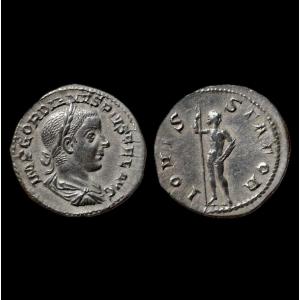
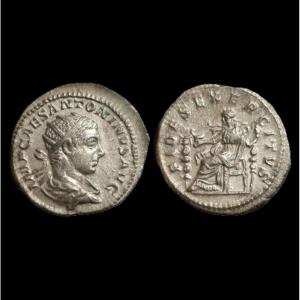
Lucius Verus Sestertius “concord Avgvstor” — Rome — Certificate Of Authenticity
This sestertius of Lucius Verus, attributed to the mint of Rome and placed within the indicated chronological sequence March–December 161, refers to a type of dynastic concord whose iconography—two Augusti clasping hands—belongs to the immediately legible political language of the first years of the joint principate of Marcus Aurelius and Lucius Verus; and the legend CONCORD AVGVSTOR states the scope of the message without ambiguity, in keeping with the Roman monetary practice of making coinage a vehicle for institutional affirmation and propaganda of stability.
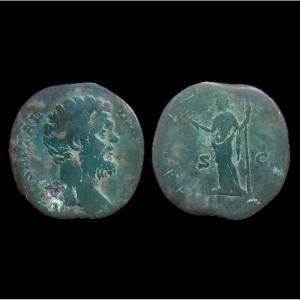
Careful observation under ×10 magnification and raking light: the close examination of the photographs, carried out through a progressive reading of the circumference, fields, reliefs, and letters, highlights a bronze in sestertius module showing a dominant green patina, nuanced by darker areas and brownish patches, with a surface texture that appears irregular in places, suggesting a history of circulation and long residence; meanwhile, the flan, noticeably oval, shows peripheral irregularities and small visible edge knocks, notably near sectors where the beaded border is locally weakened.
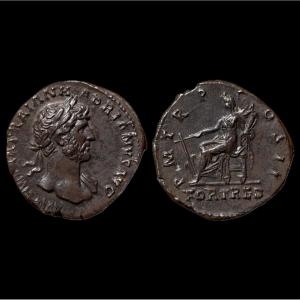
On the obverse, the laurelled portrait right remains clearly perceptible through its main volumes—the laurel wreath, brow ridge, profile of the nose, line of the lips, modeling of the chin, and the start of the drapery/cuirass—and the peripheral legend, although partly affected by wear and by a strike that appears slightly constrained at the margins, retains sufficient fragmentary legibility to recognize the imperial titulature as given in the reference description.
On the reverse, the concordia scene appears structured by two standing figures facing one another and clasping hands, one holding a scroll, with S – C in the field and COS II in the exergue; the whole remains consistent with the type classically described for this motif, even if certain fine details (drapery, limb outlines, letters of the legend) appear leveled by wear and by the surface state, a common phenomenon on large Roman bronzes.
CharacteristicsLucius Verus, 161 – 169 Sestertius March-December 161, Æ 26.43 g.
IMP CAES L AVREL VERVS AVG Laureate head r.
Rev. CONCORD AVGVSTOR TR P II S – C M. Aurelius and L. Verus clasping hands; M. Aurelius holds a scroll. In exergue, COS II.
C 161. BMC 1023 var. RIC 1284.
In the first months of the joint reign opened in 161, the Empire stages perfect agreement between the two Augusti, and the theme of CONCORDIA is one of the most direct vehicles of this rhetoric, because it allows, through a simple and universal image (the handshake), the affirmation of unity of command, the prevention of any factional reading, and the stabilization of public perception of power—an approach frequently documented by coin series bearing precisely the legend CONCORD AVGVSTOR and depicting Marcus Aurelius and Lucius Verus facing each other.
Cultural valueFor a collector, this sestertius combines the appeal of the large bronze—material, patina, sculptural presence of the portrait—with the historical interest of an emblematic type of Antonine ideology, in which coinage becomes an object of political reading, almost a miniature “public document,” where concord is not merely a displayed moral virtue but a state program put into circulation across the whole imperial space through the most everyday medium imaginable.
Traceability & guaranteesEach specimen is examined, described, and accompanied by a certificate of authenticity consistent with the standards of the art and heritage market; the study is conducted with careful observation under ×10 magnification and raking light, and identification is supported by the numismatic references commonly used for this type (as indicated in the notice provided), which precisely describe the concord reverse with handshake and the associated institutional marks.
Payment termsFor payment methods, he must send us a message and provide the location and delivery address. (If in France, we ship by Colissimo with signature and insurance (price 20 euros); if abroad, UPS with signature and insurance (35 euros).) We accept cheques (France only), but delivery is made after receipt of the funds. We accept bank transfers; simply request our bank details; we can also send you a bank link (cards accepted: CB, Visa, Mastercard, American Express, Apple Pay).
Sales restriction — United StatesWe do not sell to the United States; this limitation is motivated by the complexity of import requirements applicable to cultural goods, by the variability of customs controls, and by the insurance and liability constraints attached to the international transport of heritage objects, within which framework we favor compliance and shipping channels whose traceability remains fully controlled.
Period: Before 16th century
Style: Rome and Antic Greece
Condition: Good condition
Reference (ID): 1715764
Availability: In stock