

Diadumenian As Caesar — Denarius Princ Ivventvtis, Rome 217 — Certificate Of Authenticity
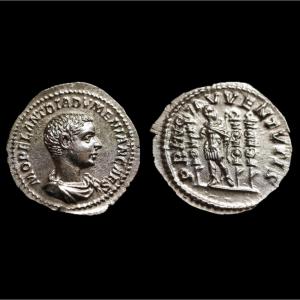
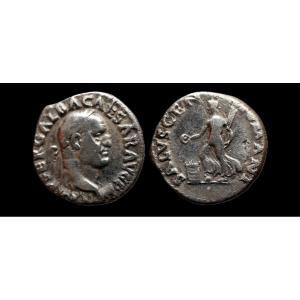
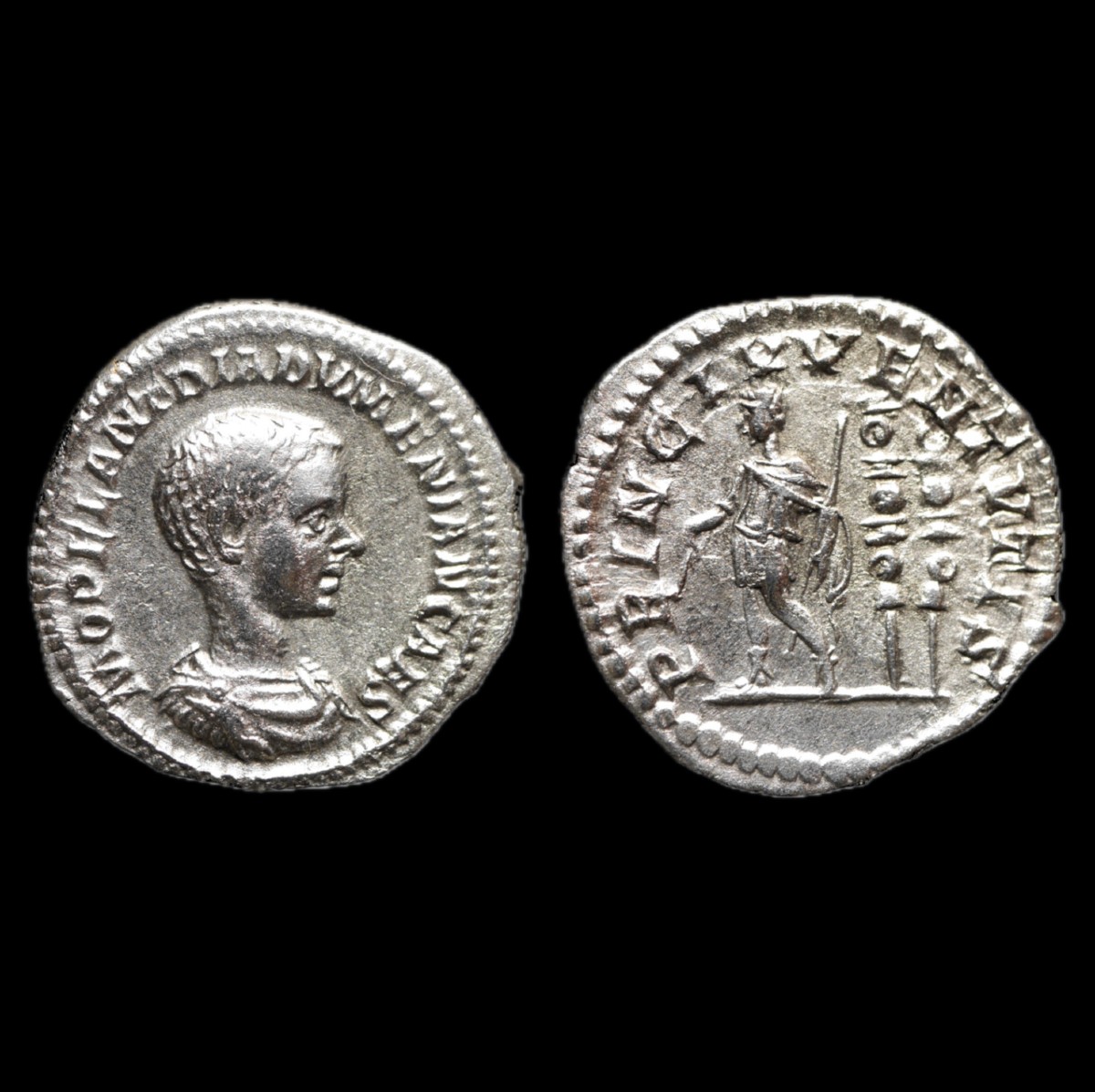
This silver denarius of Diadumenian as Caesar, struck at Rome in AD 217, belongs to a type particularly esteemed by collectors of the short Macrinian sequence, with on the obverse M OPEL DIADVMENIAN CAES around a bare-headed and draped bust right, and on the reverse PRINC IVVENTVTIS, where the young prince appears standing in military dress before two standards, according to a dynastic legitimization formula immediately legible within the monetary vocabulary of the early third century; the attribution accords with RIC IV.2, 108, as well as with the concordances RSC 14a and specialized market references describing the same typological combination, at the Rome mint, for the year 217–218, with a frequent narrowing to 217 for the first Caesar issues. The type may with full justification be presented as rare and sought-after, Numista assigning it a rarity index of 95, while WildWinds and several professionals maintain a clearly selective qualification for it within the corpus of Diadumenian denarii.
Each specimen is examined, described, and accompanied by a certificate of authenticity in accordance with the standards of the art and heritage market; the present piece stands out for an overall appearance highly favorable to the expert eye, with a weight of 2.7 g and a diameter of 19 mm, figures fully compatible with the observed range for this reference, Numista recording for RIC 108 a 19 mm type with variable metrology, while published specialist specimens fall around 3.1 g, 3.3 g, or within nearby brackets, placing the specimen within the normal dispersion of small Severan denarii struck by hammer.
Analysis & Expertise
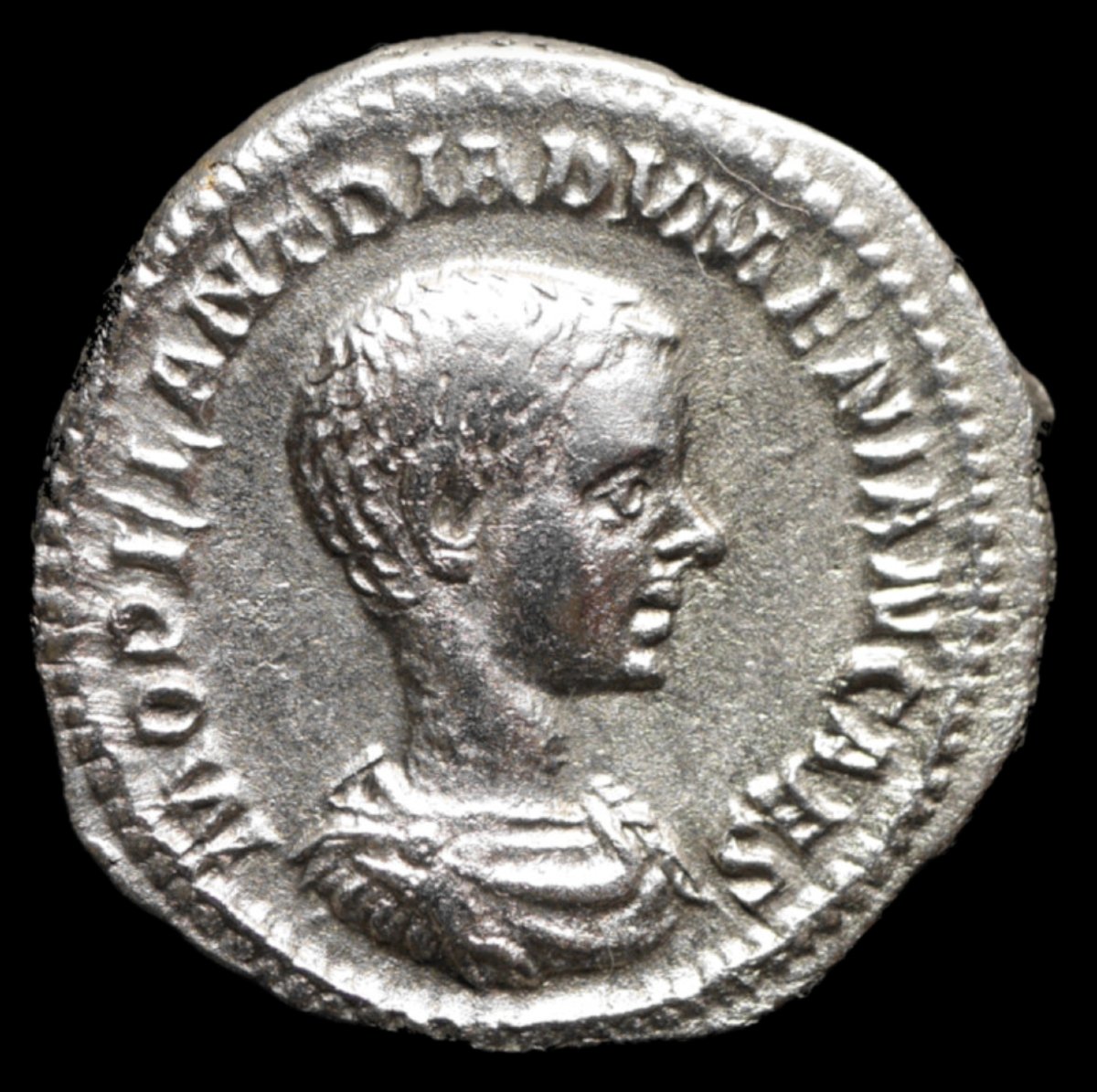
Close observation under ×10 magnification and raking light. Direct examination of the obverse reveals a youthful portrait of Diadumenian right of particularly appealing steadiness for this issue, with short and lively hair still well structured in tight locks, a frank forehead, a widely open eye, a clean nasal line, a well-marked mouth, and a still-firm chin, such that the bust retains that princely youthful physiognomy consistently sought by Rome’s Caesarian issues; the drapery at the base of the neck remains legible, the peripheral legend can be followed very satisfactorily, and the beaded border, still well present over a large part of the circumference, gives the whole a fine-quality visual presentation. The type description published by WildWinds and Numista confirms precisely, for RIC 108, a bare-headed and draped bust with the corresponding titulature.
The reverse retains particularly convincing numismatic legibility, as Diadumenian appears standing left in military dress, holding the expected command attribute, with to the right two vertical standards structuring the field and immediately anchoring the coin within the register of the princeps iuventutis; the legend PRINC IVVENTVTIS remains largely intelligible around the circumference, and the silhouette of the young Caesar—though set on a small circulating silver flan—remains sufficiently crisp to give the type its full ideological force. Specialist descriptions converge very closely here: Numista indicates Diadumenian standing left holding a baton and a scepter, WildWinds speaks of a baton and a scepter, while sale catalogues describe the same type as holding a baton of command and a spear, confirming the stable identity of the observed iconographic scheme.
The silver surface shows a coherent ancient appearance, with relief still perceptible on the high points of the portrait, drapery, and standards, as well as a clean brightness on the areas best brought out by the strike; the flan shows, in its upper portion, an old marginal striking crack, visible but stable, a well-known phenomenon on small hammer-struck silver modules, which here neither breaks the reading of the types nor the coin’s overall balance. The border morphology, the rise of the letters, the measured irregularity of the outline, and the continuity of volumes fully accord with an ancient manufacture consistent with the technical standards of the Rome series of Diadumenian.
What gives this specimen a particularly solid collecting presence lies in the conjunction of elements concretely sought by knowledgeable enthusiasts of Severan coinage: a still very lively Caesar portrait, a well-preserved titulature, an immediately identifiable PRINC IVVENTVTIS reverse, and metrology compatible with the reference comparanda, such that the coin is not only correctly attributed, but a cabinet specimen that is technically coherent and stylistically very satisfying.
Characteristics
Authority. This issue belongs to Diadumenian, son of Macrinus, promoted Caesar shortly after his father’s accession in 217, before his very brief elevation to the rank of Augustus in 218.
Mint. The mint is Rome, an attribution concordantly given by Numista, by specialized commercial catalogues, and by the typological tradition of RIC IV.2 for this reference.
Dating. The type is dated to 217–218, with a frequent narrowing to 217 for Diadumenian’s first Caesarian issues.
Denomination. Silver denarius.
Metal. Silver.
Weight. The observed weight for this specimen is 2.7 g, a value compatible with the published dispersions for the series.
Diameter. The observed diameter is 19 mm, fully consistent with the RIC 108 type as recorded by Numista.
Technique. Hammer struck, on an irregular round flan.
Obverse. The obverse bears M OPEL DIADVMENIAN CAES, with bare-headed and draped bust right; specialist catalogues note for RIC 108 a variant described as draped, sometimes draped and cuirassed depending on the notices, corresponding to the observed typological family.
Reverse. The reverse bears PRINC IVVENTVTIS, with Diadumenian standing left in military dress, holding the command attribute, before two standards to the right.
Typological references. Identification accords with RIC IV.2, 108, with concordances RSC 14a, and specialized market correspondences.
Rarity. The type may rightly be presented as rare / sought-after, with a Numista rarity index of 95.
Historical context
This denarius belongs to the very brief dynastic sequence opened by Macrinus’ elevation after the death of Caracalla in 217, when his son Diadumenian was immediately promoted as legitimate heir under the title of Caesar; biographical syntheses recall that Diadumenian, born in 208, played an effective political role only during this short period of 217–218, before his fall and death in 218, giving all of his imperial coinage an exceptionally compressed historical density.
Within this framework, the reverse PRINC IVVENTVTIS carries major ideological weight, for this title—traditionally attributed to the heir or the young prince—publicly proclaims Diadumenian’s integration into the order of imperial succession; the presence of the military standards further reinforces this reading by giving the young Caesar a visibility that is both dynastic and military, fully consistent with the legitimizing language adopted by Macrinian power. Catalogue notices explicitly translate PRINC IVVENTVTIS as Prince of the Youth, expressing without ambiguity the type’s political function.
Cultural value
The cultural value of this piece is particularly strong, because it unites within a small silver module three dimensions essential to the discerning collector: the dynastic youth of an ephemeral Caesar, the highly legible sobriety of official Roman iconography, and the structural rarity of an aborted reign; such a coin is not merely another Severan denarius, but a highly concentrated fragment of one of the briefest and most tense political experiences of the early third century.
For a cabinet oriented toward transitional issues, Caesarian portraits, or Rome denarii of the reign of Macrinus, this specimen has a specific appeal, as it combines a very fine youthful portrait, immediately expert typology, and a clean metallic presence without unnecessary decorative dispersion; the knowledgeable collector recognizes exactly what is expected of a good Diadumenian piece: clear reading, a strong political type, and a tight identification to the corpora.
Traceability & Guarantees
From a European provenance, from an established numismatic dealer, this specimen was acquired through a specialized international transaction conducted within a recognized numismatic network and validated by reference experts, in accordance with the highest standards of the art and heritage market; examination of the present object retains the stylistic, technical, epigraphic, and metrological characteristics effectively observable on the coin, set within the framework of recognized references for Roman imperial coinage and compared against specialized comparanda for this issue.
Each specimen is examined, described, and accompanied by a certificate of authenticity in accordance with the standards of the art and heritage market; in the present case, the concordance between the obverse titulature, the PRINC IVVENTVTIS reverse with two standards, the Rome style, the observed metrology, and the references RIC IV.2 108 and RSC 14a establishes a particularly solid numismatic attribution for a specimen intended for a knowledgeable collecting audience.
Period: Before 16th century
Style: Rome and Antic Greece
Condition: Good condition
Reference (ID): 1730250
Availability: In stock