

Severus Alexander Ric 468 Var., Faulty Legend — Certificate Of Authenticity
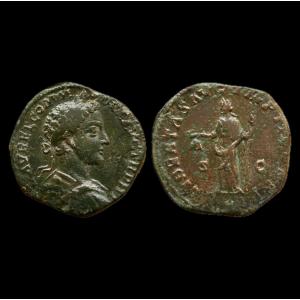
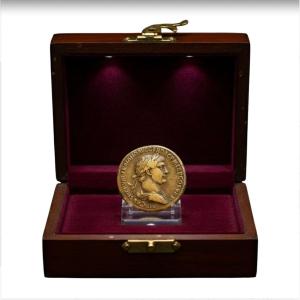
This large bronze of Severus Alexander, struck at Rome in the year numismatically tied to the sixth tribunician power, aligns with very close coherence to the sacrificial type published as RIC IV.2, 468, in which the emperor appears on the reverse standing left, sacrificing over a lighted altar and holding a scroll; the present specimen, with a diameter of 32 mm and a weight of 23.71 g, fully belongs to the family of Roman sestertii of AD 227, while distinguishing itself by a reverse-legend peculiarity, readable on the coin as a doubling of P after TR, whereas the regular type is published with the sequence P M TR P VI COS II P P S C, a circumstance that strongly individualizes the piece within a number already closely followed by collectors of Severan bronzes. Each specimen is examined, described, and accompanied by a certificate of authenticity in accordance with the standards of the art and heritage market.
Analysis & Expertise
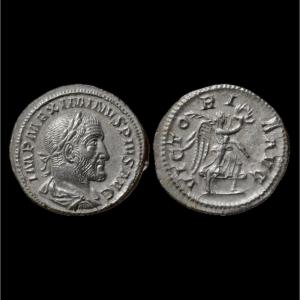
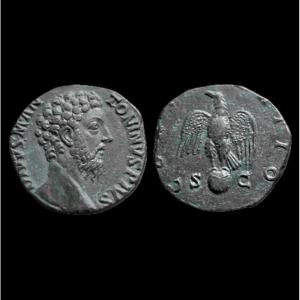
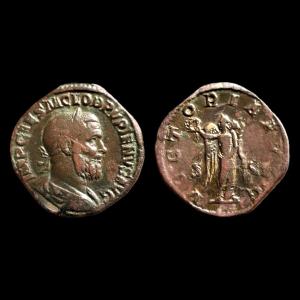
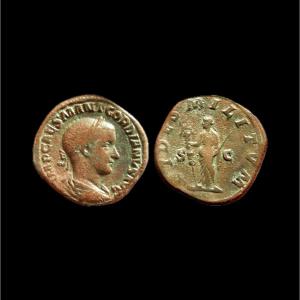
Close observation under ×10 magnification and raking light. The obverse presents a youthful portrait of Severus Alexander turned right, laureate, with facial modeling remaining very firm in its essential structure, the hair unfolding in tight, regular locks beneath the wreath, the eye remaining clearly open, the nasal line staying frank, the mouth still well defined, and the bust retaining satisfactory readability in its drapery; the peripheral legend IMP CAES M AVR SEV ALEXANDER AVG can be followed with broad legibility around a very large portion of the circumference, while the border and beaded rim preserve a visual continuity that gives the obverse a very convincing cabinet presence for a sestertius of the reign. The canonical obverse type description, with laureate, draped, and cuirassed bust right, is indeed the one retained by the corpora and specialized comparanda attached to RIC 468.
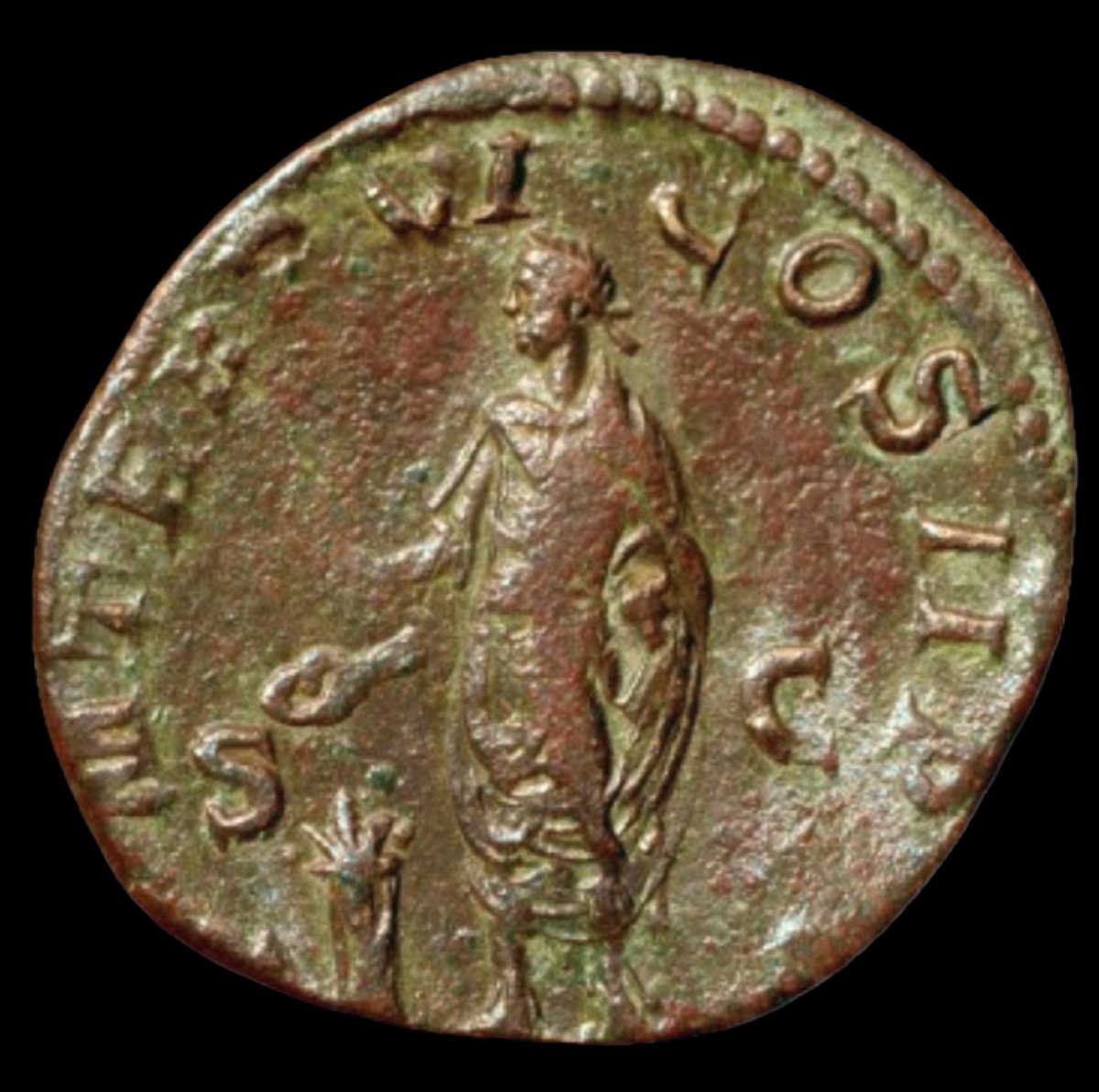
The reverse retains particularly solid typological readability, since Severus Alexander can be clearly recognized in toga, standing left, performing a sacrificial gesture with patera over a lighted altar, while holding a scroll in the other hand; the letters S C in the fields, the figure’s verticality, the altar’s structure, and the ceremonial logic of the scene remain sufficiently legible to support expert attribution without hesitation. The specimen’s most interesting peculiarity lies in the reverse legend, whose reading on the coin reveals a doubling of P after TR, a feature that may be formulated as a legend anomaly or faulty variety relative to the reference type published with the regular formula P M TR P VI COS II P P S C; this singularity in no way affects the attachment to the RIC 468 group, but it gives the coin a highly appreciable individualization for a collector of titulature varieties.
The fabric shows an old olive-brown patina with green highlights, stable in its overall logic, with relief still crisp on the high points of both portrait and reverse, and a surface showing the normal marks of ancient circulation without any break in reading of the type; the flan, broad and slightly irregular at the periphery, remains fully compatible with hammer striking on a large Roman bronze, and all visible characteristics—metal behavior, letter relief, relief structure, border continuity—accord very closely with the expected physiognomy of a Roman sestertius of AD 227. Published comparison specimens for this reference, around 28–29 mm and 19.9 to 22.1 g, confirm the group’s full weight and typological coherence, the present coin standing out by a broader flan and a more monumental material presence.
Characteristics
Authority.
The coin belongs to Marcus Aurelius Severus Alexander, Roman emperor from AD 222 to 235, last representative of the Severan dynasty.
Mint and dating.
The mint is Rome, and the reverse titulature with TR P VI COS II P P places the type in AD 227, a dating concordantly retained by specialized publications for this number.
Denomination and metal.
Sestertius in copper-alloy / large bronze, the monetary class under which the type is catalogued in public corpora and market comparanda.
Metrology.
The examined specimen is 32 mm and 23.71 g, placing it within a weight-and-module order fully coherent with the series, while giving it a particularly ample flan for the type.
Obverse.
IMP CAES M AVR SEV ALEXANDER AVG, laureate bust right; reference publications describe the regular type with laureate, draped, and cuirassed bust.
Reverse.
Sacrificial type with the published regular legend P M TR P VI COS II P P S C, showing Severus Alexander standing left, sacrificing with patera over a lighted altar and holding a scroll; on the present specimen, the legend reading shows a doubling of P after TR, an engraving peculiarity that individualizes the coin within the type.
References.
Primary attribution to RIC IV.2, 468; specialized comparanda associate with this number BMCRE 436 and Banti 74.
Historical context
This issue belongs to a phase of the reign in which Severus Alexander, still a young prince yet already firmly installed within the imperial order, develops at Rome a coinage strongly structured around sacrificial scenes and governmental allegories; the reverse of this sestertius does not show a mere abstract figure, but the emperor himself in the exercise of a public ritual gesture, placing the object within the sphere of imperial pietas and the religious visibility of power. The sixth tribunician power refers precisely to AD 227, a moment when the titulature COS II P P is already stabilized within Rome’s official coinage.
The sacrificial scene of RIC 468 occupies, within the year’s sestertius series, a position particularly intelligible for the expert collector, because it directly associates the sovereign’s image with the public act of sacrifice in a very sober, very Roman visual formulation; the legend anomaly noted on the present specimen adds further relief, introducing—within a well-catalogued type—an immediately perceptible epigraphic variety whose interest is above all documentary and classificatory.
Cultural value
The cultural interest of this piece lies in the conjunction of three dimensions an experienced collector immediately recognizes: a highly legible early “Alexandrian” portrait style, a ritual reverse of strong doctrinal clarity, and a legend peculiarity that singularizes the specimen within a well-established reference number; it is thus not merely a large circulating bronze, but an object in which typology, fabric, and epigraphic variety combine with rare clarity. The RIC 468 type is regularly published and sought after in the specialized trade, confirming the favorable place it occupies within a serious collection of Severan bronzes.
For a cabinet devoted to Severus Alexander, Rome sestertii, or legend varieties, the present specimen has a particular quality, since it retains both strong portrait authority, an immediately intelligible reverse scene, and a textual individualization that genuinely matters in an expert reading; it is precisely this kind of coin—solidly typed yet singular in detail—that gives a numismatic ensemble its most scholarly depth.
Traceability & Guarantees
From a European provenance, from an established numismatic dealer, this specimen was acquired through a specialized international transaction conducted within a recognized numismatic network and validated by reference experts, according to the highest standards of the art and heritage market; examination of the present object retains exclusively the stylistic, technical, epigraphic, and metrological characteristics effectively observable, set within the framework of the Rome type Severus Alexander / RIC 468 / sacrificial scene, and compared against corpus references and specialized comparanda.
Each specimen is examined, described, and accompanied by a certificate of authenticity in accordance with the standards of the art and heritage market; in the present case, the concordance between the obverse IMP CAES M AVR SEV ALEXANDER AVG, the sacrificial reverse of the RIC IV.2, 468 group, the Rome mint, the chronology of AD 227, the observed metrology, and the legend peculiarity noted on the coin establishes a particularly solid numismatic attribution, formulated within a framework of strict descriptive exactitude and fully suited to a knowledgeable collecting audience.
Period: Before 16th century
Style: Rome and Antic Greece
Condition: Good condition
Reference (ID): 1730283
Availability: In stock