

Rare Posthumous Sestertius Of Faustina II — Certificate Of Authenticity
This large posthumous bronze of Faustina II, struck at Rome after her death in 175, belongs to a particularly sought-after consecration type, combining on the obverse the legend DIVA FAVSTINA PIA around a draped bust right, and on the reverse AETERNITAS S C, with Aeternitas veiled, standing, head turned left, lifting her veil and holding a long torch; this attribution corresponds to RIC III 1692, BMCRE 1558, and Cohen 4, a concordance likewise confirmed by the British Museum and by specialized market catalogues for this same type. Online repertories commonly place this issue within the 176–180 horizon, within the commemorative coinage struck under Marcus Aurelius after the deification of Faustina the Younger.
Each specimen is examined, described, and accompanied by a certificate of authenticity in accordance with the standards of the art and heritage market; this one stands out at once for the nobility of its broad 32 mm module, its weight of 25.40 g, and a very harmonious metal presence, fully compatible with comparable specimens published for this type, which notably fall around 24.36 g, 26.14 g, 27.15 g, and within a weight range recorded by Numista from 20.723 to 27.15 g. The type moreover benefits from a Numista rarity index of 97, which justifies presenting it as an issue of strong attractiveness for collectors of large Antonine bronzes and posthumous female coinage.
Analysis & Expertise
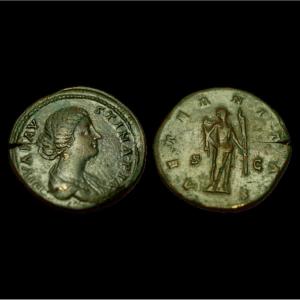
Close observation under ×10 magnification and raking light. Direct examination of the obverse reveals a draped portrait of Faustina II right of particularly appealing steadiness, whose hair—worked in almost vertical waves—retains a clear organization all the way to the low bun at the back, in accordance with the canonical iconography of the diva; the profile remains both delicate and firm, with a soft forehead line, a finely drawn nose, a mouth still well modeled, and an elegantly elongated neck that lends the bust real distinction. The peripheral border, doubled by a beaded ring still largely continuous, frames the whole with regularity, while the obverse legend preserves broad and convincing readability, markedly enhancing the coin’s cabinet presence.
The reverse retains a very real iconographic force, as the figure of Aeternitas remains immediately intelligible in her frontal stance, head turned left, with the veil lifted by one hand and the long torch held vertically by the other; the letters S C remain clearly perceptible in the fields, and the circular legend can be followed in a satisfactory manner around the figure, giving the type its full symbolic reach. The composition, sober and monumental, remains particularly legible for a posthumous large bronze of this period.
The surface displays an old olive-green and deep-brown patina, stable and finely nuanced, with relief that still catches the light favorably on the high points of the portrait, the hair, and the reverse figure; slight old marginal flan notches, discreetly distributed along the edge, integrate naturally into the object’s material life without harming its overall coherence, while relief continuity, letter modeling, and overall physiognomy fully accord with an ancient strike of a large Roman bronze. The specimen thus offers that highly sought-after alliance of typological legibility, historical presence, and characterful patina.
What particularly elevates this coin is the conjunction of several qualities the knowledgeable collector perceives immediately: a well-set diva portrait, perfectly characteristic coiffure, an elegant and recognizable Aeternitas, and a very coherent ancient fabric—so that the piece does not merely illustrate a catalogue reference, but still preserves, in its very substance, the commemorative gravity proper to consecration issues.
Characteristics
Authority.
This issue belongs to Diva Faustina II, i.e., Faustina the Younger deified after her death, under the authority of Marcus Aurelius.
Mint.
The mint is Rome, an attribution explicitly given by the British Museum, by Numista, and by the specialized comparanda consulted.
Dating.
The issue is generally placed after 175, more precisely within 176–180 according to Numista and the British Museum, corresponding to the posthumous coinage produced after the empress’s deification.
Denomination.
Sestertius, the large circulating bronze denomination of the Roman imperial system.
Metal.
Catalogued as copper alloy / bronze; commercial catalogues also use, according to sector practice, the designation “large bronze” or “orichalcum” for specimens of the same group.
Weight.
The recorded weight for this specimen is 25.40 g, a figure very favorably situated within the known comparanda for the type.
Diameter.
The recorded diameter is 32 mm, fully consistent with the large specimens published for this issue, often around 31–32 mm.
Obverse.
DIVA FAVSTINA PIA, draped bust right.
Reverse.
AETERNITAS S C, Aeternitas veiled, standing, head turned left, lifting the veil and holding a long torch—description confirmed by the British Museum and Numista.
Typological references.
Identification rests on RIC III 1692, BMCRE 1558, and Cohen 4, concordances consistently repeated by specialist market catalogues.
Rarity.
The type may rightly be presented as rare and sought-after: Numista assigns it a rarity index of 97, supported by its selective appearance in specialized trade.
Historical context
Faustina the Younger, wife of Marcus Aurelius, died in 175 at Halala in Cappadocia and soon thereafter received divine honors; modern encyclopedic sources recall that Marcus had her deified and that her memory became the subject of a significant body of posthumous issues. The British Museum specifically connects this sestertius to that commemorative series, produced at Rome under Marcus Aurelius.
The choice of Aeternitas on the reverse is not ornamental, for it expresses—within Roman religious and political vocabulary—the translation of the empress into a now-sacred duration; the goddess appears veiled, holding a torch, an image of perpetuation and consecration, exactly as described by the British Museum and Numista for this type. In this framework, the coin does not merely commemorate a death: it constructs an official, stable, and lasting memory, intended to inscribe Faustina within the order of imperial eternity.
Cultural value
The cultural value of this piece is high, because it unites within a single large bronze three dimensions that strongly resonate with collectors of Imperial Rome: the figure of a deified empress, the gravity of consecration coinage, and an allegory of eternity expressed with remarkable monumental economy. It is an object in which dynastic history, civic religion, and monetary art meet in a particularly pure form.
For the learned cabinet, such a sestertius has a clear appeal, since large-module posthumous female issues almost always combine historical interest, patina beauty, and sculptural presence; here, Faustina’s finely ordered coiffure, the vertical stance of Aeternitas, and the integrity of the broad flan give the specimen a visual dignity the collection senses at once. This coin speaks less through decorative abundance than through symbolic rightness, which is often the hallmark of the pieces that endure longest in a collector’s memory.
Traceability & Guarantees
From a European provenance, from an established numismatic dealer, this specimen was acquired through a specialized international transaction conducted within a recognized numismatic network and validated by reference experts, in accordance with the highest standards of the art and heritage market; examination retains the stylistic, technical, epigraphic, and metrological characteristics effectively observable on the coin, set within the framework of recognized references for Roman imperial coinage.
Each specimen is examined, described, and accompanied by a certificate of authenticity in accordance with the standards of the art and heritage market; in the present case, the concordance between the obverse titulature DIVA FAVSTINA PIA, the reverse AETERNITAS S C, the veiled Aeternitas-with-torch typology, the weight data, and the references RIC 1692, BMCRE 1558, and Cohen 4 establishes a particularly solid numismatic attribution.
Period: Before 16th century
Style: Rome and Antic Greece
Condition: Good condition
Reference (ID): 1730223
Availability: In stock