



Gordien III Ric Iv.iii 112 — Certificate Of Authenticity
Analysis & Expertise
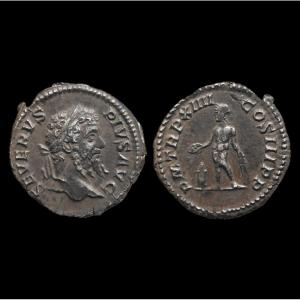
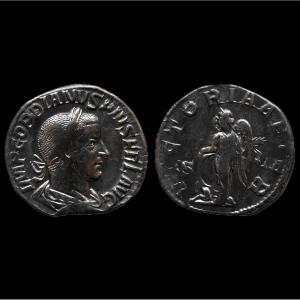
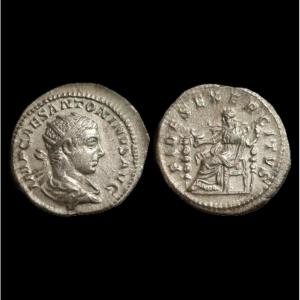
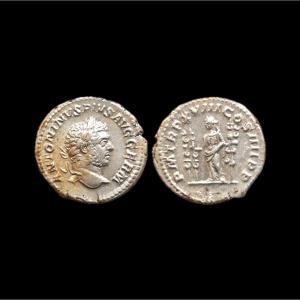
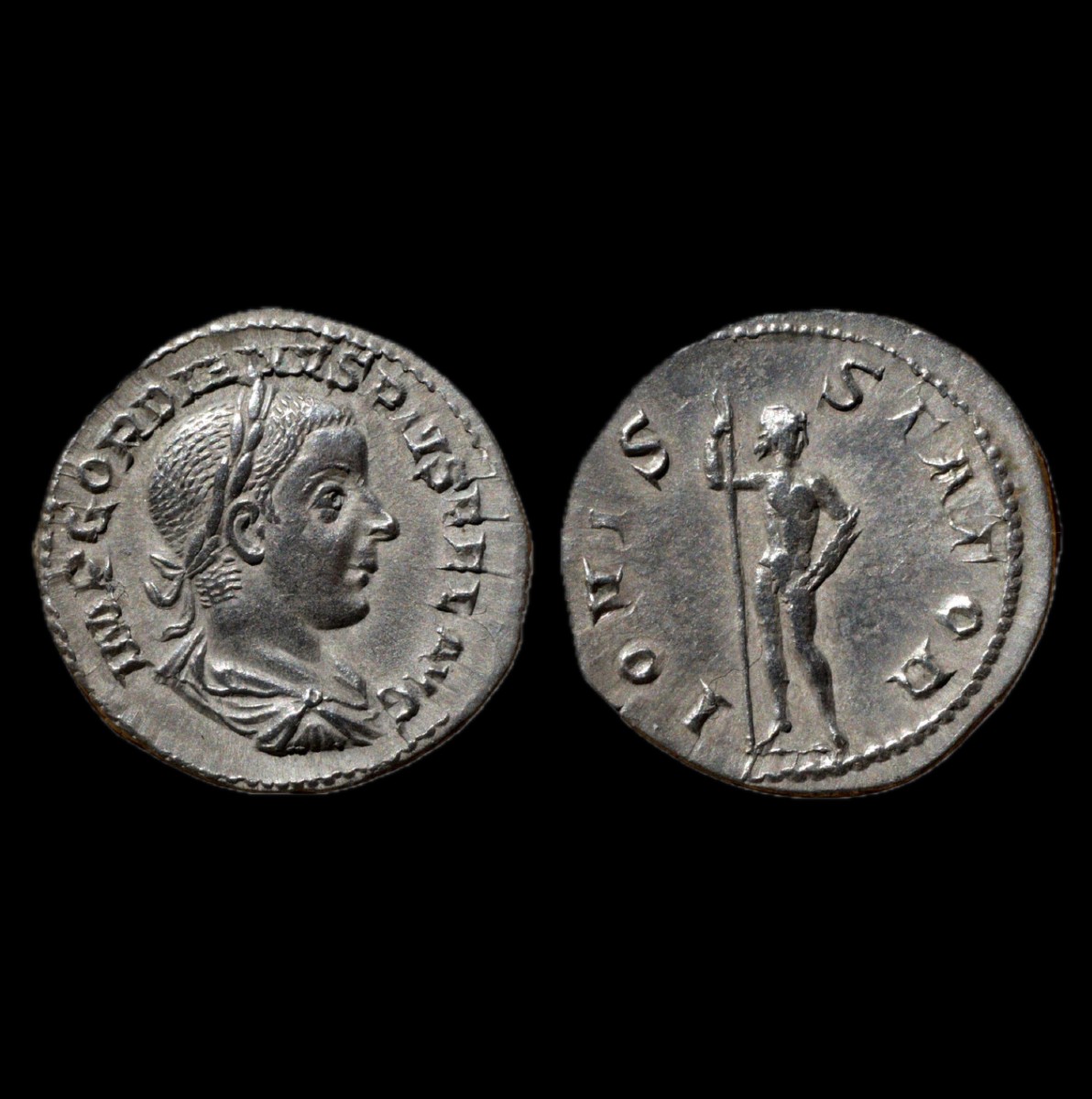
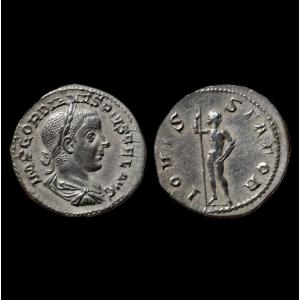
This silver denarius of Gordian III, struck at Rome between AD 241 and 243, aligns with very clear typological coherence to the IOVIS STATOR type published as RIC IV.III 112, with on the obverse IMP GORDIANVS PIVS FEL AVG and on the reverse IOVIS-STATOR; the specimen has a diameter of 20 mm and a weight of 3.00 g, fully compatible metrology for a Roman denarius of the reign, and it preserves, on both faces, a very satisfactory reading of the decisive attribution elements, giving it at once a serious, legible, and intellectually secure cabinet presence for the knowledgeable collector.
Close observation under ×10 magnification and raking light. The obverse offers a laureate portrait of Gordian III right, with draped and cuirassed bust seen from three-quarters rear, whose construction remains particularly clear in the short hair rendered in fine locks, the well-cleared forehead, the wide-open eye, the straight nasal line, the fine mouth, and the firmly drawn youthful chin; the laurel wreath is well individualized, the drapery of the paludamentum and the lines of the cuirass remain perceptible, and the peripheral legend, largely preserved, can be followed with pleasing continuity, strengthening the obverse’s overall presentation quality.
The reverse retains excellent typological legibility, since one readily recognizes Jupiter nude, standing frontally with head left, holding in the right hand a vertical scepter resting on the ground and in the left the thunderbolt, in a composition of great iconographic purity; the god’s silhouette, the carriage of the torso, the scepter’s verticality, and the mass of the thunderbolt remain clearly readable, and the legend IOVIS-STATOR remains sufficiently clear to support without hesitation attribution to the type. The reverse as a whole thus conveys an impression of stability, religious gravity, and visual authority entirely consistent with what is expected from an issue of this group.
The silver surface shows a homogeneous ancient appearance, with relief remaining crisp on the high points of both portrait and divine figure, a flan of broadly round yet slightly irregular outline compatible with ancient hammer striking, and old circulation marks that do not impair either legend reading or type comprehension; the beaded border can still be followed over broad segments, contributing to the specimen’s impression of visual integrity. The result is a coin whose balance of style, legibility, and material coherence is particularly pleasing.
What favorably distinguishes this specimen, for a collector already trained in third-century coinage, is the combination of a well-executed youthful portrait, a perfectly intelligible Jovian reverse, a titulature complete in its essential economy, and sound metrology, without excessive wear or type weakening; it is precisely this alliance between the reverse’s doctrinal clarity and the obverse’s plastic quality that gives the coin its distinguishing strength.
Characteristics
This is a denarius of Gordian III, struck at Rome, in silver, within AD 241–243.
Obverse legend: IMP GORDIANVS PIVS FEL AVG.
Obverse type: Laureate, draped, and cuirassed bust of Gordian III right, seen from behind.
Reverse legend: IOVIS-STATOR.
Reverse type: Jupiter nude, standing frontally with head left, holding a scepter resting on the ground in the right hand and the thunderbolt in the left.
Primary reference: RIC IV.III 112.
Observed metrics: 3.00 g; 20 mm.
Historical context
This issue belongs to the central phase of Gordian III’s reign, when Rome’s coinage develops with particular constancy religious types intended to place imperial power under the protection of the great divinities guarding Roman order; in this framework, Jupiter Stator is not an incidental figure, but a highly significant invocation of the god who steadies, sustains, stabilizes, and guarantees the firmness of the civic and military world. The choice of this reverse fully accords with the logic of the reign, which seeks to connect the prince’s youth to the permanence of sacred and political order.
The IOVIS STATOR type thus has very clear doctrinal force, because it couples Gordian III’s imperial titulature to an image of divine sovereignty that is firm, vertical, and protective; the scepter set upon the ground gives the figure a sovereign stability, while the thunderbolt recalls the god’s active power. In a reign where continuity of authority had to be constantly asserted, this iconography takes on particular density, immediately perceptible to those who read coinage as an instrument of political thought as much as a monetary object.
Cultural value
The cultural interest of this piece lies in the very happy meeting of a perfectly characterized youthful imperial portrait, a theologically and politically strong reverse, and a classic reference within Gordian III’s coinage; it is not merely a circulating denarius, but an object in which the Empire’s religious rhetoric is condensed into a clear, stable, and rigorously coded image. For a cabinet oriented toward late Severan and Gordian denarii, or toward issues with strong religious charge, this specimen has real representative value.
For the knowledgeable collector, the type appeals through its sober authority, the intelligence of its iconography, and the quality of its legibility; when, as here, Jupiter’s figure remains fully recognizable, the portrait retains its vigor, and the legends remain well followed, the coin acquires a particular dignity founded not on emphasis, but on the type’s correctness and the specimen’s steadiness.
Traceability & Guarantees
From a European provenance, from an established numismatic dealer, this specimen was acquired through a specialized international transaction conducted within a recognized numismatic network and validated by reference experts, according to the highest standards of the art and heritage market; examination of the present object retains exclusively the stylistic, technical, epigraphic, and metrological characteristics effectively observable, set within the framework of the type Gordian III / IOVIS STATOR / RIC IV.III 112, with particular attention to portrait coherence, titulature reading, reverse structure, and the flan’s overall conformity.
The concordance between the obverse IMP GORDIANVS PIVS FEL AVG, the reverse IOVIS-STATOR with Jupiter standing holding scepter and thunderbolt, the Rome mint, the AD 241–243 dating, the observed metrology, and the attribution to RIC IV.III 112 establishes here a particularly solid numismatic identification; each specimen is examined, described, and accompanied by a certificate of authenticity in accordance with the standards of the art and heritage market, in order to provide the collector with a serious, stable, and fully credible descriptive basis.
Period: Before 16th century
Style: Rome and Antic Greece
Condition: Good condition
Reference (ID): 1730304
Availability: In stock