

Dupondius Of The Secular Games — Certificate Of Authenticity
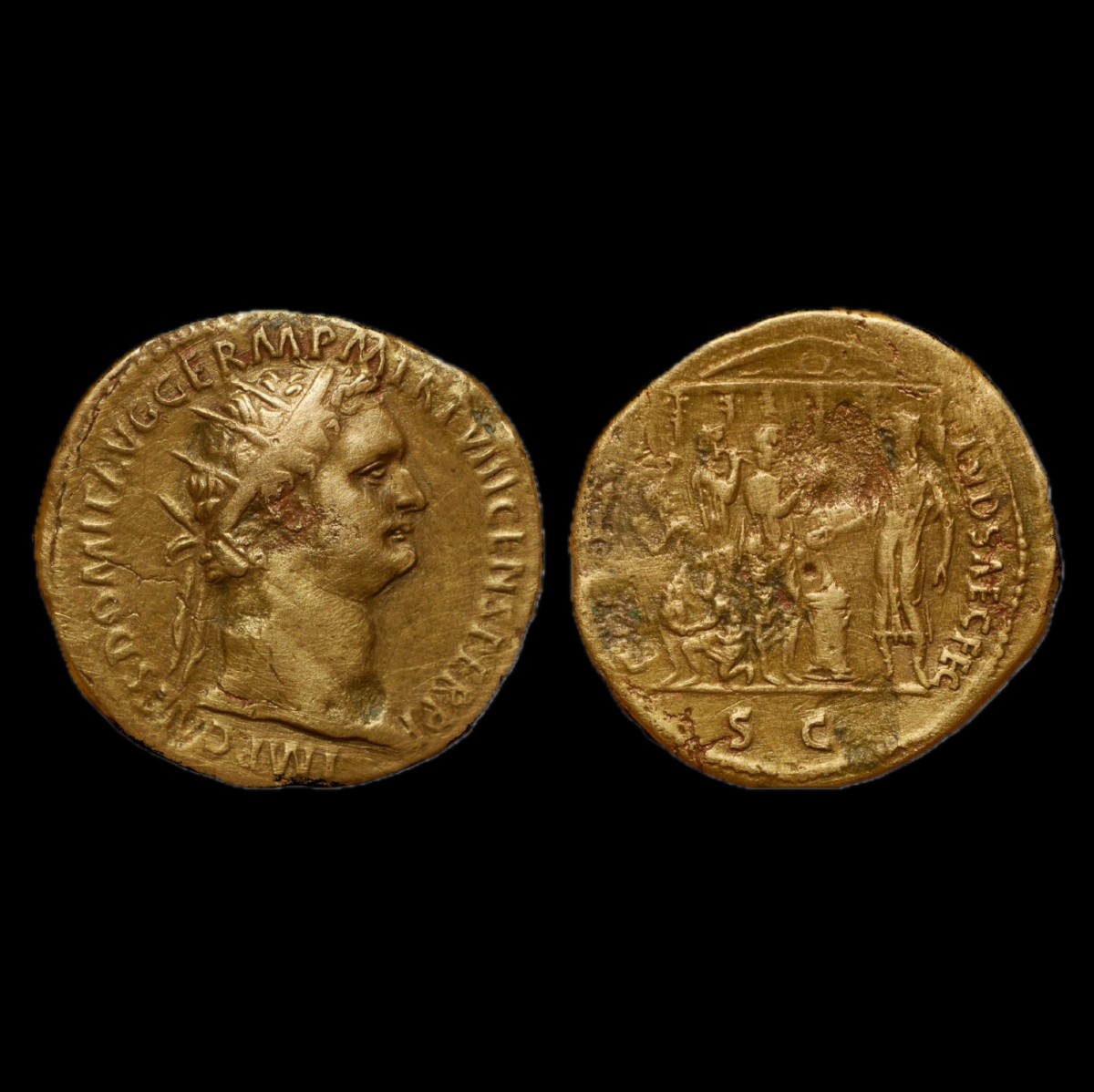
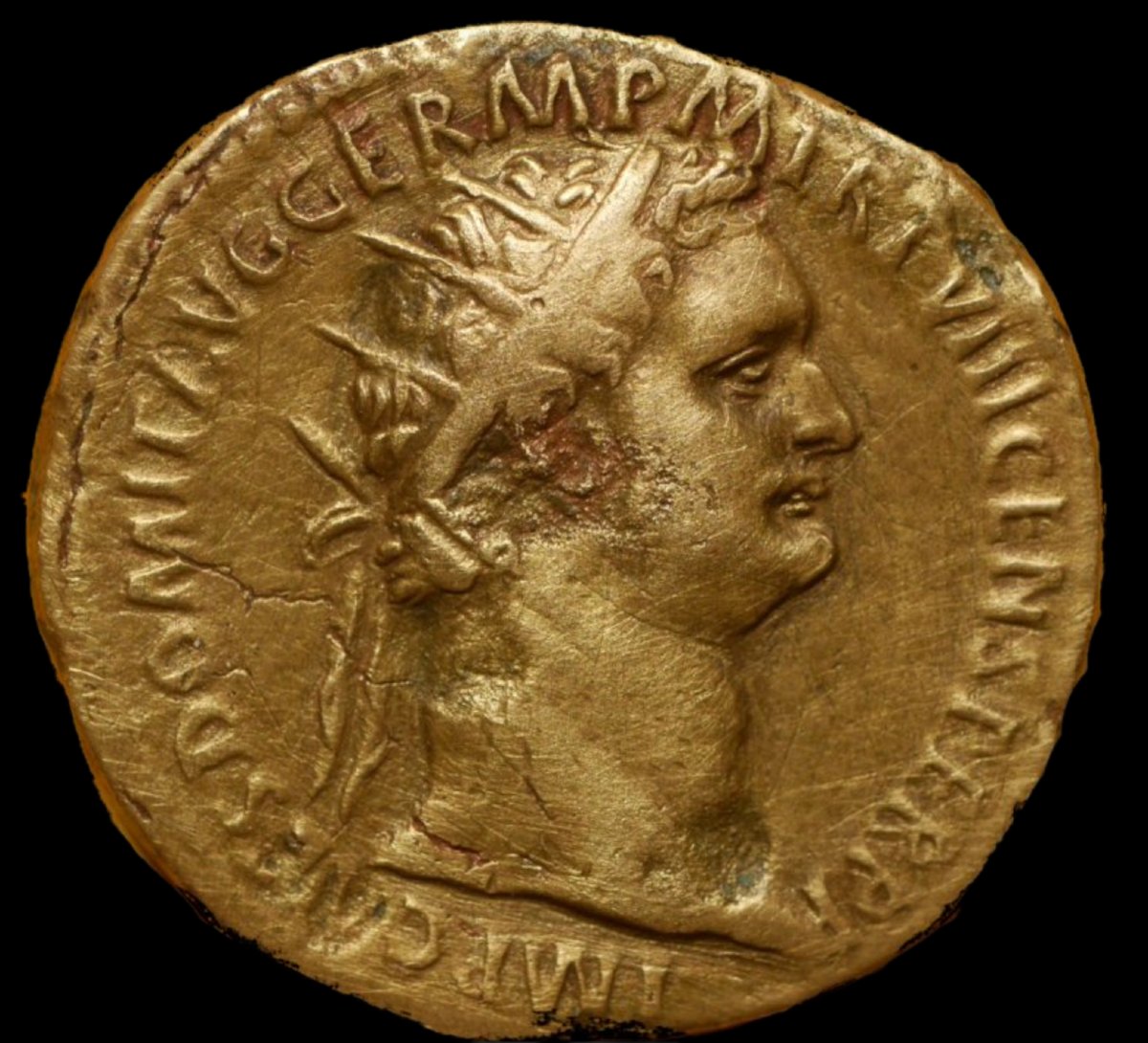
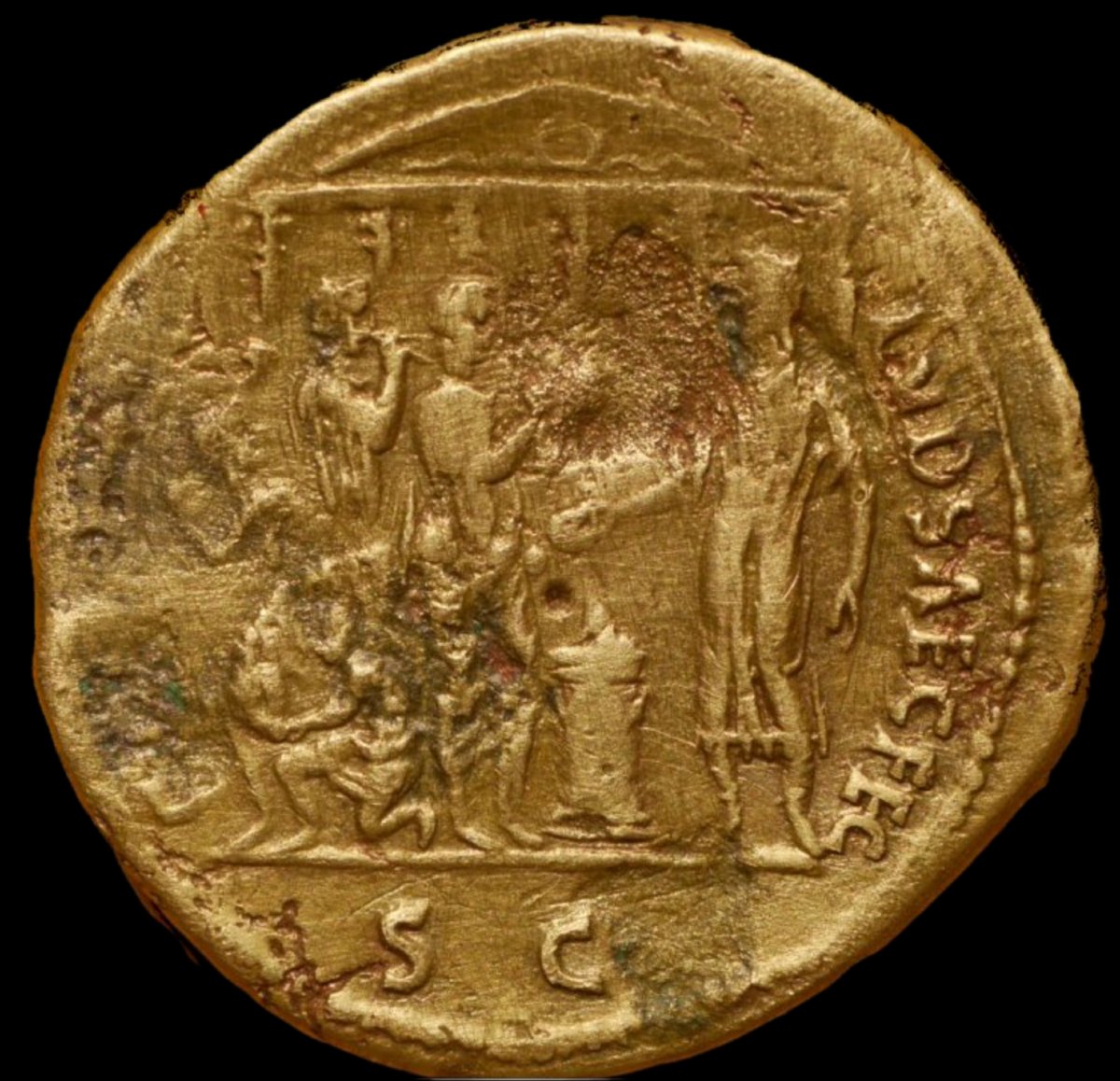
This remarkable dupondius of Domitian, struck at Rome in AD 88 for the major Secular Games issue, ranks among the most sought-after ceremonial reverses of Flavian bronze, both for the scale of its sacrificial scene and for its documentary power; the attribution to RIC II.1, no. 620 fully accords with the published type, with the obverse IMP CAES DOMIT AVG GERM P M TR P VIII CENS PER P P, radiate head right, and the reverse COS XIIII LVD SAEC FEC S C, showing Domitian sacrificing before an altar, a victimarius with a bull, musicians, and a hexastyle temple in the background, while the series is explicitly noted as rare in the standard numismatic literature and in the specialized trade.
Each specimen is examined, described, and accompanied by a certificate of authenticity in accordance with the standards of the art and heritage market; the present piece is immediately compelling for the nobility of its broad module, the assertive presence of a radiate portrait of fine authority, and above all a ceremonial reverse of uncommon iconographic density, where state religion, sacred architecture, and ritual music are brought together in a composition that speaks directly to the discerning collector of prestige coinages.
Analysis & Expertise
Close observation under ×10 magnification and raking light. Direct examination of the obverse reveals a radiate portrait of Domitian right of remarkable presence, whose volumetric construction—forehead, eye, nose, mouth, and chin—remains highly legible, with modeling vigor entirely satisfactory for an official bronze of this issue; the rays of the crown, clearly individualized, strongly structure the upper part of the field, while the hair, powerful neck, and base of the bust retain crisp relief, giving the whole an imperial physiognomy at once energetic and disciplined, highly characteristic of the Flavian repertoire.
The obverse legend unfolds with broad and convincing readability around almost the entire circumference, a decisive asset on a type where the full titulature contributes directly to the object’s majesty; the border remains perceptible in segments, the strike appears broad, and the centering—very favorable—preserves ample “breathing space” for the portrait, without notable crushing of the essential features.
Examination of the reverse confirms the singular quality of this specimen, for the great scene of the Ludi Saeculares remains not only identifiable, but genuinely constructed in its internal articulation: Domitian stands before the altar in an intelligible sacrificial posture; to the left, the animal-sacrifice scene retains a structured reading, with the victimarius and the mass of the bovine still clearly perceptible; to the right, the musician attendants can be recognized by their elongated silhouettes and ceremonial arrangement; in the background, the hexastyle temple preserves the line of its pediment, the cadence of its supports, and the central presence of the pedimental ornament, lending the reverse a particularly appreciable narrative depth.
The field displays a warm, golden copper-alloy tone consistent with the expected appearance of an ancient Roman dupondius, with a silky surface well preserved across several protected areas and high reliefs that still catch the light with great elegance; minor ancient encrustations and a few localized, discreet, and stable heterogeneities integrate naturally into the piece’s material history without impairing legibility, while letter contours, relief transitions, and overall surface coherence fully accord with an ancient hammer strike, with no visual indication pointing toward a cast reproduction.
The numismatic interest of this specimen lies precisely in this conjunction—uncommon on large ceremonial bronzes—of a well-set portrait, a broadly preserved legend, a ritual scene still developed through its various actors, and readable background architecture; the result is a collector’s coin that does not merely illustrate a catalogue entry, but still preserves, in its very substance, the religious dramaturgy of the type.
Characteristics
Authority
The issue belongs to Domitian, emperor from AD 81 to 96, under the developed titulature of the eighth tribunician power and the fourteenth consulship, placing the strike within the precise framework of the games celebrated in AD 88.
Mint
The mint is Rome, as indicated by the reference corpora and confirmed by the full typological tradition associated with this Secular Games series.
Denomination
This is a dupondius, a denomination explicitly given by the catalogue references and fully consistent with the radiate head on the obverse, the classic distinguishing marker of this value in Roman imperial coinage.
Dating
The strike belongs to the Secular Games issue of 88, an emission which modern bibliography connects to Domitian’s celebration within the Augustan computation of the saeculum.
Metal
Numismatic catalogues classify the type among the imperial bronzes, while the observed specimen displays the golden tonality of large Roman copper alloys traditionally associated with the dupondius.
Weight
The observed weight for this specimen is 13.66 g, fully compatible with the series’ standard and with specialized examples published in the numismatic trade.
Diameter
The diameter is 29 mm, corresponding exactly to the expected format for this large ceremonial bronze of Domitian.
Axis
The recorded axis is 6 h, in accordance with the measurement attached to this specimen in its commercial reference documentation.
Obverse
The obverse bears the legend IMP CAES DOMIT AVG GERM P M TR P VIII CENS PER P P around a radiate head of Domitian right, a type perfectly consistent with RIC II.1 620.
Reverse
The reverse bears the legend COS XIIII LVD SAEC FEC S C, with Domitian sacrificing at an altar, a victimarius to the left with the bovine, musicians to the right, and a hexastyle temple in the second plane, with ornament on the pediment.
Typological references
The identification is based on RIC II.1, 620, with an OCRE cross-reference via the Numista catalogue, and accords with specialist descriptions published for this market type.
Rarity
The type should clearly be presented as rare, since it receives a Numista rarity index of 100 and is also described as RARE in specialized offerings corresponding to the same RIC number.
Historical context
The Secular Games in Rome were an exceptional religious celebration, tied to the idea of the passage from one saeculum to another—that is, the opening of a new age; synthetic sources recall that the most firmly established imperial celebrations included those of Augustus in 17 BC and those of Domitian in AD 88, and that these festivals combined sacrifices, ritual music, spectacles, and the solemn affirmation of Roman order.
Within this framework, the coinage of 88 takes on particular importance, for modern research emphasizes that Domitian’s Games were regarded as legitimate because of their fidelity to the Augustan model, and that they were widely proclaimed through a vast numismatic issue intended to disseminate visually the ceremonial, imperial piety, and the continuity of Roman tradition; your specimen belongs precisely to this image policy in which coinage becomes almost a miniature historical relief.
The reverse chosen for this dupondius admirably illustrates that ambition, for it does not propose a single isolated allegorical figure, but a complete ritual staging, with the prince officiating, animal sacrifice, musical accompaniment, and architectural setting; one thus understands why Domitian’s Secular Games bronze coinage remains, for historians as for collectors, among the most eloquent ensembles of the Flavian reign.
Cultural value
The cultural value of this piece is eminent, because it unites in a single object three dimensions that great numismatics always seeks together: the imperial portrait, public ritual, and sacred architecture; far from being an ordinary circulating bronze, it is a condensed witness to state religion, the staging of power, and the monumental memory of Rome under the Flavians.
For the collector, such a dupondius carries particular force, in that it belongs to a series whose reverses narrate the ceremonies themselves, rather than mere political abstractions; there is a rare narrative density here, bringing this coin close to the historical document as much as to the work of art, and explaining the privileged place that the Ludi Saeculares issues have long held in cabinets devoted to the Roman High Empire.
From the perspective of Roman art history, this type participates in that Flavian culture of public spectacle and sovereign sign, where authority is expressed less through prolix discourse than through the precision of the represented rite; one may think here, as cultural illumination, of first-century imperial Roman civilization, of that distinctly Roman alliance between civic religion, theatre of power, and sacred monumentality, which authors such as Tacitus for political history, and modern studies devoted to the Ludi Saeculares, help us better grasp in its deeper logic.
Traceability & Guarantees
From a European provenance, from an established numismatic dealer, this specimen was acquired through a specialized international transaction conducted within a recognized numismatic network and validated by reference experts, in accordance with the highest standards of the art and heritage market; the examination of the present object, carried out according to a stable protocol of observation and description, retains exclusively the effectively observable elements and serious bibliographic concordances, in order to offer the collector a presentation that is firm, intelligible, and consistent with sector practice.
Each specimen is examined, described, and accompanied by a certificate of authenticity in accordance with the standards of the art and heritage market; in the present case, the type’s coherence, the quality of the relief, the legibility of the main legends, the natural structuring of the surfaces, and the overall fit with published references contribute to a particularly solid numismatic attribution.
Period: Before 16th century
Style: Rome and Antic Greece
Condition: En l'etat
Reference (ID): 1730168
Availability: In stock