


Trajan Ric 38 Var. — Certificate Of Authenticity
This silver denarius of Trajan, struck at Rome and assigned to the group dated to AD 100, belongs to the type with Pax standing left holding a branch and a cornucopia, with on the obverse IMP CAES NERVA TRAIAN AVG GERM; the standard type is recorded as RIC II 38 by Numista / OCRE, while the combination observed here, with slight drapery on the left shoulder, is published in the specialized trade as RIC II 38 var., with comparisons to BMCRE 76 and RSC 222a, making it a bust-variant of definite interest for a collector attentive to engraving nuances and RIC sub-classification within Trajan’s early issues. The stated metrology, 3.48 g for 18–19 mm, fully accords with the data recorded for the group: Numista gives 3.1 g for 18.5 mm and an observed range of 2.59 to 3.32 g for the base type, while specialized comparable specimens of this variant are published around 2.99 g and 3.29 g.
Analysis & Expertise
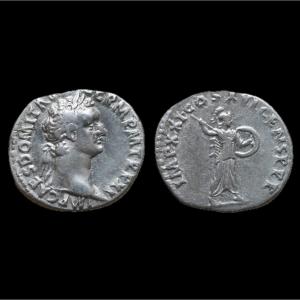
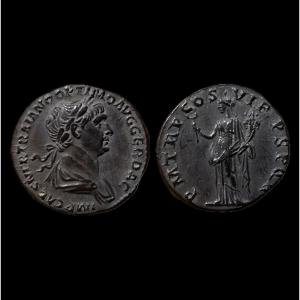
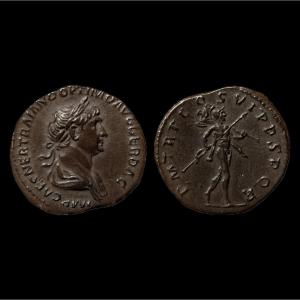
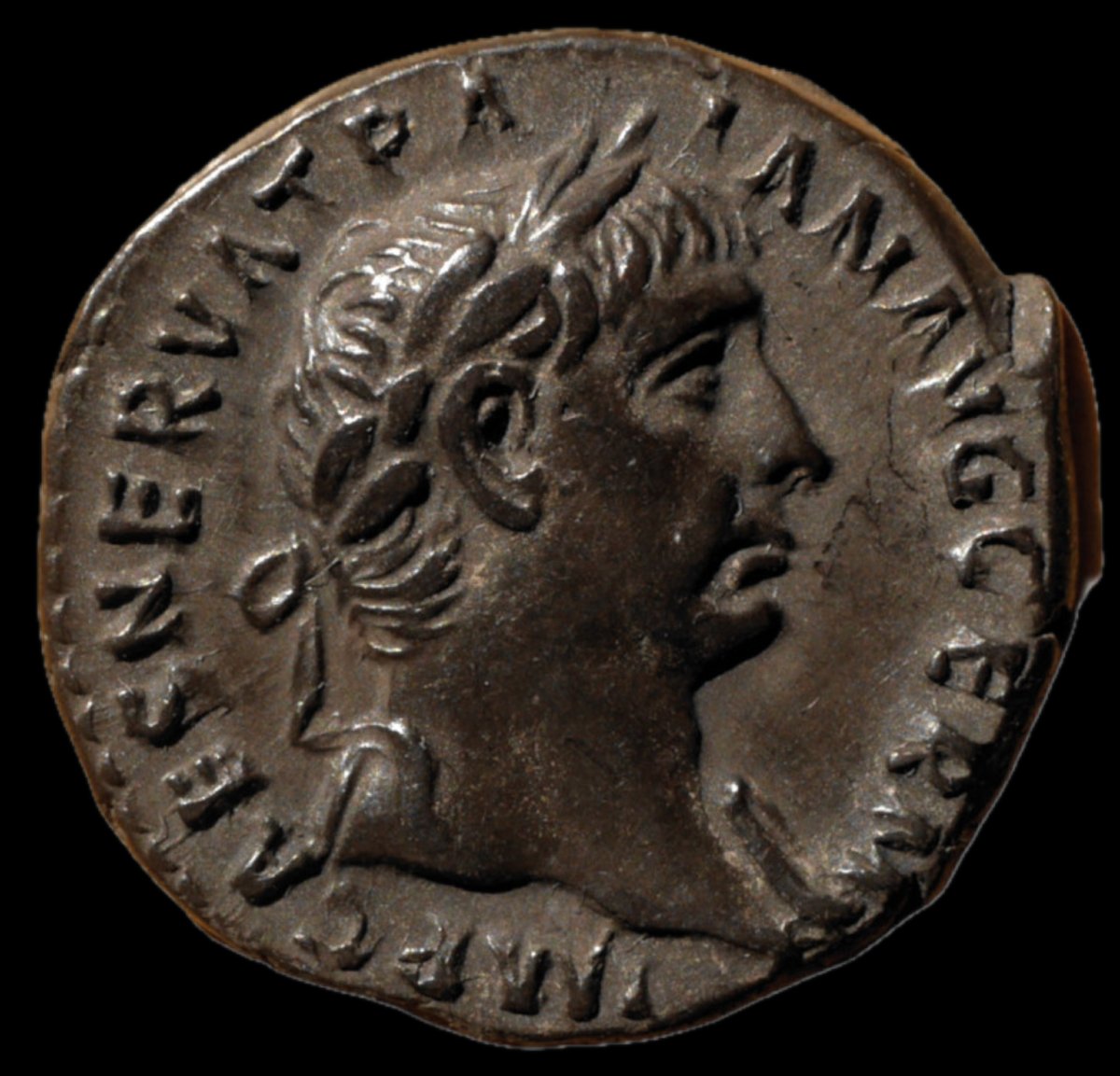
Close observation under ×10 magnification and raking light. The obverse presents a laureate head of Trajan right, of very fine stylistic quality, with firm facial modeling, hair rendered in supple layered locks, a well-structured laurel wreath, a distinctly open eye, a frank nasal line, and a solidly drawn chin; the slight drapery on the left shoulder stands out with sufficient clarity to support attribution to the bust variant published by specialized professionals. The peripheral legend remains largely legible, the beaded border can be followed around a large part of the circumference, and the strike appears well centered on the portrait, giving the obverse a particularly convincing cabinet presence. The base type, without drapery, is described by Numista as Head of Trajan, laureate, right, while the variant with drapery on the left shoulder is explicitly published by a professional as RIC II 38 var.
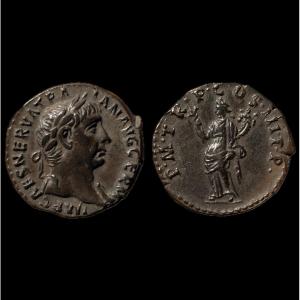
The reverse retains clear, homogeneous iconographic legibility, with Pax standing left, draped and crowned, holding in the right hand a branch and in the left a cornucopia; the figure, well set within the field, keeps a stable, immediately intelligible silhouette, and the legend P M TR P COS III P P can be followed very satisfactorily around the motif. The fields show regular ancient wear consistent with effective circulation, but without loss of type readability, while the essential relief remains firm on the hair, profile, and reverse allegory. The reverse description corresponds exactly to that retained by Numista / OCRE and repeated in specialized trade for RIC 38.
The silver surface presents a coherent ancient physiognomy, with a slightly nuanced light-gray tone, relief still well catching on the high points, and a few marginal flan irregularities visible at the edge, fully compatible with ancient hammer-struck production; the outline remains slightly irregular, the border keeps good continuity, and overall readability remains particularly sound for this group. Numista indeed records the type as an irregular round coin struck by hammer, which closely accords with the material characteristics observed on this specimen.
The key strength of this specimen lies in the combination of a highly legible early Trajanic portrait, a fully canonical Pax reverse, a broadly preserved beaded border, and above all a bust variant with drapery on the left shoulder that directly interests Trajan collectors attentive to the sub-types of the older RIC; the RIC 38 group is moreover flagged by Numista with a rarity index of 90, confirming a sought-after status without removing it from a thoroughly documented typological framework.
Characteristics
Authority.
This issue belongs to Trajan (Marcus Ulpius Traianus), Roman emperor from AD 98 to 117.
Mint.
Rome.
Dating.
The standard type RIC II 38 is assigned to AD 100 by Numista / OCRE; the bust variant with slight drapery is published by specialized professionals within the same chronological horizon.
Denomination.
Denarius.
Metal.
Silver.
Weight.
The recorded weight for this specimen is 3.48 g; the standard type is given as 3.1 g by Numista with an observed range of 2.59 to 3.32 g, and specialized comparanda exist at 2.99 g and 3.29 g.
Diameter.
The recorded diameter is 18–19 mm; Numista records 18.5 mm, with an observed range of 18 to 20 mm for the base type.
Obverse.
IMP CAES NERVA TRAIAN AVG GERM, laureate head right; on the present specimen, slight drapery is visible on the left shoulder, in accordance with the published variant.
Reverse.
P M TR P COS III P P, Pax standing left holding a branch in the right hand and a cornucopia in the left.
Typological references.
The base type is recorded as RIC II 38 and OCRE ric.2.tr.38; the bust variant with drapery is published as RIC II 38 var., with comparisons to BMCRE 76 and RSC 222a.
Historical context
This issue belongs to the beginning of Trajan’s reign, in the phase when the titulature AVG GERM and the formula COS III P P are already stabilized on Rome’s coinage; the Pax type belongs to a very classical political language of the principate, in which peace is not shown as a neutral abstraction but as a governing virtue, expressed through the branch and the cornucopia. Numista translates the reverse legend as Pontifex Maximus, Tribunicia Potestate, Consul Tertium, Pater Patriae, situating the type within a clearly characterized institutional sequence of the reign.
The reverse with Pax standing left thus fits within a monetary program of stabilization and affirmation of imperial order typical of Trajan’s first years; the combination of a portrait still close to the reign’s earliest style and a simple, strongly legible allegory explains this group’s constant appeal among High Empire collectors. Recent specialized offerings published under RIC 38 show that this type remains actively followed on the numismatic market.
Cultural value
The cultural interest of this coin lies in the precision with which it concentrates, within a small silver module, a high-quality imperial portrait, an immediately intelligible allegorical reverse, and a bust sub-type that attracts expert collectors; it is a piece whose iconographic reading is quick, yet whose classificatory precision remains subtle, giving it a particular value within a Trajan-specialist cabinet.
For the knowledgeable collector, the true interest of this specimen lies less in any artificial emphasis than in the clean combination of a published bust variant, sound metrology, a well-asserted Rome style, and a Pax reverse complete in its concept; the RIC 38 group, already sought after in itself, gains additional documentary relief here through the presence of drapery on the left shoulder, a detail that genuinely matters in an expert reading of early Trajanic coinage.
Traceability & Guarantees
From a European provenance, from an established numismatic dealer, this specimen was acquired through a specialized international transaction conducted within a recognized numismatic network and validated by reference experts, according to the highest standards of the art and heritage market; examination retains only the stylistic, technical, epigraphic, and metrological characteristics effectively observable on the coin, set within the framework of Trajan’s Rome Pax / COS III type and compared against the available typological documentation.
Each specimen is examined, described, and accompanied by a certificate of authenticity in accordance with the standards of the art and heritage market; in the present case, the concordance between the obverse IMP CAES NERVA TRAIAN AVG GERM, the reverse P M TR P COS III P P with Pax standing, the observed metrology, the Rome mint, the attribution to RIC II 38, and the specialized publication of the bust variant with drapery on the left shoulder establishes a particularly solid numismatic attribution, written for a knowledgeable collecting audience within a framework of strict descriptive exactitude.
Period: Before 16th century
Style: Rome and Antic Greece
Condition: Good condition
Reference (ID): 1730274
Availability: In stock