


Geta As Caesar — Denarius Vota Pvblica, Ric Iv.1 38b — Certificate Of Authenticity
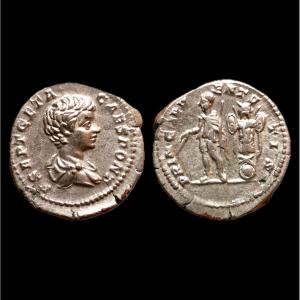
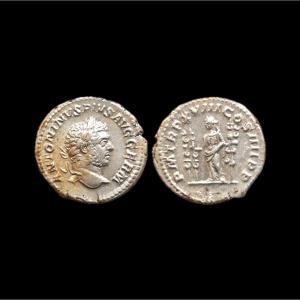
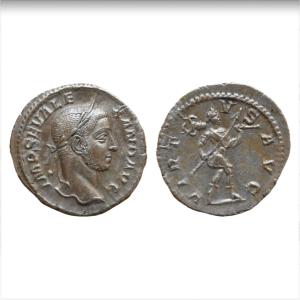
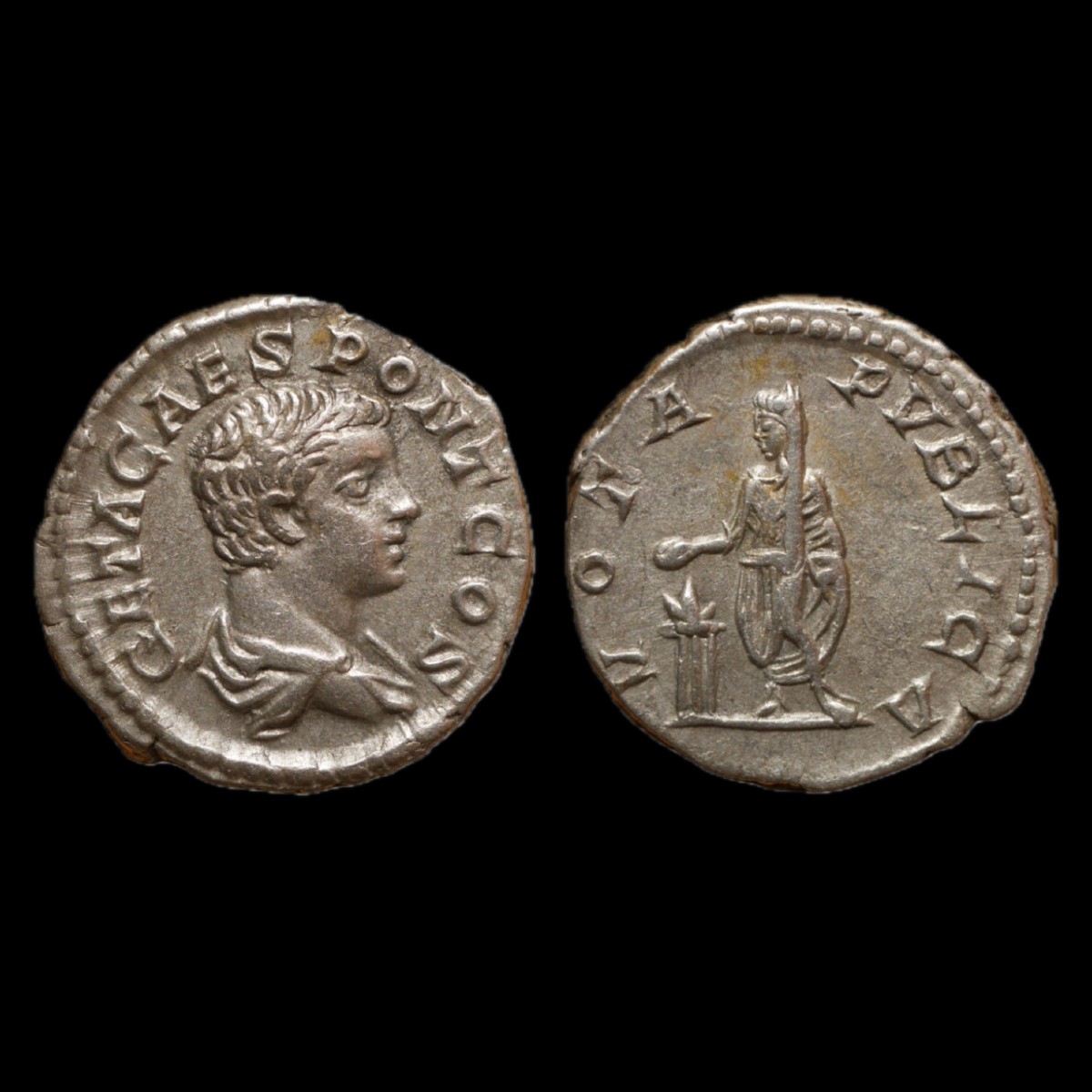
This silver denarius of Geta as Caesar, struck at Rome within the interval AD 203–208, is of the GETA CAES PONT COS / VOTA PVBLICA type, concordantly attributed to RIC IV.1, 38b, BMC 442, and Cohen 230; it belongs to the first phase of Geta’s personal coinage before his accession as Augustus, and fits within the Roman series of Severan votive issues, with an obverse showing a bare-headed and draped bust right, and a sacrificial reverse in which the young prince officiates before a tripod-altar, holding patera and scroll. The stated metrology, 3.22 g for 19 mm, falls exactly within the expected fabric for the type, published comparanda clustering around 19 mm and about 3.0–3.4 g.
Analysis & Expertise
Close observation under ×10 magnification and raking light. The obverse presents a youthful portrait of Geta right, bare-headed and draped, whose stylistic construction remains particularly crisp, with short, close-set hair arranged in firm locks, a regular forehead, a well-opened eye, a continuous nasal line, a finely drawn mouth, and a chin still well held; the titulature GETA CAES PONT COS unfolds with sustained legibility around almost the entire circumference, and the beaded border remains largely continuous, giving the obverse a strike quality very satisfactory for a Severan denarius of true circulation. This configuration fully accords with the reference description given by the British Museum, WildWinds, and specialist catalogues for RIC 38b.
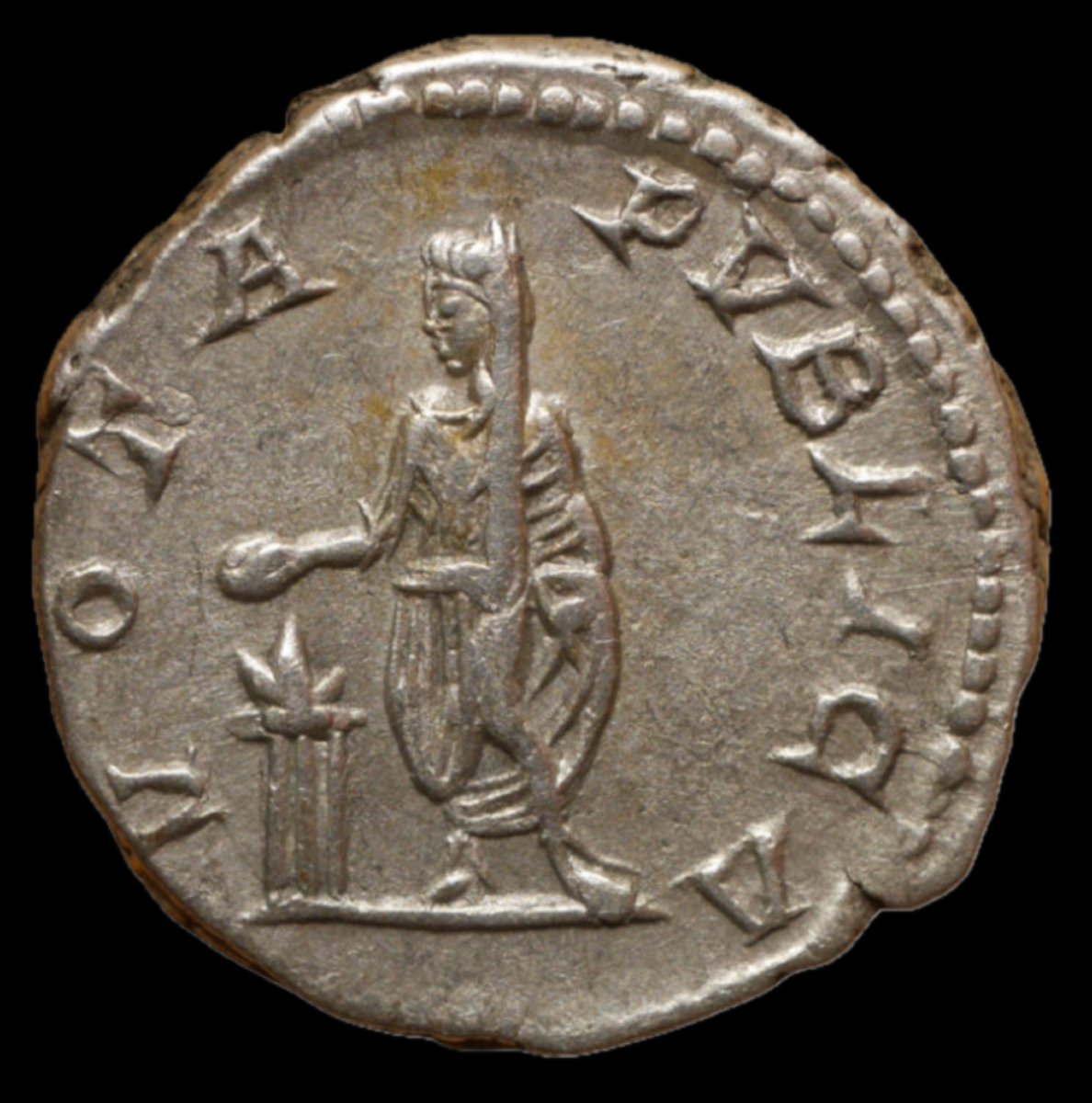
The reverse retains a particularly secure typological reading, with Geta standing left in sacrificial toga, holding in the right hand a patera turned toward the tripod-altar, and in the left a scroll, according to a very stable iconographic scheme for VOTA PVBLICA; the prince’s silhouette, the tripod-altar to the left of the central field, the attribute held in the left hand, and the distribution of the legend around the field remain sufficiently clear to support expert identification without methodological reservation. British Museum documentation describes this type precisely as Geta sacrificing over a lighted tripod, holding a scroll, and specialist market notices repeat the same reading under RIC 38b / BMC 442 / Cohen 230.
The silver surface presents a coherent ancient physiognomy, with relief still crisp on both the portrait and the votive scene, a regular residual brightness on the high points, and fine old handling marks that integrate naturally into the flan’s material life; several old marginal striking tensions, clearly visible along the upper and lower edge, remain stable and affect neither comprehension of the type nor the coin’s overall balance. The slightly irregular outline, the rise of the letters, the continuity of the border, and the overall aspect of the metal fully accord with a Rome hammer strike for this issue.
The numismatic interest of this specimen lies in the combination, on a well-proportioned module, of a highly legible Caesarian portrait, an obverse titulature complete in its economy, and an immediately identifiable VOTA PVBLICA reverse, making it a technically coherent cabinet piece and particularly eloquent for the study of Geta’s earliest monetary phase. Published comparanda under the same reference further show diameters, weights, and typological arrangements in close concordance with the specimen examined here.
Characteristics
Authority. The issue belongs to Geta as Caesar, under the dynastic authority of Septimius Severus and Caracalla, in the phase prior to his elevation to Augustus.
Mint. Rome.
Dating. The type is documented at Rome as AD 203–208 in specialized trade, with a broader framework of AD 199–204 in the British Museum for the same obverse and reverse; the specimen therefore falls securely within Geta’s first Roman Caesarian sequence.
Denomination. Denarius.
Metal. Silver.
Weight. 3.22 g, fully compatible with published comparanda for the reference.
Diameter. 19 mm, exactly consistent with published reference specimens.
Obverse. GETA CAES PONT COS, bare-headed and draped bust right.
Reverse. VOTA PVBLICA, Geta standing left, sacrificing with patera over a tripod-altar, holding a scroll in the left hand.
Typological references. RIC IV.1 38b; BMC 442; Cohen 230.
Historical context
This issue belongs to the period when Geta, promoted Caesar in AD 198, is progressively integrated into the Severan dynastic structure; his Roman Caesarian coinage is not merely presence coinage, but an instrument of public representation of the young heir within an imperial house that visibly organizes succession. Specialist notices associate this type with the years AD 203–208, i.e., the moment when his personal image begins to stabilize numismatically at Rome.
The reverse VOTA PVBLICA belongs to the official vocabulary of public vows and depicts not an abstract allegory but the prince himself in the sacrificial act; the coin therefore directly associates Geta with public piety and Roman ritual, in a politically dense formula uniting dynastic visibility, religious legitimization, and participation in state cult. The British Museum describes this sacrificial action unambiguously, and the stability of this description across specialist catalogues confirms the type’s institutional nature.
Cultural value
The cultural interest of this coin is high, because it offers—within a very concentrated form—one of the most revealing themes of youthful Severan coinage: the integration of the prince into the sphere of public rite; the denarius does not merely carry Geta’s portrait, it shows him officiating, i.e., acting within Roman religious order, giving it particularly strong documentary value for the history of imperial power.
For the knowledgeable collector, the type holds sustained appeal because it combines a clearly defined Caesarian titulature, a youthful portrait of good style, and a votive reverse fully intelligible in function, making it a highly representative issue of Geta before his elevation to Augustus. Its collecting strength lies precisely in this exemplary articulation between portrait, rite, and dynastic program.
Traceability & Guarantees
From a European provenance, from an established numismatic dealer, this specimen was acquired through a specialized international transaction conducted within a recognized numismatic network and validated by reference experts, in accordance with the highest standards of the art and heritage market; examination retains only the stylistic, technical, epigraphic, and metrological characteristics effectively observable on the coin, set within the framework of the Roman GETA CAES PONT COS / VOTA PVBLICA type and compared against currently available corpora and comparanda.
Each specimen is examined, described, and accompanied by a certificate of authenticity in accordance with the standards of the art and heritage market; in the present case, the concordance between the obverse GETA CAES PONT COS, the VOTA PVBLICA reverse, the Rome mint, the observed metrology, and the references RIC IV.1 38b, BMC 442, and Cohen 230 establishes a particularly solid numismatic attribution, fully suited to a presentation intended for knowledgeable collectors.
Period: Before 16th century
Style: Rome and Antic Greece
Condition: Good condition
Reference (ID): 1730270
Availability: In stock