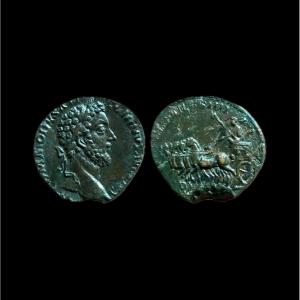
African Half-siliqua Of Heraclius — Certificate Of Authenticity
Small-module silver coin (AR), attributed to the mint of Carthage, in the name of Heraclius (610–641), with on the reverse Heraclius Constantine and the empress Martina: a highly sought-after North African issue for its frontal dynastic typology (facing busts, crowns with pendilia, cross above) and for the relative scarcity of African small silver pieces that remain clearly readable.
Analysis & expertiseCareful observation under ×10 magnification and raking light: the photographs show a light gray silver tone, with livelier highlights on the relief (crowns, faces) and duller fields. The surface displays a network of fine linear marks (micro-scratches and contact traces) and a few lightly flattened areas, consistent with ancient circulation on a reduced module.
The flan is irregular and slightly wavy, with a clear edge weakness in one sector (small notch/irregularity), a frequent feature on hammer-struck pieces of this size. Despite these characteristics, the main structural elements remain legible: frontal composition, dotted crowns, pendilia, upper cross, and a clear separation of the reverse busts. As seen in the images, the whole remains consistent with an African half-siliqua of this group.
ObverseThe obverse presents the facing bust of Heraclius, draped and cuirassed, wearing a crown with pendilia. In the images, the crown reads as a construction of pearls/raised dots forming a band, with lateral pendants rendered as chains of pellets.
The face is treated in the frontal Byzantine manner—pellet eyes, simplified nose, indicated mouth—while preserving satisfactory readability of the main volumes (face oval, chin, base of the neck). The peripheral legend, given as D N ЄRACΛIO P P AV, appears in fragments: some letters are clearer, others softened by centering and peripheral wear, which is common on such a tight diameter.
ReverseThe reverse brings together two facing busts: Heraclius Constantine on the left and Martina on the right, each with a crown with pendilia, with a cross above as the symbolic axis of the composition. In the photograph, the cross is perceptible in the upper area, and the dotted relief of the crowns is well distinguished.
The separation between the two figures remains readable: differentiated heads, visible lateral pendants, and garment lines suggested by vertical planes. The fields retain micro-marks but do not erase the iconographic structure, supporting identification of the Carthaginian type for this dynastic trio.
CharacteristicsAuthority: Heraclius, with Heraclius Constantine and Martina (610–641).
Denomination: Half-siliqua (AR).
Mint: Carthage.
Obverse: D N ЄRACΛIO P P AV, facing draped and cuirassed bust of Heraclius, crown with pendilia.
Reverse: facing busts of Heraclius Constantine (l.) and Martina (r.), crowns with pendilia; cross above.
References (cross bibliography): DOC 233 ; MIB 149 ; SB 871.
Weight: 0.79 g.
Diameter: 13 mm.
After the reconquest, Carthage remained a key monetary center. Under Heraclius, amid military pressures and institutional adjustments, small silver modules served local circulation while carrying a message of continuity. The association of the ruler with his heir and the empress on a circulating coin expresses dynastic assertion, conveyed through a frontal, hieratic layout characteristic of Byzantine visual language.
Cultural valueFor a collector, this half-siliqua concentrates highly desirable features:
an African mint (Carthage) and a historically meaningful small silver module;
an immediately recognizable dynastic iconography (Heraclius / Heraclius Constantine / Martina);
a strong stylistic identity (facing busts, crowns with pendilia, cross), offering a direct visual summary of Byzantine Africa and the Heraclian dynasty.
In accordance with our practices, each specimen is examined, described, and accompanied by a certificate of authenticity consistent with the standards of the art and heritage market. The assessment is based on careful observation under ×10 magnification and raking light, and on typological, stylistic, and metrological coherence, set against reference corpora.
Provenance is European, from a professional numismatic circuit; the acquisition falls within a specialized international transaction, carried out within a recognized network and validated by expertise, according to practices applicable to heritage objects.
Secure shippingTo provide the most suitable terms, please send us a message specifying your location and full delivery address; we will then immediately confirm the corresponding payment and shipping procedure.
France: Colissimo shipment, with signature and insurance (20 euros).
Abroad: UPS shipment, with signature and insurance (35 euros).
Period: Before 16th century
Style: Rome and Antic Greece
Condition: Good condition
Reference (ID): 1716270
Availability: In stock