

Gordian III Ric 37 — Certificate Of Authenticity
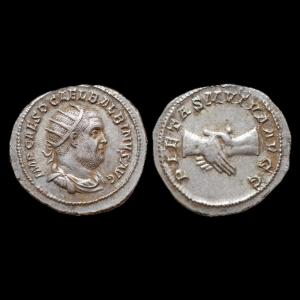
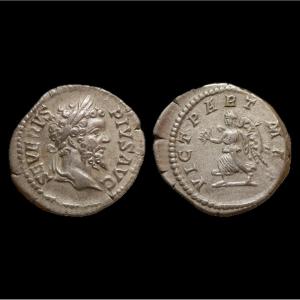
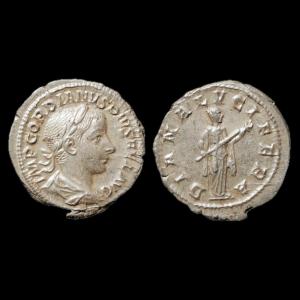
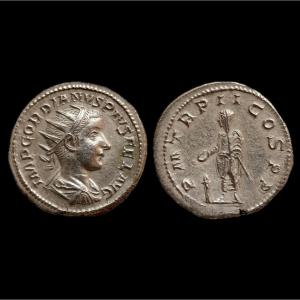
This remarkable silver antoninianus of Gordian III, struck at Rome in the very early part of AD 240, aligns with very clear typological coherence to RIC IV 37, with on the obverse IMP CAES M ANT GORDIANVS AVG around a radiate, draped, and cuirassed bust right, and on the reverse P M TR P II COS P P, where the emperor, veiled and toga-clad, stands in a sacrificial attitude before a lighted altar, holding a patera in the right hand and a ritual wand in the left; standard numismatic literature and specialized comparanda place this type in the sequence January to March 240, at the beginning of Gordian III’s second tribunician power, and assign it material parameters very close to those observed here—namely a diameter of about 23 to 24 mm and a weight around 4.1 to 4.9 g—so that the specimen at 4.16 g and 24 mm falls fully within the metrological range expected for the series.
Analysis & Expertise
Close observation under ×10 magnification and raking light. The obverse presents a youthful portrait of Gordian III of particularly satisfactory stylistic presence: the radiate crown spreads with clear definition in its rays, the hair retains a lively and regular modeling, the eye, nasal line, mouth, and chin remain very legibly structured, and the bust—both draped and cuirassed—keeps a clear articulation in the fall of the folds and the shoulder line; the peripheral legend, very largely preserved, reads broadly and continuously, while the beaded border, well followed around much of the circumference, strengthens the overall presentation quality and gives the coin a particularly convincing cabinet presence for an early antoninianus of the reign.
The reverse preserves first-rate typological legibility, as one readily recognizes the emperor sacrificing, veiled and toga-clad, in a frontal stance with head turned left, holding the patera above a lighted altar and a ritual wand in the other hand; the scene, of great religious and political density, remains immediately intelligible, the imperial figure’s verticality being well supported by the field arrangement, the clarity of the attributes, and the distinct presence of the altar to the left of the type, in a composition exactly consistent with that described for RIC 37 in specialist catalogues and reference repertories.
Material examination reveals an ancient silver surface, homogeneous in its overall logic, with relief remaining crisp on the high points of both portrait and reverse, a flan fairly broad for the denomination, of slightly irregular outline yet fully coherent with hammer striking, and an overall physiognomy that corresponds entirely to the technical economy of Gordian III’s earliest antoniniani; moreover, the coin retains a very balanced visual steadiness between obverse and reverse, which is far from negligible in this group where the sacrificial scene requires, to be fully appreciated, a certain freshness of relief and good preservation of the titulature.
What gives this specimen particular interest for the knowledgeable collector is the conjunction of several concretely sought-after qualities: a very well-executed radiate portrait, an obverse legend that remains broadly readable, a fully identifiable religious reverse, and highly favorable metrology, the coin sitting precisely within the healthy upper zone of the series, with a diameter above the average often published and a weight fully consistent with strong comparison specimens.
Characteristics
This is an antoninianus of Gordian III, struck at Rome, in silver, within the interval January to March AD 240, with a recorded weight of 4.16 g, a diameter of 24 mm, and an axis of 12 h; the obverse bears the titulature IMP CAES M ANT GORDIANVS AVG with radiate, draped, and cuirassed bust right, while the reverse bears P M TR P II COS P P with the emperor toga-clad and veiled, sacrificing with patera over a lighted altar and holding a ritual wand. The principal attribution is to RIC IV 37, with correspondence RSC 210, and specialized specimens published under this reference show very similar diameters and weights, notably 23 mm / 4.51 g, 24 mm / 4.86 g, or 22 mm / 4.76 g, confirming the present specimen’s very strong metrological fit within the type.
Historical context
This issue belongs to the initial phase of Gordian III’s autonomous coinage after the crises of AD 238–239, at a moment when the titulature TR P II and COS P P already places the young prince within full imperial legitimacy, and when the sacrificial reverse gives power an explicitly religious expression; far from being a decorative scene, this iconography shows the emperor in the very exercise of public pietas, i.e., the visible performance of the rite guaranteeing the order of the Roman world—particularly significant at so early a date in his reign. Specialist descriptions converge on this sacrificial character of the type, clearly identifying the lighted altar, the patera, and the wand.
The place of this number within the chronology of Gordian III’s antoniniani gives it precise numismatic interest, since it belongs to a short, clearly delimited period and bears a titulature anterior to the larger, more abundant issues with PIVS FEL AVG of the following years; this earlier status, together with the portrait quality still close to the reign’s earliest effigies, gives the coin real documentary value for the study of the visual and ideological construction of power under Gordian III.
Cultural value
The cultural interest of this coin is high, because it brings together, within a third-century emblematic denomination, a youthful imperial portrait of fine presence, an immediately intelligible ritual scene, and a tightly framed dating, allowing the collector to hold an object in which iconography, titulature, and chronology respond to one another with rare clarity; it is therefore not merely a circulating antoninianus, but a compact testimony to the way Rome, as early as AD 240, stages the religious legitimacy of the young Augustus.
For a cabinet oriented toward early antoniniani, third-century religious issues, or Gordian III’s first series, this specimen has particular quality, because it preserves that rare alliance of legend legibility, reverse clarity, and metal presence without which sacrificial types quickly lose an essential part of their force; it is precisely this overall coherence that gives the coin its true distinction.
Traceability & Guarantees
From a European provenance, from an established numismatic dealer, this specimen was acquired through a specialized international transaction conducted within a recognized numismatic network and validated by reference experts, according to the highest standards of the art and heritage market; examination retains only the stylistic, technical, epigraphic, and metrological characteristics effectively observable on the coin, set within the framework of the Rome type Gordian III / P M TR P II COS P P / RIC 37, and compared with the references and comparanda of the dossier. Each specimen is examined, described, and accompanied by a certificate of authenticity in accordance with the standards of the art and heritage market; in the present case, the concordance between the radiate obverse portrait, the sacrificial reverse, the titulature, the early-AD 240 dating, the observed metrology, and the attribution to RIC 37 establishes a particularly solid numismatic identification, formulated within a framework of strict descriptive exactitude and fully suited to a knowledgeable collecting audience.
Period: Before 16th century
Style: Rome and Antic Greece
Condition: Good condition
Reference (ID): 1730290
Availability: In stock