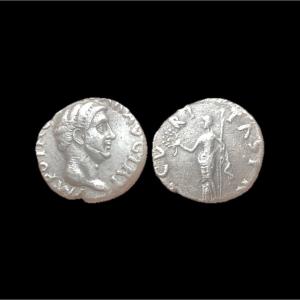
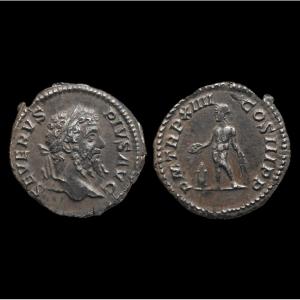
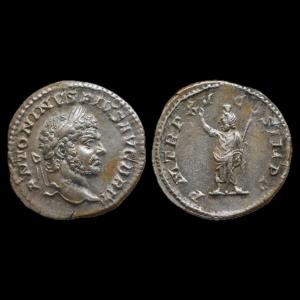
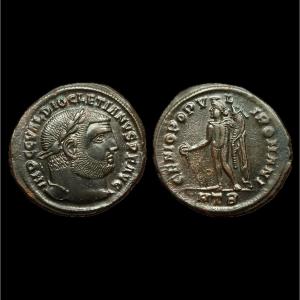
Antoninien Of Elagabalus “victor Antonini” — Certificate Of Authenticity
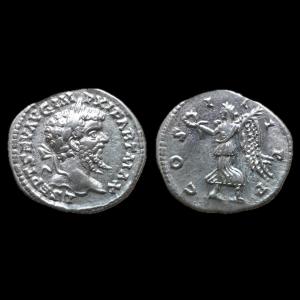
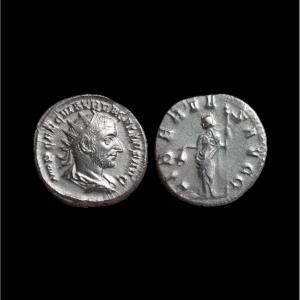
Immediately appealing to the Severan silver enthusiast, this antoninianus of Elagabalus, struck at Rome at the beginning of the reign (218–219), combines a youthful portrait with a highly legible imperial radiance and a Victory reverse of classical iconography, both military and dynastic, whose legend VICTOR ANTONINI AVG constitutes a sought-after typological signature—particularly when, as here, the scene stands out clearly within the field and the overall balance of the reliefs remains coherent and pleasing to the eye.
Careful observation under ×10 magnification and raking light: the examination of the images, conducted according to a numismatic framework (rim → fields → reliefs → legends → flan edge → surface singularities), highlights a hammer-struck issue on a silver flan showing crisp volume modeling, generally even wear, and perceptible manufacture markers through the natural continuity of the surfaces and the way light catches the edges of the portrait and of Victory; meanwhile, the edge reveals an old irregularity consistent with the material life of an ancient flan, notably a flan crack visible toward the lower area, readable in raking light as a clean line affecting the periphery without erasing the structure of the types.
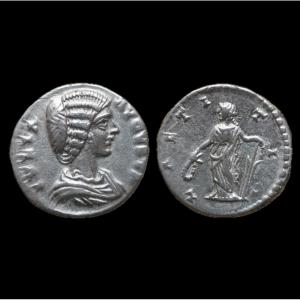
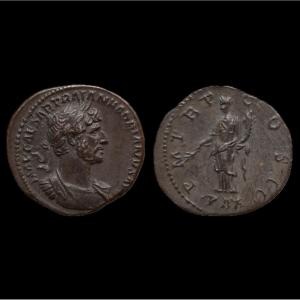
Obverse (portrait, titulature, style)Type: radiate, draped and cuirassed bust right, seen from three-quarters rear, with particularly expressive relief in the radiate crown, the spikes standing out clearly against the field, and a facial rendering with a regular profile in which the eye, cheek, and jawline remain well structured despite wear from use.
Legend: IMP CAES M AVR ANTONINVS AVG, visible in segments around the circumference, with stronger legibility in certain areas and attenuation elsewhere, consistent with a true centering on the flan and prolonged circulation, without the photograph allowing anything beyond this strictly visual observation.
Surface: homogeneous gray silver tone at the scale of the image, with fine contact micro-marks consistent with ancient handling and circulation, and fields whose texture remains natural, without a uniformly “smoothed” appearance.
Reverse (Victory, attributes, reading)Type: Victory advancing right, holding a wreath in the right hand and a palm carried over the left shoulder, the scene centered on a discreet ground line, with a well-established silhouette, wings and drapery perceptible in volume, and a relief contrast that makes the scene immediately identifiable.
Legend: VICTOR ANTONINI AVG, legible around the motif, with some areas sharper and others weaker, the reading dynamic remaining satisfactory to the collector’s eye thanks to the persistence of the main letter forms.
Flan / edge: irregular border, with a flan crack clearly visible at about 6 o’clock, and small peripheral distortions consistent with ancient striking on a flan that is not perfectly circular, a common phenomenon on early antoniniani.
Characteristics (attribution, metrology, references)Authority: Elagabalus, 218–222.
Mint: Rome.
Denomination / metal: Antoninianus, silver.
Date: 218–219.
Obverse: IMP CAES M AVR ANTONINVS AVG, radiate, draped and cuirassed bust right, seen from three-quarters rear.
Reverse: VICTOR ANTONINI AVG, Victory advancing right, wreath in right hand, palm over left shoulder.
References: BMC 32 ; Cohen 291 ; RIC 155.
Specimen data: 24 mm ; 4.82 g.
Historical context (coinage, power, message)In the early years of Elagabalus’s reign, coinage participates in a strategy of symbolic stabilization, in which the assertion of a young prince is expressed less through iconographic innovation than through the mobilization of immediately legible values; and Victory—bearing wreath and palm—offers precisely this language of legitimation, linking the emperor to a military and triumphal grammar that, at Rome, remains one of the visual foundations of authority, so that the legend VICTOR ANTONINI AVG fits into a rhetoric of political effectiveness, intended to reassure, to persuade, and to inscribe power within the continuity of Roman successes.
Cultural value (collecting, style, presence)This antoninianus brings together qualities highly sought after in collections: a radiate portrait of strong presence, typical of Severan aesthetics; a Victory reverse that is immediately recognizable and historically meaningful; and a silver materiality whose topography and nuances make the object feel “alive” in the cabinet, while offering the collector a type firmly identified by its references, therefore easily placeable, comparable, and integrable into a coherent imperial series.
Traceability & guaranteesIn accordance with our practices, each specimen is examined, described, and accompanied by a certificate of authenticity consistent with the standards of the art and heritage market; the study is conducted with careful observation under ×10 magnification and raking light, and set against the usual typological and descriptive reference works; provenance is European, from an established numismatic dealer, and the acquisition stems from a specialized international transaction carried out within a recognized numismatic network and validated by reference experts, according to the highest standards of the art and heritage market.
Payment terms (on request, depending on the delivery address)In order to establish the conditions best suited to your situation and to guarantee shipment compliant with insurance and signature requirements, we invite you to send us a message specifying your location as well as the exact delivery address, after which we will immediately confirm the corresponding payment and shipping procedure.
France: Colissimo shipment, with signature and insurance, at a rate of 20 euros.
Abroad: UPS shipment, with signature and insurance, at a rate of 35 euros.
We accept:
Cheque (shipment is made after effective receipt of funds).
Bank transfer (simply request our bank details).
Bank link (card payment accepted: CB, Visa, Mastercard, American Express, Apple Pay).
In accordance with a compliance policy and a management of logistical, documentary, and insurance risk applicable to certain destinations, we do not sell to the United States; this limitation is motivated by the potential complexity of import requirements, controls, and liabilities associated with the international transport of heritage objects, which leads us to favor shipping channels offering fully controlled legal and operational security.
Period: Before 16th century
Style: Rome and Antic Greece
Condition: Good condition
Reference (ID): 1715705
Availability: In stock