Justinian African Siliqua — Vot / Mvlt / Hti — Certificate Of Authenticity
Silver issue attributed to Carthage (date range AD 533–537), prized for its votive reverse VOT / MVLT / HTI within a wreath, and for its position among the earliest African strikes following the imperial restoration. The type is firmly framed by standard corpora (DOC, MIB/MIBE, Sear).
Analysis & expertiseCareful observation under ×10 magnification and raking light (from the photographs): the coin is a small, hammer-struck silver piece on a naturally irregular flan (non-circular edge, slight peripheral flat spots, and local rim weakness), features frequently encountered on African modules of this group.
The surface shows a light gray tone with a soft, satiny sheen, plus field micro-striations and fine contact marks consistent with ancient circulation and handling. The relief catches the light well on the high points: pearl-diadem band, facial profile, and shoulder drapery; on the reverse, the wreath veins and votive letters stand out clearly. Within the strict limits of non-destructive visual assessment, the overall coherence (metal, texture, style, portrait construction, reverse layout, and exergue) accords with published specimens of this Carthage issue.
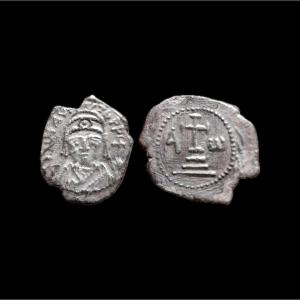
ObverseThe obverse shows the bust of Justinian I right, diademed, draped, and cuirassed. On the photograph, the diadem reads as a continuous beaded band, and the profile remains well structured (forehead, nose, chin), despite gentle wear on the highest points. Drapery and cuirass can be distinguished at the lower bust through layered planes/folds.
The circular legend D N IVSTINIANVS PP AC is visible in segments, with readability conditioned by centering and flan irregularities—an expected configuration on these small-module strikes.
ReverseThe reverse carries the votive formula in three lines within a wreath:
VOT
MVLT
HTI
The wreath is well formed, with a regular leaf rhythm, and the letters—slightly softened by use—remain highly legible. In the exergue, CONOS is present (sometimes partly affected by the edge depending on the flan), a decisive identifying element.
Under raking light, the hierarchy of the design is clear: outer wreath, central inscription, then exergue, giving a particularly secure typological reading.
SpecificationsAuthority: Justinian I (527–565)
Mint: Carthage
Date: 533–537
Denomination: Siliqua (terminology in sales sometimes given as half-siliqua / “heavy half-siliqua” for this module)
Metal: Silver
Weight: 1.17 g
Obverse: D N IVSTINIANVS PP AC, diademed, draped and cuirassed bust right
Reverse: VOT / MVLT / HTI within a wreath; CONOS in exergue
References: DOC 280; MIB/MIBE 51; Sear (SB) 253
The years 533–537 mark the first phase of restored Byzantine rule in Africa following Justinian’s reconquest. Carthage issues of this group make the return of imperial authority visible through coinage while retaining features typical of African production (small module, irregular flans, and often tight centering).
Cultural valueFor collectors, this coin combines highly desirable features:
an immediately recognizable imperial portrait on a sought-after African silver module;
the votive reverse VOT / MVLT / HTI within a wreath—an unmistakable “signature” type that is easy to document;
a type securely anchored in standard references (DOC / MIB-MIBE / Sear) and readily comparable to published and market-recorded examples.
In accordance with our practices, each specimen is examined, described, and supplied with a certificate of authenticity consistent with art and heritage market standards. The assessment is conducted under ×10 magnification and raking light and relies on non-destructive criteria (typological coherence, legend logic, style, strike structure, and observable surface characteristics).
The coin is offered with professional European provenance; acquisition forms part of a specialized international transaction within a recognized numismatic network and validated by expertise.
Secure shippingFrance: Colissimo, signature + insurance (€20).
Abroad: UPS, signature + insurance (€35).
Reinforced packaging, shock protection, tracked shipment.
Period: Before 16th century
Style: Rome and Antic Greece
Condition: Good condition
Reference (ID): 1716317
Availability: In stock