


Rare Dupondius Of Utica — Tiberius & Livia — With Certificate Of Authenticity
Struck at Utica (Zeugitana) under Tiberius (AD 14–37), and dated by the imperial title IMP VIII to the year AD 29/30, this provincial dupondius brings together, in a broad module highly sought after by collectors of Roman Africa, a ruler’s portrait of immediately secure readability and a civic scene of strong institutional significance; the whole corresponds, point for point, to RPC I 742 (concordances MAA/Alexandropoulos 115d and SNG Copenhagen 442) and is, in numismatic market practice, clearly noted as rare for this specific combination of titulature, magistrates, and reverse.
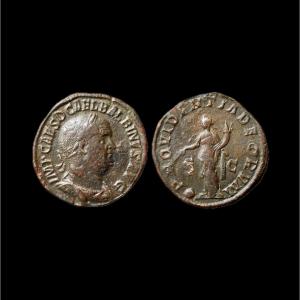
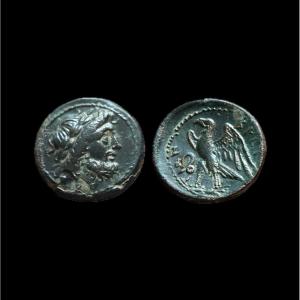
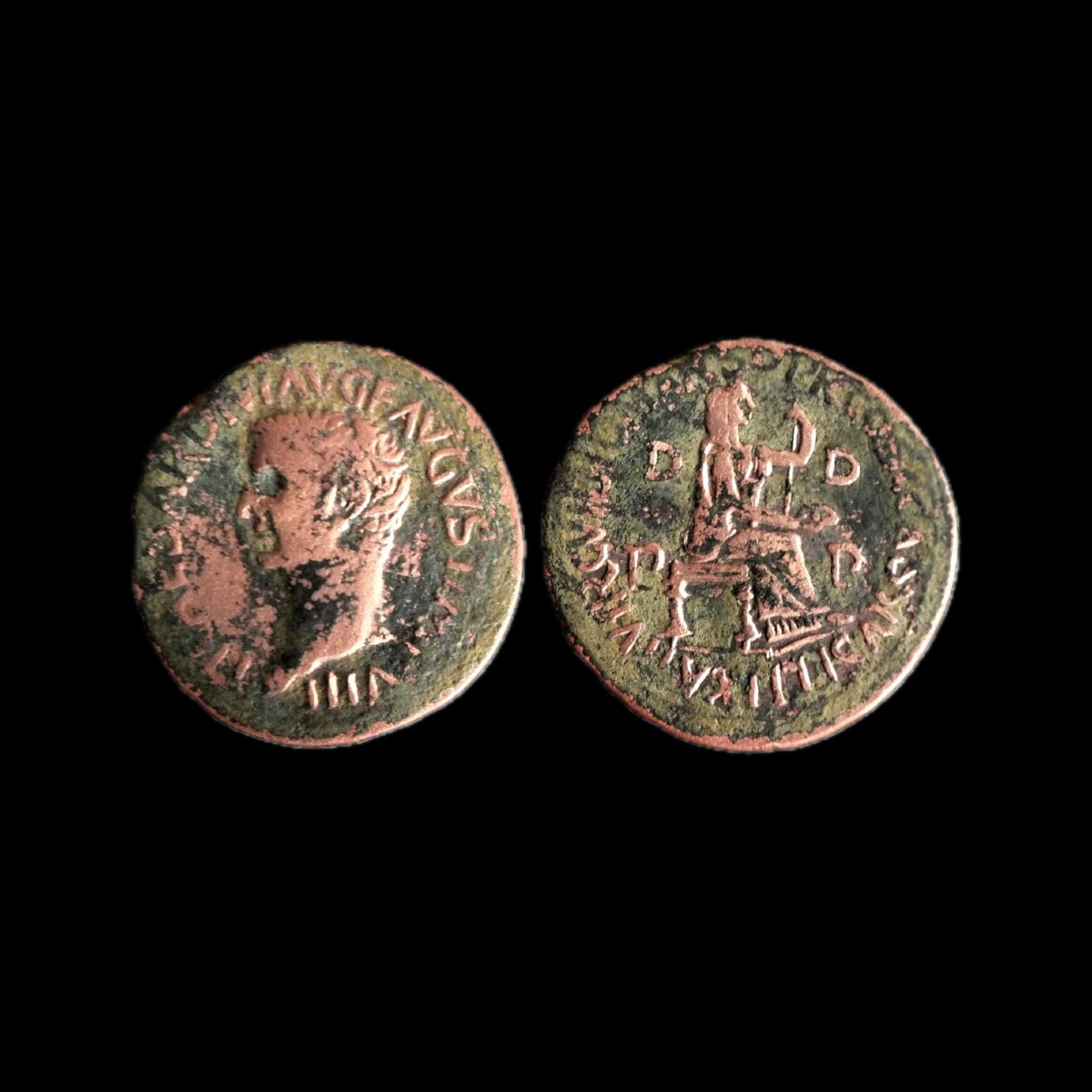
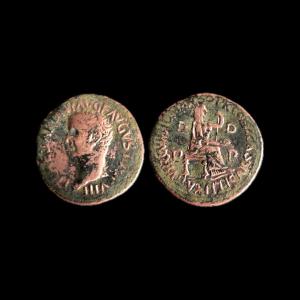
Analysis & expertiseClose observation under ×10 magnification and raking light, conducted according to the standards of expertise for provincial bronzes, first establishes on the obverse a circular titulature readable in its structuring segments — TI CAESAR DIVI AVG F AVGVST IMP VIII — surrounding a bare head of Tiberius facing left, whose profile, despite the normal softening of the high points, retains coherent volumes, a clearly perceptible hairline, and a neck articulation consistent with the stylistic grammar of African workshops of the period; the attribution thus rests on positive, verifiable elements rather than on a mere overall impression.
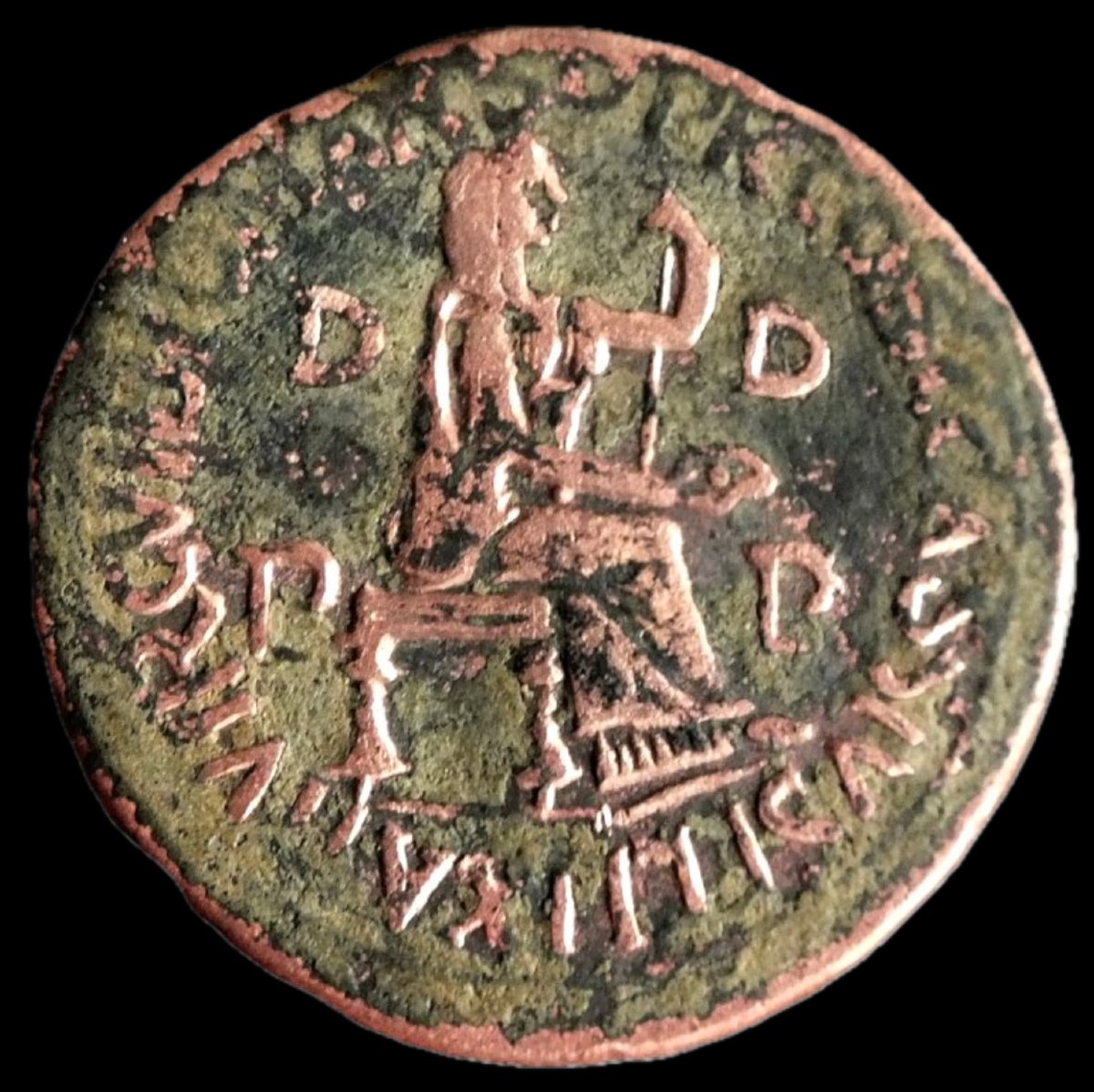
On the reverse, examination highlights the expected civic scene: Livia, veiled, seated right, holding a scepter and a phiale/patera, a composition whose reading remains very satisfactory for a circulating bronze; the peripheral inscription — C VIBIO MARSO PR COS III C CASSIVS FELIX A IIVIR — explicitly associates the issue with the responsible magistrates, and the formula D D / P P in the field refers, according to the expansion given by the corpora, to decreto decurionum, pecunia publica, that is, an issue ordered by the civic authorities and financed from public funds—an institutional element particularly sought after in African provincials.
In terms of surfaces, the alloy displays a highly expressive two-tone patina—dominant olive-green, enhanced by coppery notes on the relief and friction areas—an aesthetic contrast typical of ancient bronzes that experienced a long life in circulation and then a stay in a terrestrial environment; this dynamic underscores both the portrait and the reverse scene here, giving the relief a legibility naturally “sculpted” by time, without altering the coin’s typological identity, firmly fixed by the concordance of legends, magistrates, and the imperial dating.
CharacteristicsAuthority / mint: Tiberius, Utica (Zeugitana), Africa Proconsularis.
Type date: IMP VIII, i.e., AD 29/30.
Denomination / metal: Æ Dupondius (copper-alloy).
Metrology (specimen data): 31 mm; 12.70 g.
Obverse: TI CAESAR DIVI AVG F AVGVST IMP VIII, bare head of Tiberius left.
Reverse: Veiled Livia seated, scepter and phiale/patera; magistrates’ legend; D D / P P (decree of the decurions / public funds).
References: RPC I 742; concordances MAA/Alexandropoulos 115d; SNG Copenhagen 442.
Rarity: type commonly described as rare in numismatic market notices for this precise combination.
Historical contextIn 1st-century Roman Africa, Utica—an ancient, prestigious, and strongly Romanized city—expresses through these dated, magistrate-named bronzes a remarkable balance between imperial authority (here, Tiberius’ titulature as imperator for the eighth time) and municipal autonomy, since the explicit naming of the civic officials (proconsul and duovir), as well as the formula decreto decurionum, pecunia publica, give the coin the dimension of a public act: the city shows loyalty to Rome while affirming its own institutional functioning.
Cultural valueFor the collector, the principal appeal of this dupondius lies in the rare conjunction of three mutually reinforcing qualities: first, a portrait of Tiberius that remains immediately “speaking”; second, a Livia reverse whose symbolic charge—between dynastic continuity and civic virtue—sits at the heart of prolonged Augustan ideology; and finally, a complete municipal epigraphy (magistrates + public financing) that turns the piece into a document of administrative history as much as a collectible object, which explains why this type is readily presented as rare and particularly desirable within African series.
Traceability & guaranteesEach specimen is examined, described, and accompanied by a certificate of authenticity consistent with the standards of the art and heritage market, and close observation under ×10 magnification and raking light constitutes an explicit step in the procedure; the certainty of the attribution rests here on fully verifiable concordances—legends, magistrates, iconographic type, IMP VIII dating—as given by RPC I 742 and its cataloguing cross-references.
The provenance is European, from an established numismatic dealer, and the acquisition is carried out through a specialized international transaction, conducted within a recognized numismatic network and validated to high standards, in order to offer the collector a purchasing framework that is both reassuring and rigorously documented.
Period: Before 16th century
Style: Rome and Antic Greece
Condition: Good condition
Reference (ID): 1721014
Availability: In stock