

Superb Denarius Of Saturninus — Certificate Of Authenticity
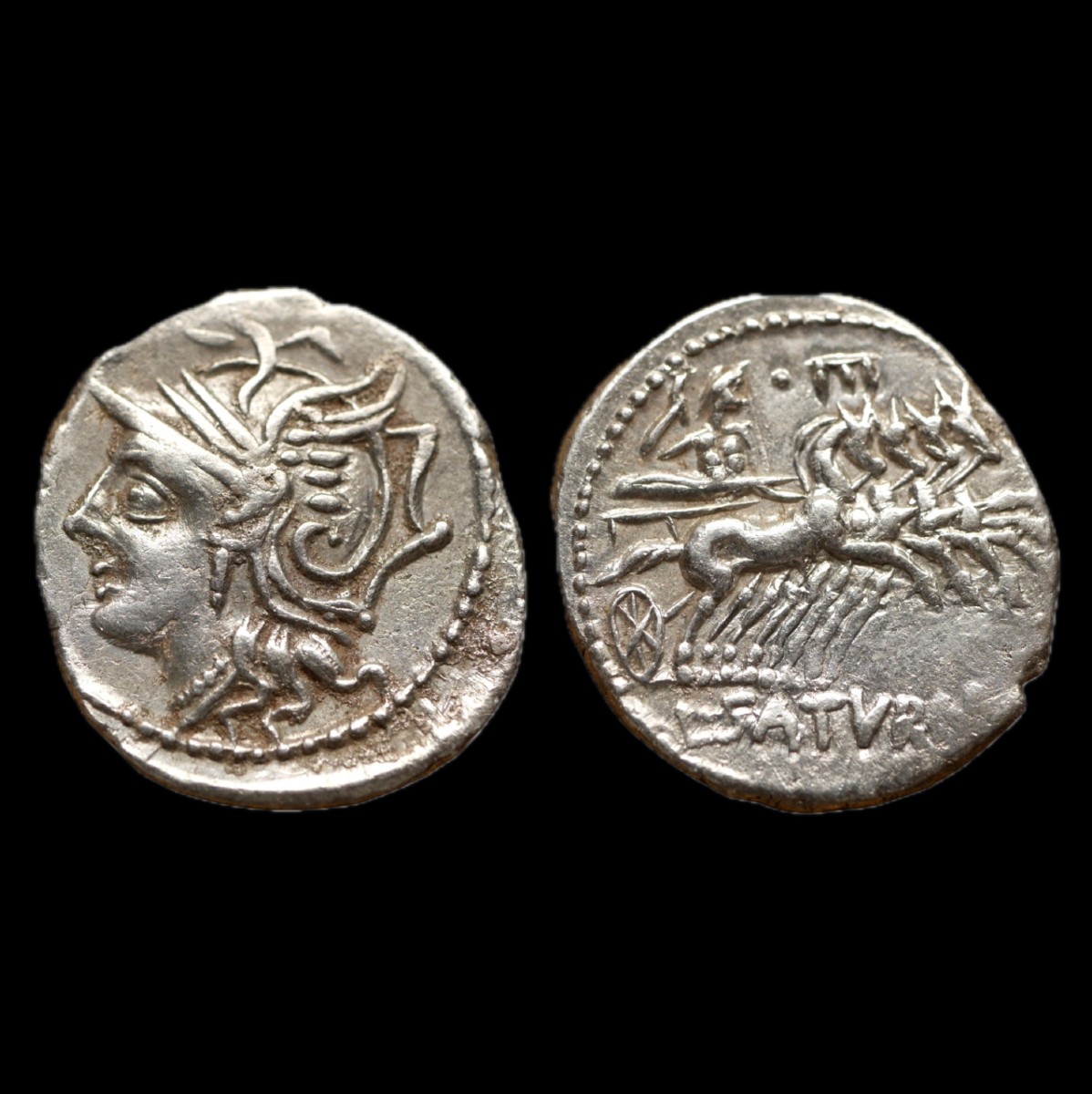
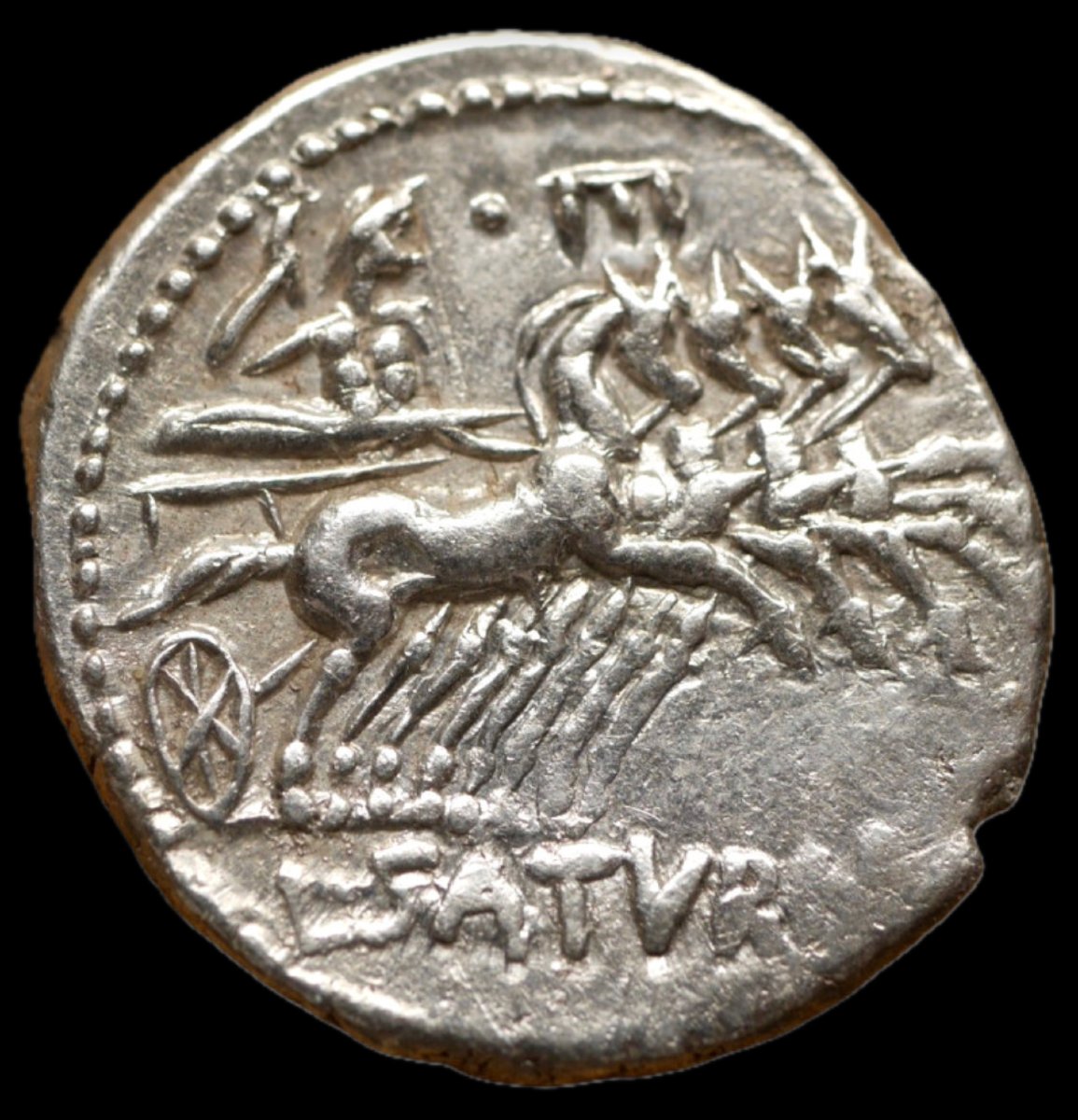
This Republican silver denarius of L. Appuleius Saturninus, struck at Rome around 104 BC, belongs to an issue that is immediately appealing to the collector for the assuredness of its iconographic language: the obverse presents the helmeted head of Roma left, while the reverse shows Saturn driving a quadriga at the gallop to the right, with L·SATVRN in the exergue, a type firmly recorded as Crawford 317/3a and associated with RSC Appuleia 1 in the usual corpora; the concordance of this attribution is found in modern numismatic repertories, notably Numista, WildWinds, and the British Museum.
Each specimen is examined, described, and accompanied by a certificate of authenticity in accordance with the standards of the art and heritage market; the present piece draws particular attention for the breadth of its Roma portrait, the vigor of the reverse scene, and metrological data of 3.87 g for 19 mm, very harmoniously situated within the range observed for the type, Numista giving a reference of about 3.58 g for 18.4 mm, while several published specialist examples fall around 3.75 g, 3.84 g, or 3.98 g for comparable diameters.
Analysis & Expertise
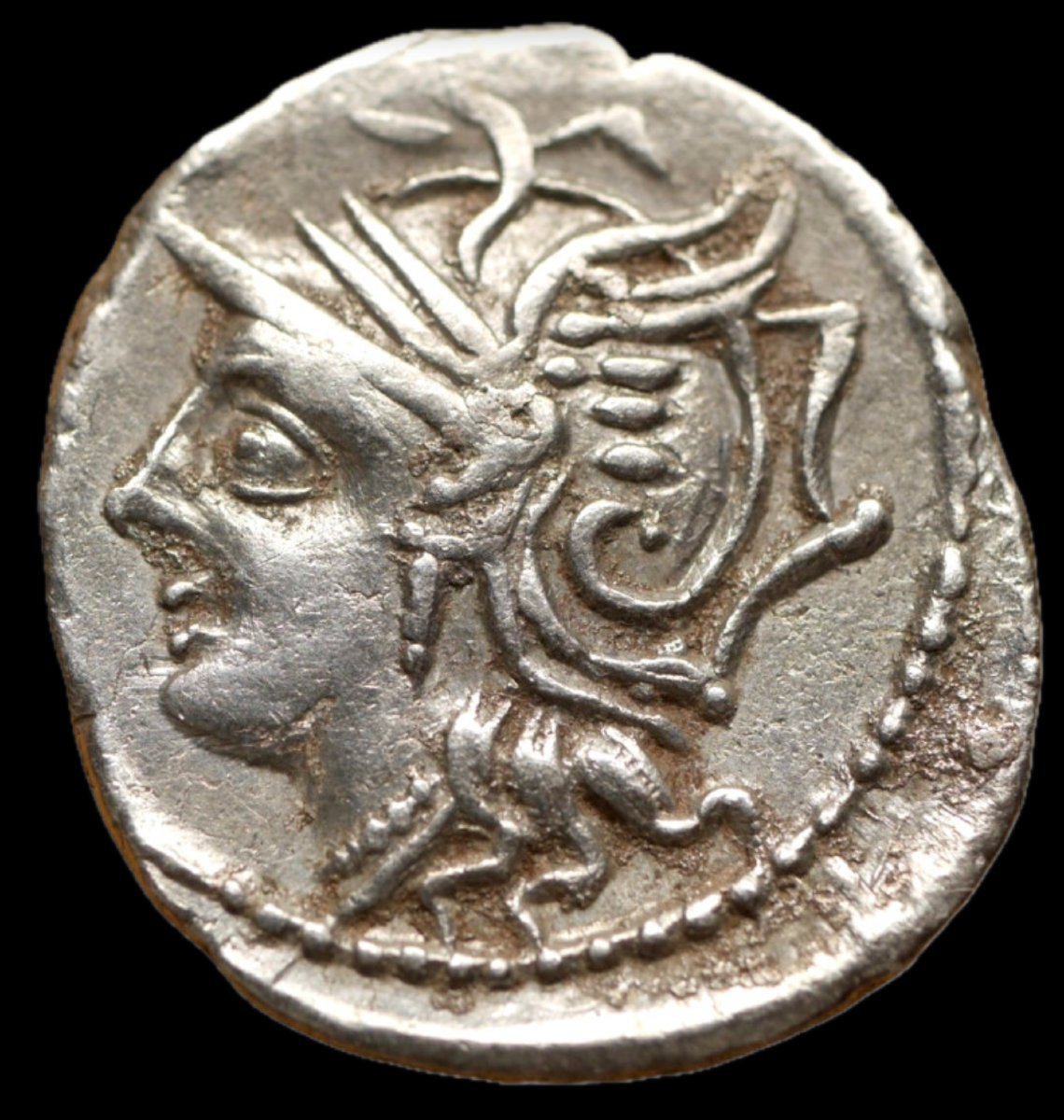
Close observation under ×10 magnification and raking light. Direct examination of the obverse reveals a head of Roma turned left of thoroughly convincing presence, whose profile remains firmly drawn, with a well-opened eye, a clean nasal line, a finely marked mouth, and a powerful chin; the winged helmet, a major element of the composition, retains a highly legible architecture, with its principal volumes, ornamentation, and the decorative crest of griffin type still perceptible in its essential design, while the necklace, the line of the neck, and the beginning of the bust contribute to a reading that is particularly satisfying for a Republican denarius of this group.
The beaded border can be followed around a large part of the circumference, elegantly framing the portrait and reinforcing the impression of a well-executed strike; the silver surface shows a homogeneous ancient sheen, with fields remaining sufficiently open to let the image breathe, and a few natural flan irregularities fully consistent with a Republican hammer strike. The obverse thus offers that highly sought-after union of graphic vigor, typological legibility, and visual balance.
The reverse draws attention with particular force, as Saturn in his quadriga remains immediately identifiable, with a strong sense of galloping movement in the horses’ surge, the line of the reins, and the god’s posture; the harpa, an essential attribute of the type, can be recognized in the raised hand, confirming with authority the iconographic coherence of the issue. The legend L·SATVRN, firmly set in the exergue, remains legible with a very appreciable frankness, and the lower linear frame preserves its function as a visual base with pleasing clarity.
The quality of this specimen lies precisely in the combination of several strengths which together produce a very favorable impression of numismatic seriousness: a well-set Roma portrait, an ornamented helmet that remains expressive, a lively reverse complete in its conception, a telling monetary legend, and a frank metallic presence without breaks in readability. The object therefore stands not only as a catalogue reference, but as a fully convincing collector’s coin, still capable of restoring—within its very substance—the visual nobility of the middle Roman Republic.
Characteristics
Monetary authority
The issue is attributed to L. Appuleius Saturninus, a Roman moneyer identified by the reverse legend L·SATVRN.
Mint
The mint is Rome, an attribution retained by modern corpora for this type.
Dating
The strike is generally placed around 104 BC, a dating concordantly repeated by Numista, WildWinds, and specialist comparanda catalogues.
Denomination
This is a silver denarius of the Roman Republic.
Metal
The type is catalogued in silver.
Weight
The observed weight for this specimen is 3.87 g, a figure fully consistent with the published metrology for this issue.
Diameter
The observed diameter is 19 mm, particularly well situated within the documented range for the type.
Technique
Flan morphology, relief modeling, and the reference literature indicate a hammer strike, consistent with Republican minting practice.
Obverse
The obverse shows the head of Roma left, helmeted, with its traditional ornamental attributes.
Reverse
The reverse shows Saturn driving a quadriga at the gallop to the right, holding the harpa, with L·SATVRN in the exergue.
Typological references
Identification rests on Crawford 317/3a, with association to RSC Appuleia 1; the British Museum also catalogs the type as RRC 317/3a.
Collecting position
The type is well sought-after within Republican coinage, Numista assigning it a rarity index of 80, and specialist sales show a real but selective presence, particularly appreciated when the Roma portrait and the quadriga retain broad readability.
Historical context
This issue belongs to an important moment in Republican coinage, when the denarius remained Rome’s principal silver coin and moneyers began to give their types a more personal coloration while staying within the great traditional civic repertoire; here, Roma on the obverse ensures the coin’s civic and institutional anchoring, while the choice of Saturn on the reverse introduces a speaking reference to the very name Saturninus, according to an onomastic logic explicitly noted by several numismatic notices.
The historical figure of Lucius Appuleius Saturninus further heightens the interest of the type, as Britannica recalls that he was quaestor around 105/104 BC before becoming one of the great popular tribunes of the late second century BC; this coin therefore belongs to an early moment in his public career, on the threshold of a political destiny that would strongly mark the last decades of the middle Republic.
The Saturn-in-quadriga reverse moreover carries a singular cultural resonance, for it replaces the more canonical Dioscuri scene with an image that is at once rarer and more directly tied to the moneyer’s identity; the result is a type whose personality is immediately perceptible, while remaining profoundly Roman in its compositional discipline, balance of masses, and symbolic legibility.
Cultural value
The cultural value of this piece is high, because it unites—within a compact module yet great visual density—three dimensions prized by collectors of the Roman Republic: the personification of Roma, the assertion of the moneyer’s name, and a mythological reverse of strong individuality. This denarius is not merely a circulating coin, but a small monument of civic and familial identity, where Rome’s public language harmonizes with the personal imprint of the monetary magistrate.
For the collector, the appeal of this specimen also lies in the elegance of a type that remains highly legible without renouncing the richness of its details, for the head of Roma, the elaborate helmet structure, the quadriga’s momentum, and the explicit presence of L·SATVRN together form an object that is particularly satisfying within a cabinet devoted to Republican denarii. Its strength is that of coins instantly recognizable, and long remembered for the clarity of their idea.
From the broader perspective of the history of monetary art, this piece belongs to that classical phase of the second century BC in which Roman engraving manages to unite civic firmness, linear elegance, and narrative efficiency; one finds here that Roman intelligence of the brief form, where only a few signs suffice to express the city, the magistrate, and religious tradition.
Traceability & Guarantees
From a European provenance, from an established numismatic dealer, this specimen was acquired through a specialized international transaction conducted within a recognized numismatic network and validated by reference experts, in accordance with the highest standards of the art and heritage market; its examination rests on direct observation of the coin, study of its stylistic, technical, and material characteristics, and comparison with the recognized references of Roman Republican coinage.
Each specimen is examined, described, and accompanied by a certificate of authenticity in accordance with the standards of the art and heritage market; in the present case, the concordance between the Roma / Saturn-in-quadriga typology, the L·SATVRN legend, the observed metrological data, and the references Crawford 317/3a and RSC Appuleia 1 establishes a particularly solid numismatic attribution.
Period: Before 16th century
Style: Rome and Antic Greece
Condition: En l'etat
Reference (ID): 1730207
Availability: In stock