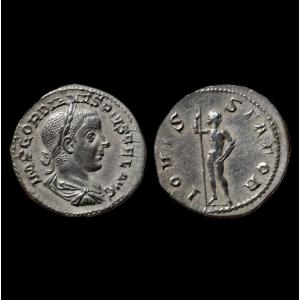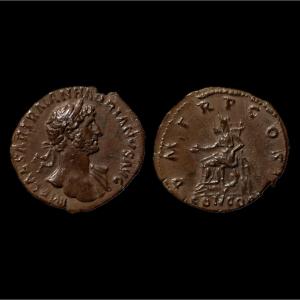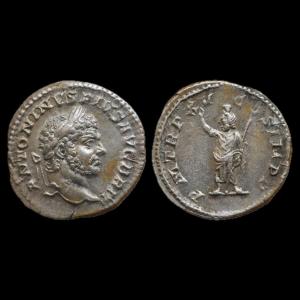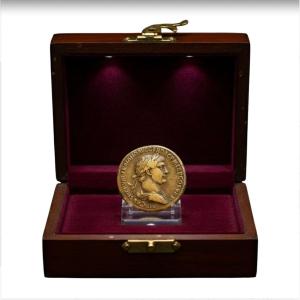
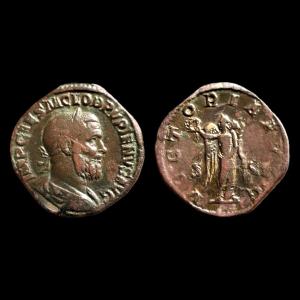


Rare Sestertius Of Pupienus With Victory — Certificate Of Authenticity
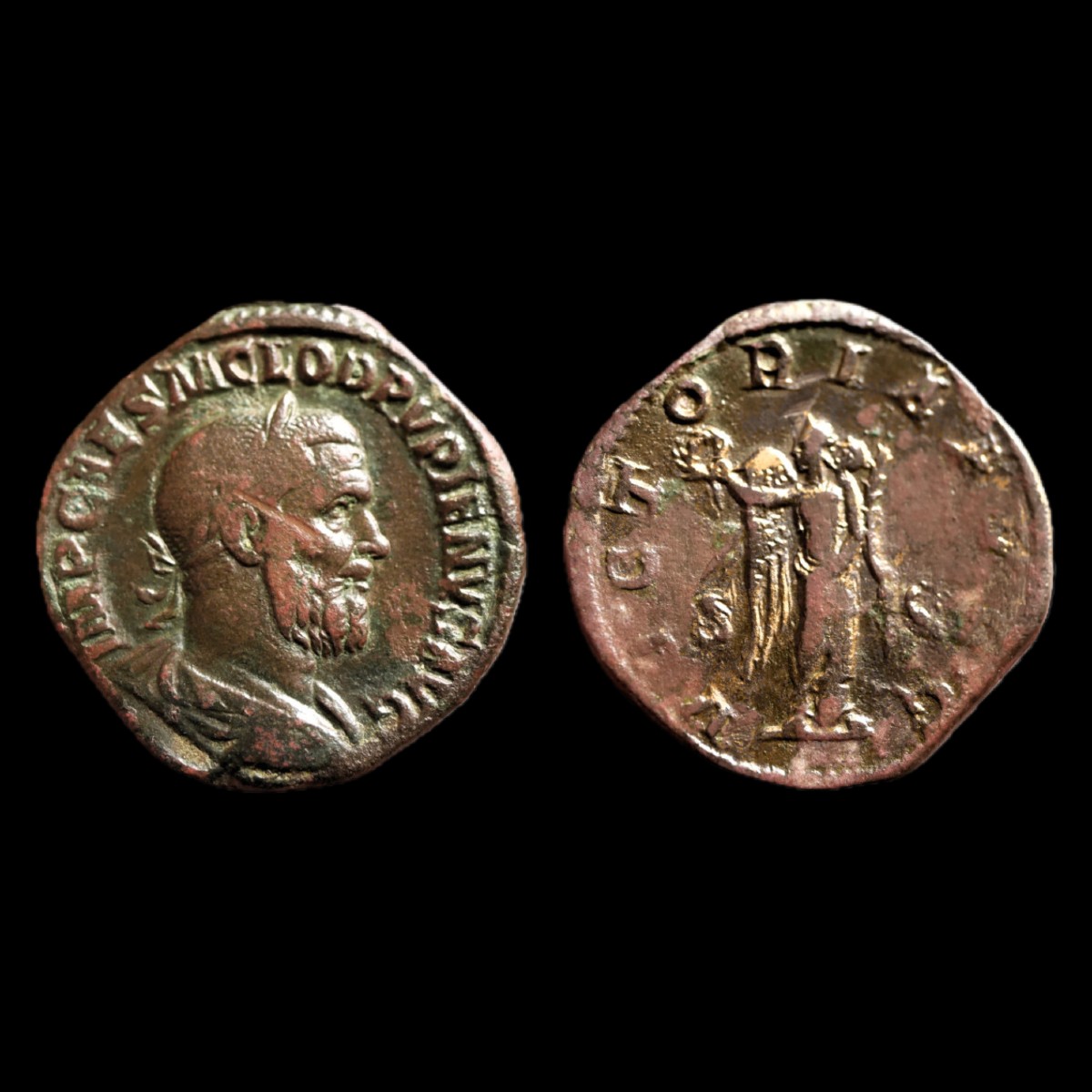
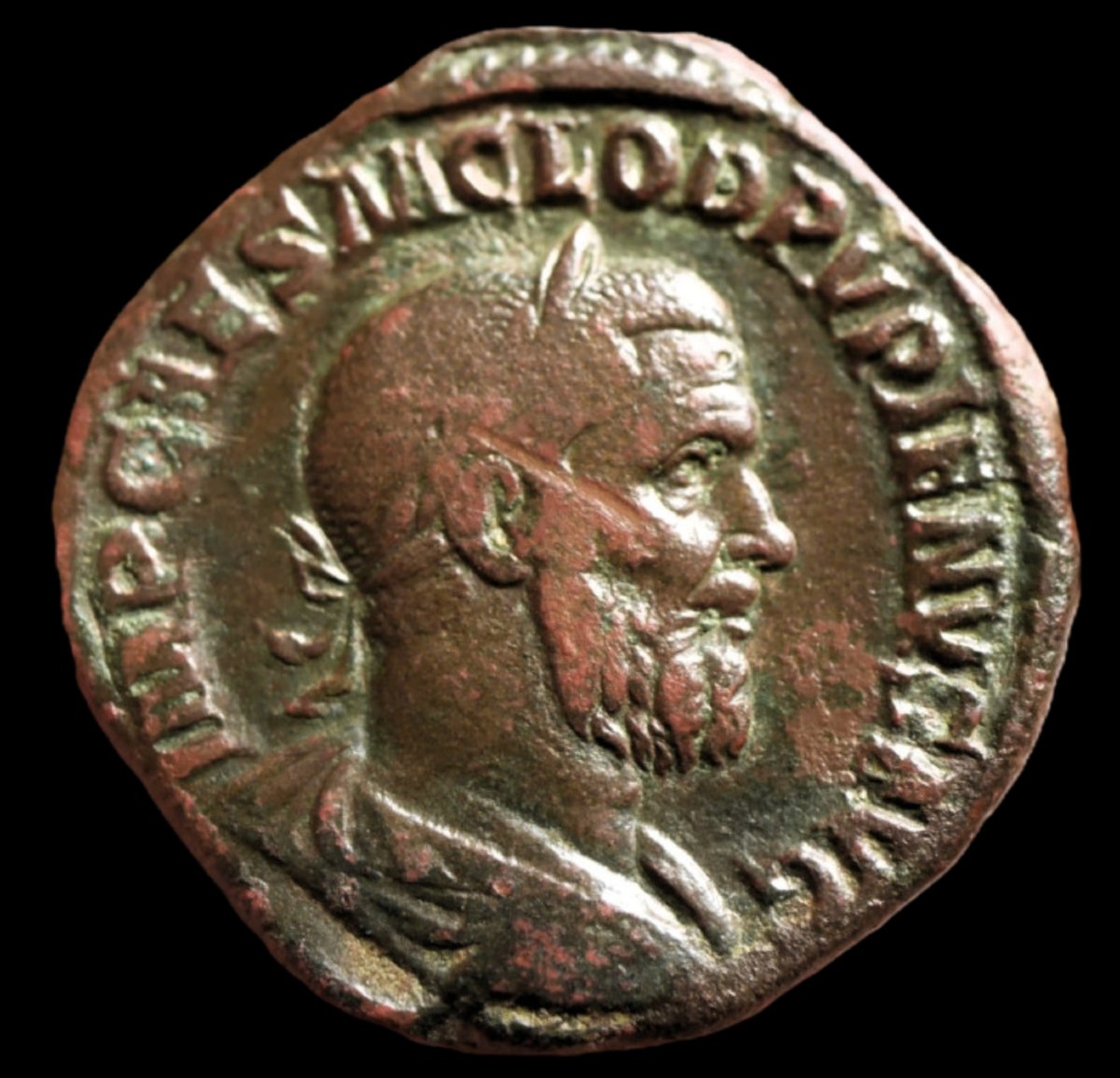
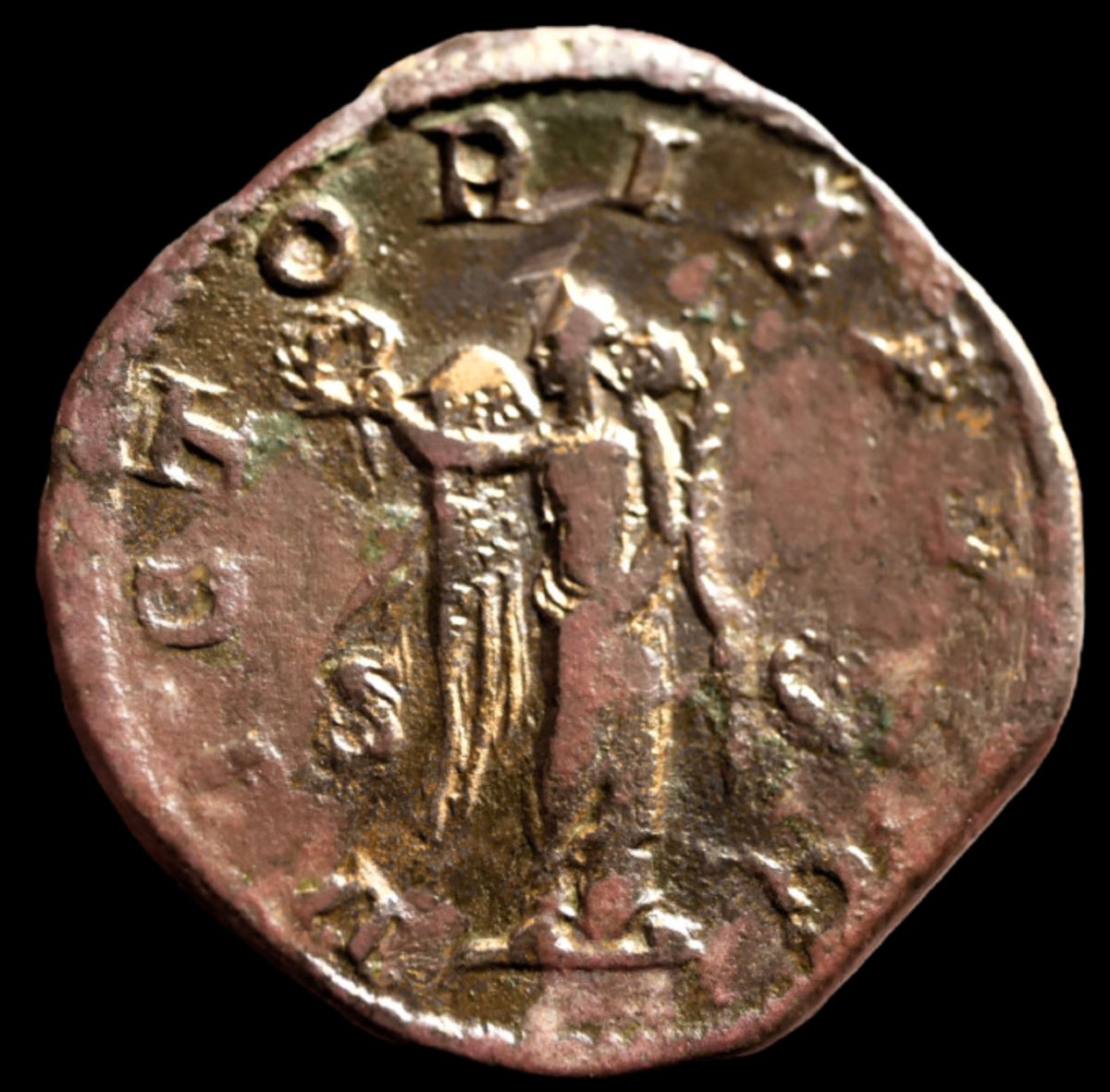
This remarkable sestertius of Pupienus, struck at Rome in AD 238, belongs to one of the briefest, most tense, and most sought-after issues of the third-century crisis, with on the obverse the titulature IMP CAES M CLOD PVPIENVS AVG around a laureate, draped, and cuirassed bust right, and on the reverse VICTORIA AVGG, where Victory stands, facing, head turned left, holding a wreath and a palm, with S-C in the fields; this identification corresponds to RIC IV.2, 23a, with the concordance BMCRE 58, and fully accords with the major typological databases and specialized market comparanda. Pupienus, under his full name Marcus Clodius Pupienus Maximus, was co-emperor with Balbinus for only a few months in 238, which gives all of his coinage a particular historical density and desirability.
Each specimen is examined, described, and accompanied by a certificate of authenticity in accordance with the standards of the art and heritage market; the present piece stands out for its broad 31 mm module, its weight of 21.50 g, and an immediately convincing visual presence, very favorably situated within the known benchmarks for the type, Numista giving for this issue a standard of about 20.3 g for 30.5 mm, with an observed variation of 16.57 to 27.65 g and 27.5 to 34 mm, while comparable specimens published by professionals fall around 20.70 g for 30 to 33 mm. The type moreover deserves to be presented clearly as rare, Numista’s rarity index being 97.
Analysis & Expertise
Close observation under ×10 magnification and raking light. Direct examination of the obverse reveals a portrait of Pupienus right of particularly firm presence, with a clearly legible laurel wreath, a high forehead, a distinctly open eye, a vigorous nasal line, a well-marked mouth, and a short but solidly structured beard, while the drapery and cuirass still retain satisfactory readability at the base of the bust; the peripheral legend remains widely perceptible, with tall, clear letters that frame the portrait with authority, and the border, still traceable in broad segments, gives the whole a very appreciable visual steadiness for a large bronze of this senatorial issue.
The reverse retains particularly convincing central legibility, as Victory standing, facing, head turned left, stands out with real clarity, holding her wreath in the right hand and the palm in the left, according to an immediately intelligible iconographic formula; the letters S-C can still be read in the fields, and, despite areas naturally softened by ancient circulation and the life of the metal, the composition remains stable, balanced, and fully recognizable, with a slender silhouette that preserves the type’s full nobility.
The surface shows an old olive-brown patina with warmer highlights, with discreet reddish and green nuances settled in the recesses and on certain relief areas, lending the coin a very appealing material presence; the flan, slightly irregular at the edge, remains fully consistent with an ancient hammer strike, and the overall volumes, letters, and relief transitions accord convincingly with the expected physiognomy of a Rome sestertius from mid-238.
What particularly distinguishes this specimen is the conjunction of qualities the knowledgeable collector consistently seeks in bronzes of ephemeral emperors: a strongly expressed portrait, a broadly preserved obverse legend, a reverse Victory that remains immediately legible, and a characterful old patina; the result is a piece that is by no means reduced to a mere catalogue reference, but still preserves, in its very substance, the political and military energy of its issue.
Characteristics
Authority.
This coin belongs to Pupienus, i.e., Marcus Clodius Pupienus Maximus, Roman co-emperor in AD 238.
Mint.
The mint is Rome, as retained by Numista, specialized comparanda, and the bibliographic tradition attached to RIC 23a.
Dating.
The strike belongs to AD 238, i.e., the very brief collegial reign of Pupienus and Balbinus.
Denomination.
Sestertius, the large circulating bronze denomination of the Roman imperial monetary system.
Metal.
Catalogued in bronze, produced by hammer strike.
Weight.
The stated weight for this specimen is 21.50 g, very favorably within the observed range for the type.
Diameter.
The stated diameter is 31 mm, fully consistent with the published standards and comparanda for this issue.
Obverse.
IMP CAES M CLOD PVPIENVS AVG, laureate, draped, and cuirassed bust right, corresponding precisely to the RIC 23a variant.
Reverse.
VICTORIA AVGG / S-C, winged Victory standing facing, head left, holding wreath and palm.
Typological references.
Identification accords with RIC IV.2, 23a and BMCRE 58.
Rarity.
The type may be presented with full justification as rare: Numista assigns it a rarity index of 97, and specialized commercial notices likewise describe it as rare.
Historical context
This sestertius belongs to one of the most compressed sequences in Roman imperial history, since Pupienus was chosen by the Senate, together with Balbinus, to face Maximinus, before exercising power for only a few months in 238; Britannica notes that he was an experienced soldier, raised to the throne at an advanced age amid the turmoil of what historiography calls the Year of the Six Emperors.
In this context, the reverse VICTORIA AVGG carries particular force, because the plural formula explicitly refers to the victory of the two Augusti—Pupienus and Balbinus—while S-C recalls the Senate’s role in the issue; Numista translates the legend precisely as Victoria Duorum Augustorum. Senatus Consultum, giving the coin an immediate political resonance closely tied to the senatorial legitimization of power in the face of the moment’s military crisis.
Cultural value
The cultural value of this piece is particularly high, because it unites, within a large bronze of strong presence, three dimensions that matter deeply to the demanding collector: the biographical rarity of a lightning-brief reign, the allegorical force of a collegial victory reverse, and the dignity of a crisis-emperor portrait whose gravity still reads in the metal; such a coin belongs not only to imperial numismatics, but also to the most vivid political history of third-century Rome.
For the learned cabinet, this sestertius has a clear appeal, since Pupienus’ bronzes are structurally sought after due to the reign’s brevity, and the Victory type further combines legibility, authority, and historical meaning; it is precisely this kind of piece which, through the concentration of its message and the density of its moment, gives a Roman collection a depth that is more historical than merely typological.
Traceability & Guarantees
From a European provenance, from an established numismatic dealer, this specimen was acquired through a specialized international transaction conducted within a recognized numismatic network and validated by reference experts, in accordance with the highest standards of the art and heritage market; examination retains the stylistic, epigraphic, technical, and metrological characteristics effectively observable on the coin, set within the framework of recognized references for Roman imperial coinage.
Each specimen is examined, described, and accompanied by a certificate of authenticity in accordance with the standards of the art and heritage market; in the present case, the concordance between the obverse titulature IMP CAES M CLOD PVPIENVS AVG, the reverse VICTORIA AVGG / S-C, the diameter and weight data, and the references RIC IV.2, 23a and BMCRE 58, establishes a particularly solid numismatic attribution.
Period: Before 16th century
Style: Rome and Antic Greece
Condition: Good condition
Reference (ID): 1730229
Availability: In stock